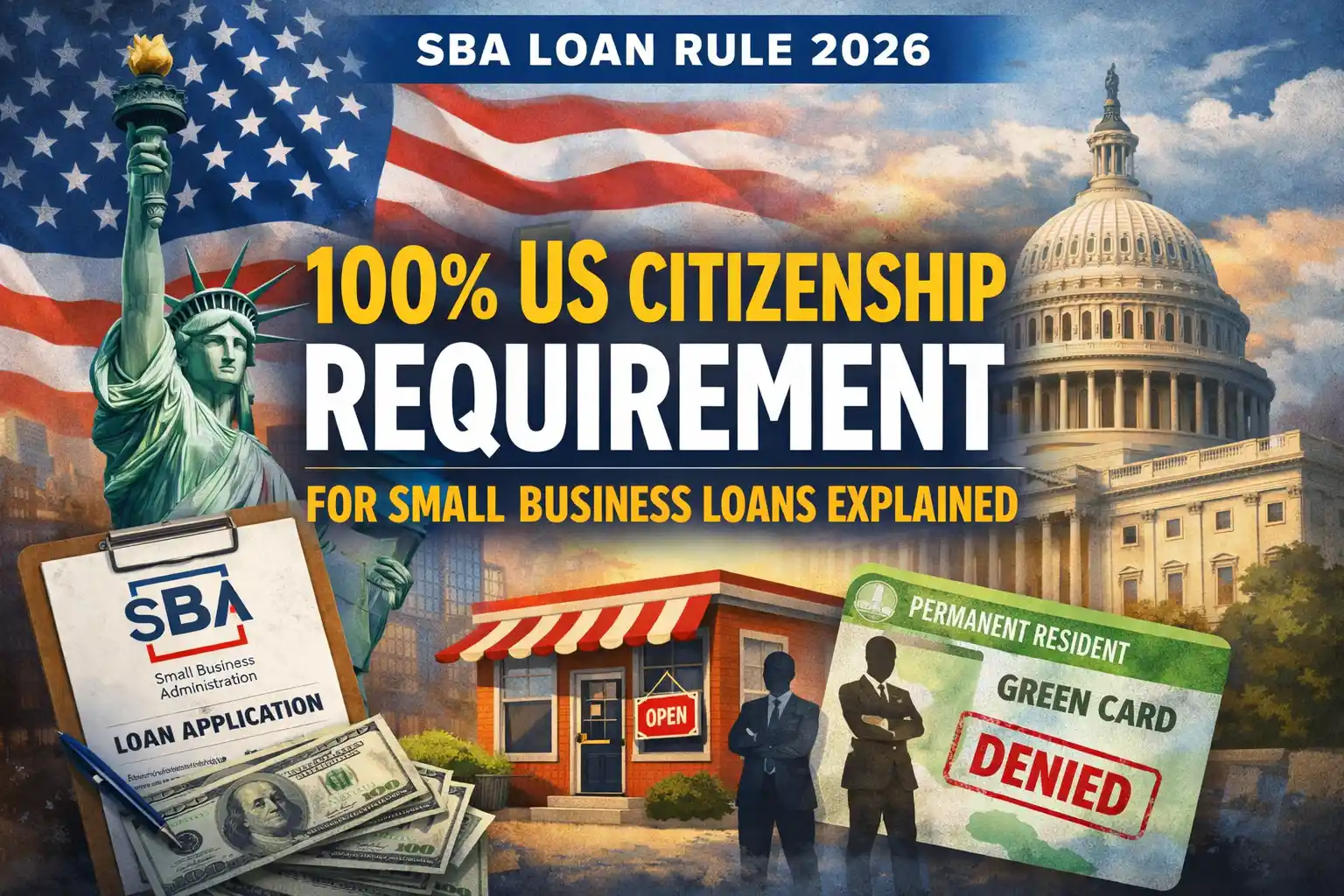
In 2026, the U.S. Small Business Administration (SBA) introduced a major policy change. Under the new rule, SBA-backed business loans will only be available to businesses that are 100% owned by U.S. citizens. Because of this change, green card holders and other non-citizens are no longer eligible for these government-backed loan programs.
The rule came into effect on March 1, 2026, and it may impact thousands of immigrant entrepreneurs operating small businesses in the United States.
What is SBA?
The U.S. Small Business Administration is a federal government agency in the United States that provides financial support, loans, and advisory services to small businesses.
Its main objectives include:
- Helping people start new businesses
- Providing financing support to small businesses
- Encouraging job creation and economic growth
The SBA usually does not directly give loans. Instead, it guarantees loans provided by banks and lenders, which makes it easier for small businesses to obtain funding.
What is the New Rule?
In 2026, the SBA significantly tightened its loan eligibility rules.
New Requirement
- Businesses must be 100% owned by U.S. citizens or U.S. nationals to qualify for SBA loans.
- No owner in the company can be a non-citizen or green card holder.
- The rule applies to both direct and indirect ownership.
This means that if a business has even a small percentage of ownership by a non-citizen, the company will not qualify for SBA-backed loans.
Which Loan Programs Are Affected?
The new rule applies to most major SBA loan programs, including:
Major Programs
- 7(a) Loan Program
- Working capital
- Equipment purchase
- Business expansion
- 504 Loan Program
- Commercial real estate
- Heavy equipment financing
- Microloan Program
- Small startups and early-stage entrepreneurs
- Surety Bond Program
All these programs now require full U.S. citizenship ownership to qualify.
What Were the Previous Rules?
Previously, SBA loan eligibility was more flexible.
Earlier Policy
- Businesses could have some level of foreign ownership.
- Green card holders were eligible for SBA loans.
- In some cases, limited foreign ownership was allowed.
However, the 2026 rule removed this flexibility entirely, introducing a strict 100% citizenship ownership requirement.
Why Was This Policy Introduced?
According to government officials, the goal of this policy is to ensure that government-backed funding primarily benefits American citizens.
Main Reasons
- Prioritizing U.S. citizens for government financial support
- Reducing the risk of loan misuse or fraud
- Supporting domestic job creation and economic growth
The SBA stated that government-backed financing is a limited resource, and the priority should be given to American entrepreneurs.
Who Will Be Most Affected?
1️⃣ Immigrant Entrepreneurs
Many businesses in the United States are run by immigrants.
Under the new rule, many of these entrepreneurs will no longer qualify for SBA loans.
2️⃣ Green Card Holders
Legal permanent residents (green card holders), who were previously eligible, are now completely ineligible for SBA-backed loans.
3️⃣ Mixed-Ownership Businesses
Companies that have both citizen and non-citizen owners will also lose eligibility for SBA loans.
Can Non-Citizens Still Start Businesses in the US?
Yes. The rule only affects eligibility for SBA-backed loans.
Non-citizens can still:
- Start businesses in the United States
- Obtain loans from private banks
- Raise venture capital or private investment
However, they cannot access SBA government-backed loan programs.
Economic Impact
The policy could affect the business environment in several ways.
Possible Effects
- Immigrant-owned startups may face greater difficulty obtaining funding
- Small business growth could slow in some sectors
- Lenders will need to perform stricter ownership verification
Many analysts point out that immigrant entrepreneurs contribute significantly to the U.S. economy, so the policy may have broader implications for the startup ecosystem.
Outcome
The new “100% citizenship rule” introduced by the U.S. Small Business Administration represents a major shift in small business financing policy in the United States.
Key points:
- SBA loans are now limited to businesses fully owned by U.S. citizens
- Green card holders and other non-citizens are no longer eligible
- The rule came into effect on March 1, 2026
- The goal is to prioritize government financial resources for American entrepreneurs
However, many experts believe that the rule could create challenges for immigrant-owned businesses and impact the broader startup ecosystem in the United States.
Source: SBA news