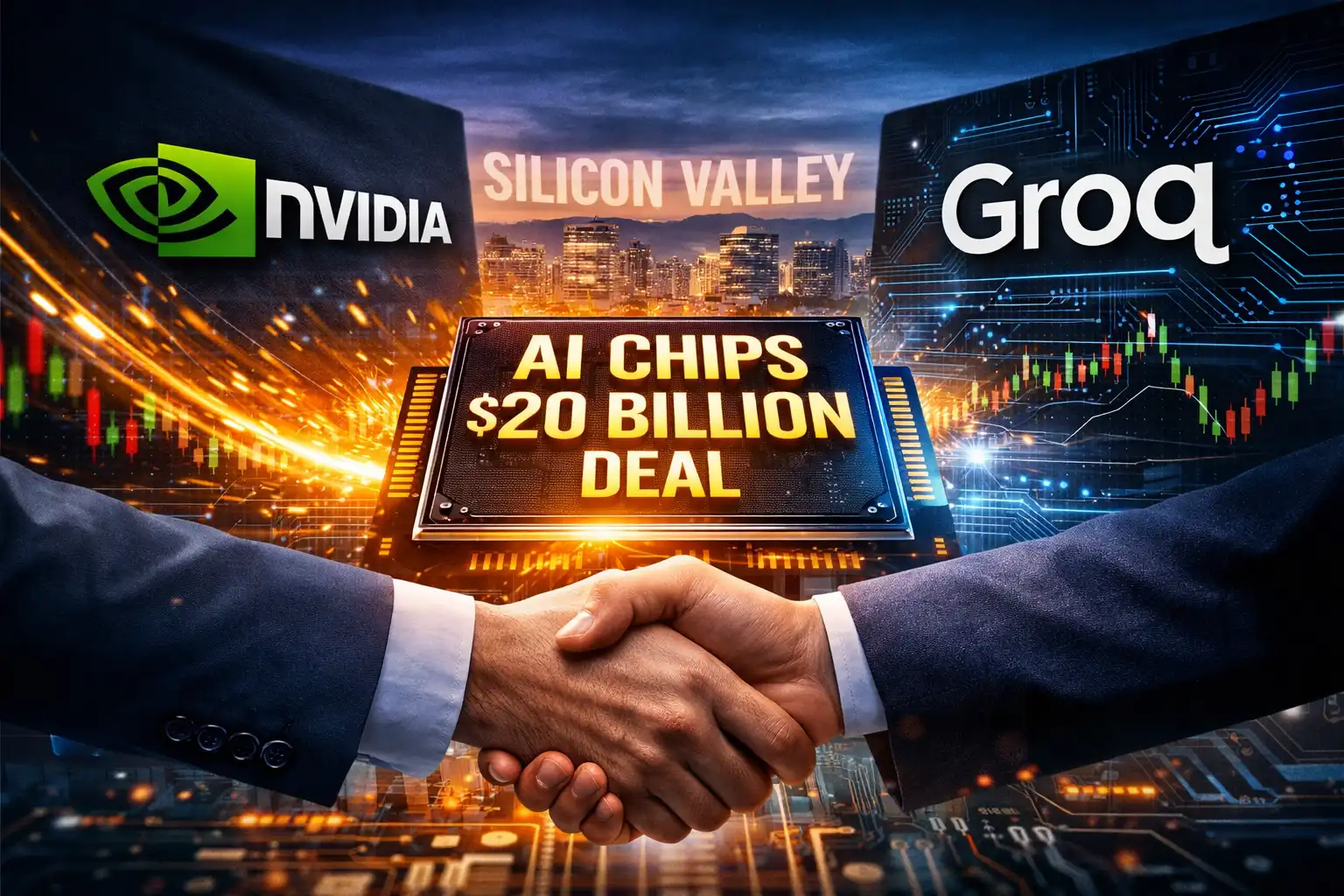
The global technology industry is abuzz after Nvidia announced a massive licensing and talent acquisition deal with AI chip startup Groq, a move estimated to be worth around $20 billion. The agreement has sent strong signals across Silicon Valley, highlighting how intensifying competition in AI inference hardware is reshaping strategies of the world’s biggest chipmakers.
What Exactly Happened?
Nvidia has entered into a non-exclusive licensing agreement with Groq, allowing it to use Groq’s advanced AI inference chip technology. Alongside the licensing deal, Groq’s founder and CEO Jonathan Ross, its president, and several senior engineers are joining Nvidia.
Importantly, Nvidia is not acquiring Groq outright. Groq will continue to operate as an independent company, while Nvidia gains access to critical intellectual property and top-tier engineering talent.
Why Is This Deal So Important?
This deal stands out not just because of its size, but because of what it represents for the future of AI computing.
- Nvidia already dominates AI training through its GPUs.
- The next big battleground is AI inference — where trained models deliver real-time responses in chatbots, search, voice assistants, and enterprise AI tools.
- Groq specializes in high-speed, low-latency inference chips, an area where demand is growing rapidly as AI moves from labs into everyday products.
By licensing Groq’s technology, Nvidia is strengthening its position in this fast-growing segment without fully absorbing the company.
What Does Groq Bring to the Table?
Groq is known for its Language Processing Units (LPUs), chips designed specifically for fast and predictable AI inference.
In simple terms:
- These chips focus on speed, efficiency, and consistency
- They are optimized for real-time AI tasks rather than large-scale model training
- In certain workloads, Groq’s approach can outperform traditional GPU-based inference
This makes Groq’s technology highly valuable as enterprises demand faster and cheaper AI deployment.
Strategic Thinking Behind Nvidia’s Move
Analysts see this deal as a strategic masterstroke by Nvidia:
- 🔹 It accelerates Nvidia’s inference roadmap without waiting years for in-house development
- 🔹 It secures rare AI chip talent in a market where engineers are extremely scarce
- 🔹 It prevents competitors from exclusively locking in Groq’s technology
- 🔹 It reflects a broader Silicon Valley trend: licensing + talent deals instead of full acquisitions, reducing regulatory risk
In short, Nvidia is using its financial strength to stay ahead in every layer of the AI stack.
Market Reaction and Investor Sentiment
Following news of the deal, investor sentiment around Nvidia remained positive, with markets viewing the agreement as a long-term bet on AI infrastructure growth.
Investors see this move as:
- A sign Nvidia expects AI inference demand to explode
- Proof that the company is preparing for the next phase of AI monetization
- A defensive strategy against rising competition from specialized chip startups
Voices of Caution
Not all analysts are fully convinced.
Some experts argue:
- Groq’s architecture is highly specialized, and may not replace GPUs across all use cases
- Nvidia already has strong inference capabilities, raising questions about overlap
- Integration of external technology always carries execution risk
Still, most agree that the talent acquisition alone makes the deal strategically valuable.
Bigger Picture: What This Means for the AI Industry
This deal highlights a clear shift in the AI ecosystem:
- The focus is moving from “who trains the biggest model” to “who runs AI fastest and cheapest at scale”
- AI inference is becoming the real revenue engine for enterprise and consumer AI
- Large players like Nvidia are increasingly partnering with niche innovators instead of buying them outright
For Silicon Valley, this deal is another sign that the AI chip race is far from over.
In Simple Words: The Bottom Line
- Nvidia has secured Groq’s AI inference technology and top engineers
- Groq remains independent, but Nvidia strengthens its AI future
- The deal underlines how critical real-time AI performance has become
- Silicon Valley’s AI hardware competition has entered a new phase
Source: Information based on groq newsroom and media reports