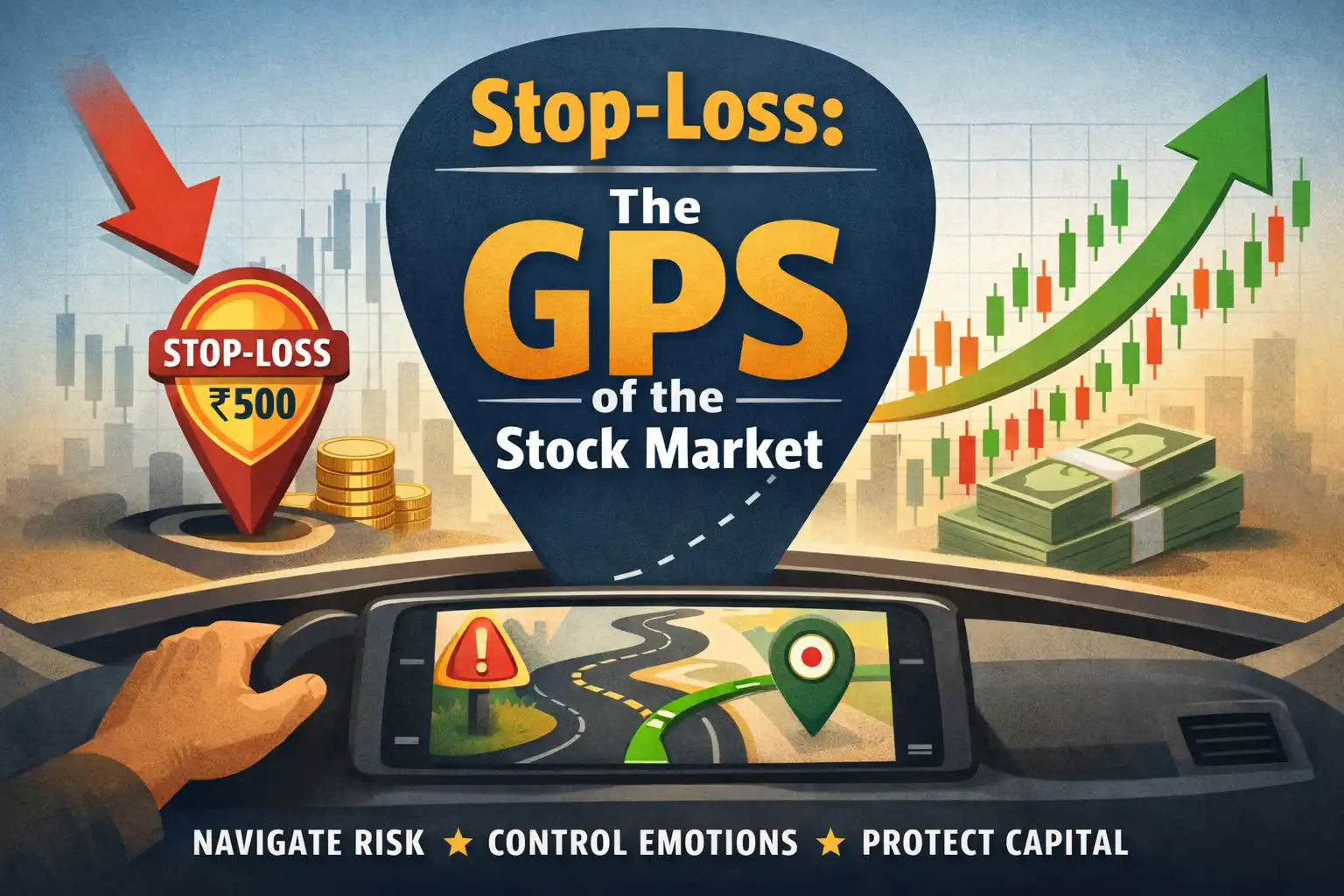
Imagine driving in a completely new city without Google Maps or GPS.
Every turn feels risky. Every signal creates doubt. One wrong turn and you’re stuck in traffic, wasting fuel, time, and energy.
Now imagine the same drive with GPS:
- It warns you before a wrong turn
- It recalculates if you go off track
- It keeps your destination in focus
- It removes panic and confusion
The stock market works exactly the same way.
Prices change every second.
News, emotions, rumors, and expectations constantly pull investors in different directions.
In this chaos, the one tool that prevents you from getting lost is:
Stop-Loss — the GPS of the market
Stop-loss is not just a safety switch.
It is a decision system, a risk filter, and a discipline enforcer that keeps traders alive in an unpredictable market.
Stop-Loss: More Than Just a Definition
Most people define stop-loss as:
“Exit the trade when loss reaches a certain level.”
But in reality, stop-loss is:
- A pre-planned decision
- Taken before emotions take control
- Designed to protect capital, not ego
📌 Stop-loss teaches one brutal but essential truth:
Every trade does not need to be right, but every loss must be controlled.
Why Stop-Loss Is Like a GPS
🚦 It Warns You When You’re on the Wrong Path
A GPS doesn’t wait for you to crash.
It alerts you before the damage happens.
Similarly, stop-loss tells you:
“If price reaches this level, your idea is no longer valid.”
Being wrong in the market is normal.
Staying wrong for too long is dangerous.
Stop-loss forces acceptance early.
🛡️ Capital Protection = Survival
Without GPS, one wrong road can end your journey.
In the stock market:
- Big losses reduce confidence
- Big losses reduce opportunity
- Big losses often end participation altogether
📌 Stop-loss protects your ability to continue.
You can’t catch the next opportunity if your capital is already damaged.
It Removes Emotional Decision-Making
Common emotional thoughts:
- “It has already fallen a lot”
- “It will bounce back”
- “Let me wait a little more”
Stop-loss eliminates negotiation with yourself.
Just like GPS:
- You don’t argue with directions
- You follow them
Stop-loss converts emotion into rule-based action.
Stop-Loss Placement Is an Art, Not Guesswork
Many investors fail because they place stop-loss randomly.
❌ Common Mistakes
- “I’ll put a 2% stop-loss”
- “₹10 below my buying price is enough”
📌 Markets don’t move by percentages.
They move by structure, volatility, and behavior.
✅ How Smart Stop-Loss Is Decided
A good stop-loss considers:
- Support and resistance
- Daily price volatility
- Timeframe of the trade
📌 Practical Example (Clear and Realistic)
Example 1: Proper Stop-Loss
- Buy price: ₹520
- Strong support: ₹500
- Daily movement: ₹8–10
👉 Logical stop-loss: ₹490–492
Why?
- Below support
- Outside normal noise
- Protects from fake breakdowns
Example 2: Poor Stop-Loss
- Buy price: ₹520
- Stop-loss: ₹515
Result:
- Normal market fluctuation hits stop-loss
- Stock later moves higher
- Trader exits early and regrets
🎢 Tight vs Wide Stop-Loss — Both Are Dangerous
❌ Too Tight
- Frequent stop-outs
- Loss of confidence
- Feeling that “market is against me”
❌ Too Wide
- Large losses
- Hope-based holding
- Capital erosion
✅ Balanced Stop-Loss
- Acceptable loss
- Clear logic
- Emotional stability
Advanced Stop-Loss Strategies (GPS Upgrade)
🔄 1. Trailing Stop-Loss
Just like GPS updates routes based on traffic, trailing stop-loss adjusts with price movement.
Example:
- Buy at ₹200
- Initial stop-loss: ₹190
- Price moves to ₹230 → Stop-loss shifts to ₹215
- Price moves to ₹260 → Stop-loss shifts to ₹245
✔ Profit gets locked
✔ Downside stays limited
⏱️ Time-Based Stop-Loss
If price doesn’t move as expected within a certain time, exit.
📌 Sometimes price is not wrong — timing is.
This is extremely useful in intraday and swing trading.
🧠 Psychology: Why People Don’t Follow Stop-Loss
Human nature:
- Cut profits early
- Hold losses longer
The brain hates accepting loss.
Stop-loss forces discipline against natural instincts.
📌 This is why most traders know stop-loss but don’t follow it.
The market rewards systems, not emotions.
📚 Real-Life Style Examples
Case 1: No Stop-Loss
Investor buys at ₹700
Stock falls to ₹620
Loss becomes unmanageable
➡ Capital damage
Lesson: Hope is not a strategy.
Case 2: Too Tight Stop-Loss
Buy at ₹250
Stop-loss at ₹248
Noise triggers exit
Stock rallies later
➡ Missed opportunity
Lesson: Logic matters more than fear.
Case 3: Trailing Stop-Loss
Buy at ₹150
Initial stop-loss: ₹140
Price moves to ₹210
Trailing stop-loss protects profit
➡ Controlled exit with gains
Lesson: Discipline beats prediction.
Stop-Loss Is Survival
Success in the stock market does not come from winning every trade.
It comes from surviving every wrong trade.
Stop-loss is not your enemy — it is your bodyguard.
It doesn’t stop losses; it stops destruction.
Just like GPS doesn’t guarantee a smooth journey but ensures you don’t get lost,
stop-loss doesn’t guarantee profits but ensures you stay in the game.
In a market full of noise, rumors, and emotions,
discipline is the real edge — and stop-loss is its strongest form.