The Biggest Stock Market Puzzle That Confuses Even Experienced Investors
Imagine this situation.
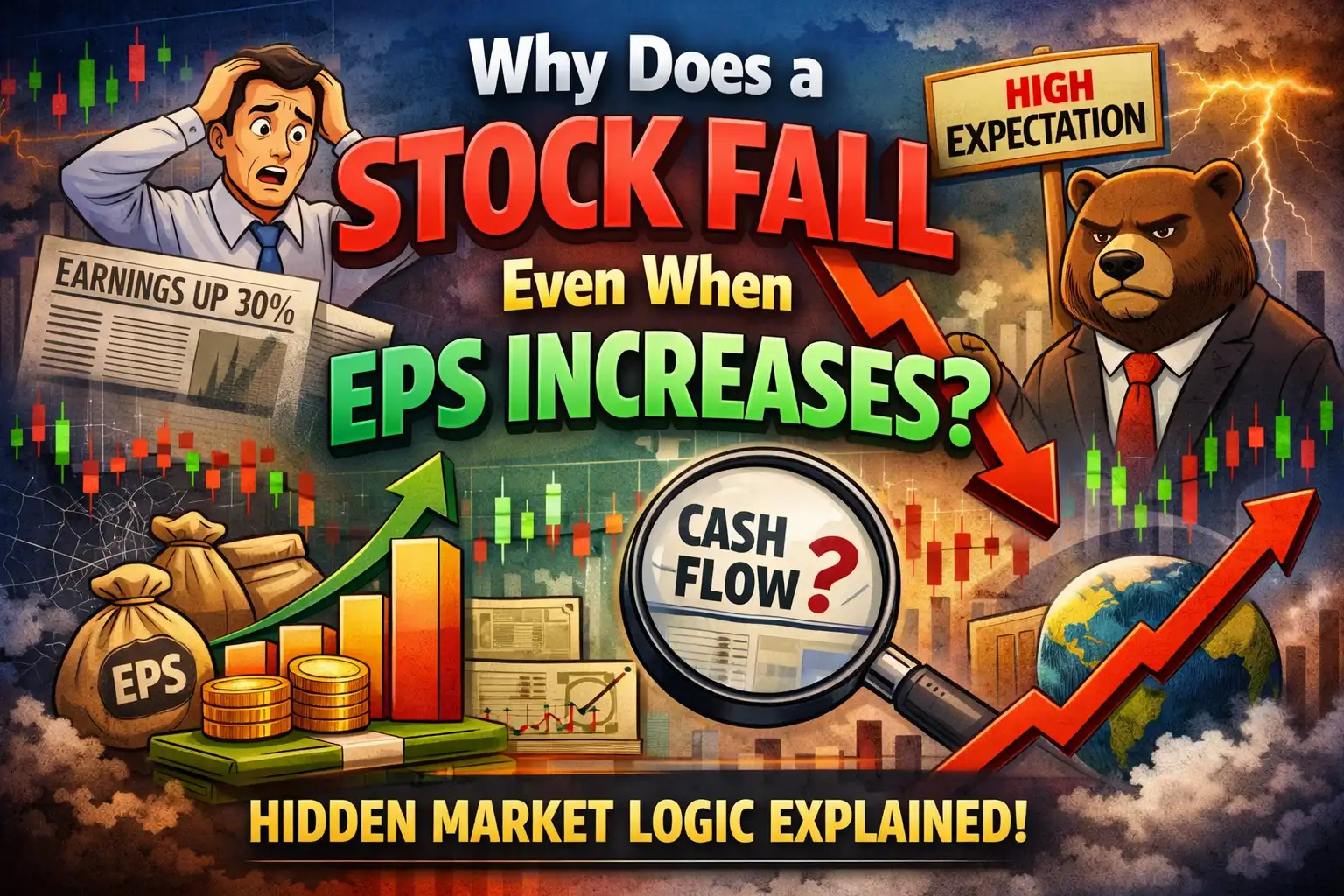
You wake up in the morning, check your phone, and see the company’s quarterly results headline flashing everywhere:
“Company reports 30% jump in EPS”
You smile.
You feel confident.
You expect the stock to open higher 📈
But as soon as the market opens…
the stock starts falling — down 6–8% within minutes 📉
Confusion hits hard.
You ask yourself:
“If EPS has increased, isn’t that a good thing?
Then why is the stock price falling?”
This single question separates surface-level investors from market thinkers.
The truth is simple but uncomfortable:
👉 EPS is just one number. The market looks at the entire story.
Let’s break this illusion — clearly, deeply, and in an interesting way.
Understanding EPS — Important, But Not Enough
EPS (Earnings Per Share) simply means:
- Company’s net profit
- Divided by total outstanding shares
Higher EPS means:
- More profit per share
- Better profitability — on paper
But the stock market does not reward numbers alone.
It rewards future certainty, quality, and expectations.
EPS Increased, But Fell Short of Market Expectations
📌 The Market Runs on Expectations, Not Results
Let’s say:
- Last year EPS: ₹5
- This year EPS: ₹8 → 60% growth (sounds amazing)
But…
- Market expectation: ₹10
Even after strong growth, the result becomes a disappointment.
Why?
Because professional investors think like this:
“Growth is good — but was it good enough?”
📉 When expectations are missed, stocks fall — even on positive growth.
EPS Increased Due to One-Time or Low-Quality Income
📌 Not All Profits Are Equal
EPS can increase because of:
- Asset or land sale
- Investment gains
- One-time government incentives
- Tax benefits
These profits do not come from core business operations.
Example:
- Core business profit: Flat
- Asset sale profit: Huge
- EPS jumps suddenly
Market reaction:
“This profit is not repeatable. What about next quarter?”
📉 Result: Stock declines.
💡 The market prefers sustainable profits, not lucky profits.
EPS Grew Due to Cost Cutting, Not Business Growth
📌 The Most Dangerous Type of EPS Growth
Companies can increase EPS by:
- Cutting employees
- Reducing marketing expenses
- Pausing expansion
- Delaying maintenance
This improves margins temporarily.
But the reality:
- Revenue growth is weak
- Demand is slowing
- Business is not expanding
Market conclusion:
“This company is surviving, not growing.”
📉 Stock price falls.
EPS Increased, But Management Gave Weak Future Guidance
📌 The Market Listens to Words More Than Numbers
After results, management often gives guidance.
If management says:
- “Next quarter may be challenging”
- “Margin pressure is expected”
- “Demand visibility is weak”
The market immediately thinks:
“Today looks good, but tomorrow looks uncertain.”
📉 Investors exit — stock declines.
The Stock Had Already Rallied Before Results
📌 Classic Rule: Buy the Rumor, Sell the News
Before results:
- Analyst upgrades
- Positive expectations
- Insider optimism
The stock rises 30–40% before results.
When results arrive:
- EPS increases
- But nothing new or surprising
Market reaction:
“The good news is already priced in.”
📉 Heavy profit booking begins.
EPS Improved, But Valuation Became Too Expensive
📌 Good Growth at the Wrong Price Is Still Risky
Example:
- EPS: ₹10
- Stock price: ₹600
- P/E ratio: 60
Market question:
“Is future growth strong enough to justify this valuation?”
If the answer is unclear:
📉 Stock corrects — even with rising EPS.
EPS Looks Strong, But Cash Flow Is Weak
📌 EPS Is Accounting — Cash Flow Is Reality
Possible situation:
- Profit shown on paper
- Cash not coming into the bank
- Receivables rising
- Inventory piling up
Market understands:
“These are paper profits, not real cash profits.”
📉 Stock price weakens.
Overall Market Sentiment Was Negative
📌 The Market Mood Can Overpower Any Result
During:
- Market corrections
- Global uncertainty
- Heavy FII selling
- Interest rate fears
Even the best results fail to support stock prices.
📉 Good EPS cannot fight a bad market mood.
The Biggest Truth Every Investor Must Accept
EPS is a signal — not a decision-maker.
The market evaluates:
- Quality of earnings
- Revenue growth
- Cash flow strength
- Management credibility
- Valuation comfort
- Future visibility
Not just one number.
Key Takeaways for Smart Investors
✔ Always ask why EPS increased
✔ Separate core profit from one-time income
✔ Never ignore revenue and cash flow
✔ A fall after results is not always a negative signal
✔ Markets reward long-term business strength, not short-term numbers
Outcome
“In the stock market, every number tells the truth —
but no single number tells the whole truth.”
An increase in EPS is encouraging,
but the quality behind that increase
and the future it supports
decide whether a stock rises or falls.
So next time a stock falls despite higher EPS,
don’t panic.
The market may simply be reminding you to look deeper, not just faster