Imagine there are two investors.
The first investor buys shares of a strong company. A few months later, the market experiences a correction, and the stock falls by 20%. The investor becomes nervous and starts believing that the investment was very risky.
The second investor puts money into a company whose business is gradually deteriorating. The stock price remains relatively stable for some time, so the investor assumes that the investment is safe.
Now the question is: which investor is actually taking more risk?
Many investors mistakenly treat stock price fluctuations as risk itself. However, in the world of investing, volatility and risk are two very different concepts. Sometimes what appears risky is not actually very risky, while something that appears safe may turn out to be the biggest risk of all.
Myth: Risk and Volatility Are the Same Thing
Many investors believe that if a stock’s price moves up and down significantly, it must be risky.
Because of this belief:
- People panic when they see daily price movements.
- Investors sell during market corrections.
- Many avoid volatile stocks altogether.
But the reality is quite different.
Fact: Volatility and Risk Are Different Concepts
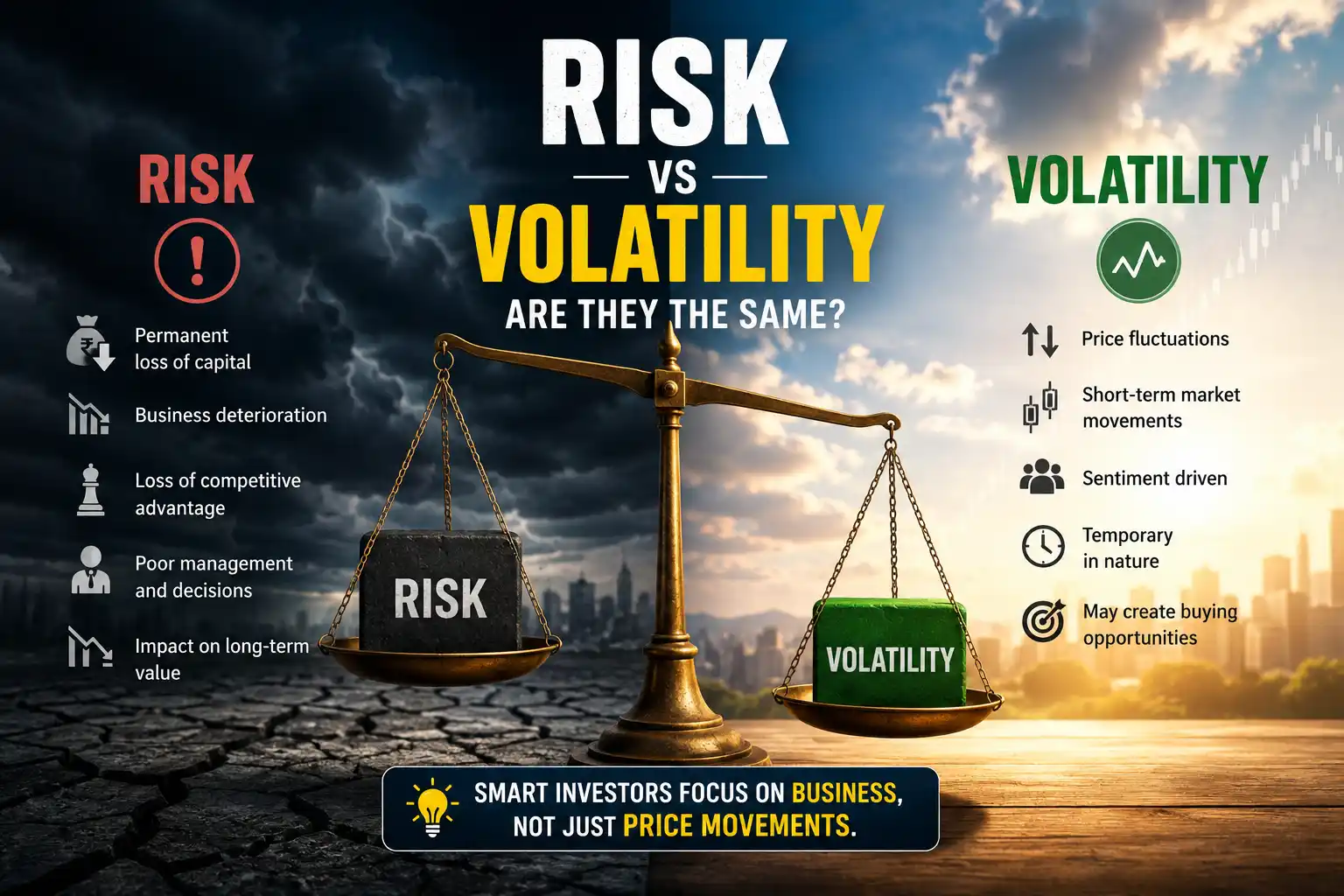
Volatility refers to how much the price of an asset fluctuates.
Risk refers to the possibility of permanently losing capital or failing to achieve the expected return.
In simple terms:
Volatility can be temporary.
Risk can be permanent.
That is why not every volatile investment is risky, and not every stable investment is safe.
What Is Volatility?
Volatility measures the ups and downs in the price of an asset.
For example:
- Stock A moves from ₹100 to ₹120 and then falls back to ₹105 within a month.
- Stock B stays close to ₹100 throughout the month.
Stock A is clearly more volatile.
But does that automatically make Stock A more risky?
Not necessarily.
If Stock A belongs to a strong business with solid long-term growth prospects, then temporary volatility may simply be short-term market noise.
What Is Real Risk?
In investing, real risk occurs when:
- A company’s business deteriorates.
- Its competitive advantage disappears.
- Debt levels become excessive.
- Management makes poor decisions.
- Capital is permanently destroyed.
These risks are often not immediately visible on a stock chart.
Example: Stable Share Price, High Risk
Suppose a company’s stock price remains almost unchanged for two years.
An investor may believe the stock is safe because volatility is low.
However, inside the company:
- Sales are declining.
- Profits are shrinking.
- Debt is increasing.
- Market share is falling.
In this situation, volatility may be low, but the actual risk is very high.
One day, when the market realizes the reality of the business, the stock could suddenly fall by 60–70%.
Example: High Volatility, Low Risk
Now consider another example.
A company has:
- A strong brand
- Healthy profit growth
- Low debt
- Strong cash flow
During a market correction, the stock falls by 25%.
In the short term, volatility is high.
However, if the company’s fundamentals remain strong, the long-term risk may be much lower than the stock price movement suggests.
How Warren Buffett Views Risk
Legendary investor Warren Buffett has often emphasized that stock price volatility should not be confused with risk.
His investment approach focuses on:
- Business quality
- Competitive advantage
- Management quality
- Long-term earnings power
Rather than daily stock price movements.
Why Are Investors So Afraid of Volatility?
The answer lies in psychology.
When investors see the value of their portfolio decline, they immediately feel that their money is at risk.
As a result:
- Panic selling occurs.
- Long-term plans are abandoned.
- Emotional decisions take over.
Many investors try so hard to avoid volatility that they move into low-return assets and miss opportunities for long-term wealth creation.
The Most Important Question for Long-Term Investors
A long-term investor should ask:
“Is the stock price falling, or is the business deteriorating?”
There is a huge difference between the two.
If only the stock price is falling while the business remains strong, it may simply be volatility.
However, if the business model, earnings, and competitive position are weakening, then the investment may face genuine risk.
How to Distinguish Between Volatility and Risk
Signs of Volatility
- Market corrections
- Global news events
- Short-term sentiment changes
- Temporary uncertainty
Signs of Real Risk
- Falling cash flow
- Rising debt
- Poor management decisions
- Declining competitive advantage
- Structural problems within the industry
Investor Lesson
Successful investors analyze businesses, not just stock prices.
If you treat every price fluctuation as risk, surviving in the market becomes difficult.
However, if you focus on business fundamentals, you can view volatility as a natural part of the investing journey.
Conclusion
“Risk and Volatility Are the Same Thing” is one of the most common myths in investing.
In reality, volatility simply reflects price movements, while risk relates to the permanent loss of capital.
A strong business may experience significant short-term volatility and still create substantial wealth over the long term. On the other hand, a stock that appears stable may be extremely risky if its fundamentals are steadily deteriorating.
Therefore, smart investors focus not on short-term price fluctuations but on business quality, earnings power, and long-term potential. Understanding this distinction is one of the most important steps toward becoming a better investor.