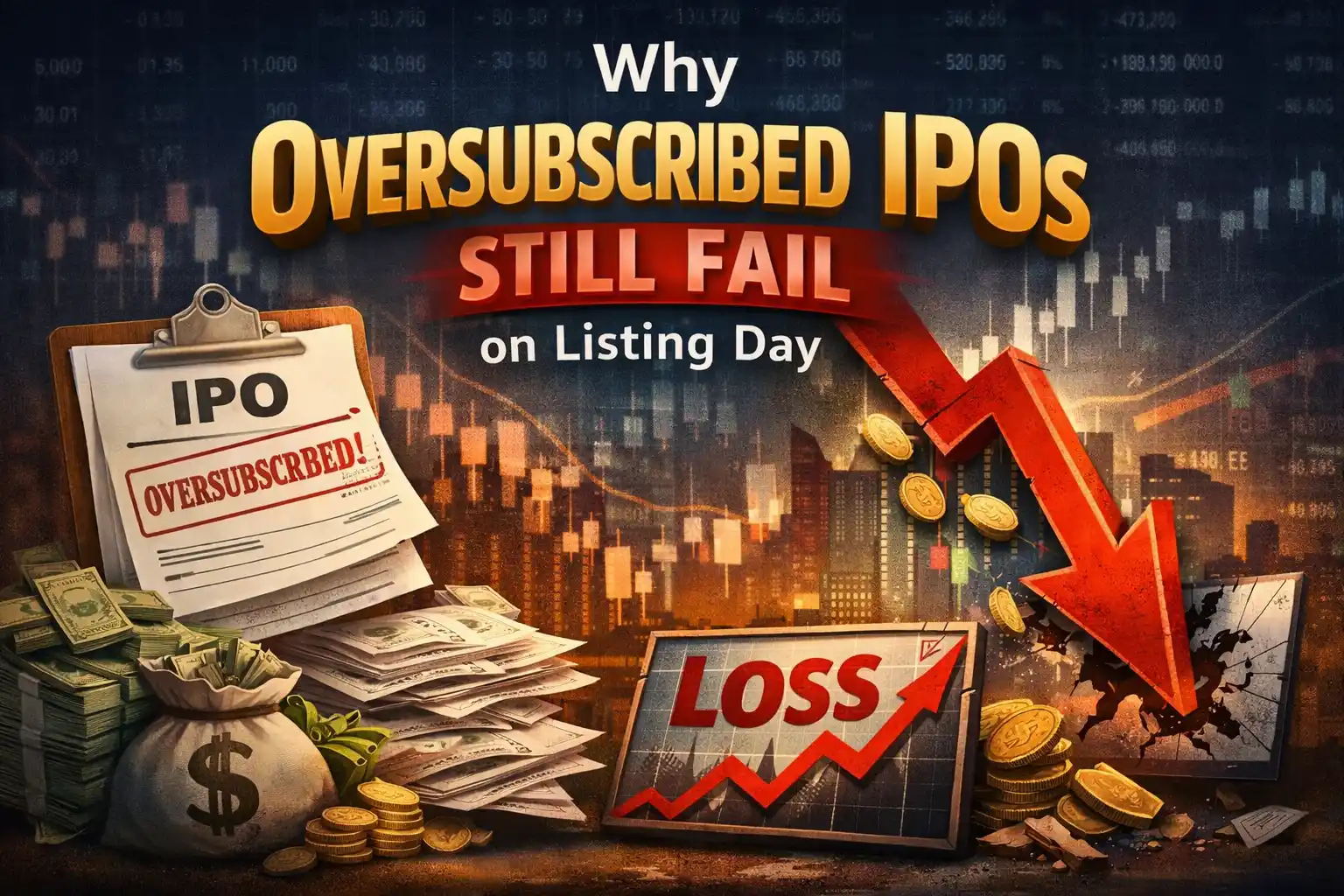
Why Do Some IPOs Deliver Listing Losses Despite Heavy Oversubscription?
Whenever a new IPO hits the market and headlines scream
“IPO subscribed 200x… 300x… even 500x!”,
excitement spreads instantly.
Telegram groups light up.
YouTube thumbnails promise “Guaranteed Listing Gains”.
Retail investors start believing:
“If demand is this high, profit on listing day is almost certain.”
But then listing day arrives —
and the share opens below the issue price.
Confusion turns into frustration.
👉 “How can an IPO with massive demand still give losses?”
👉 “Was oversubscription fake?”
The reality is simple but uncomfortable:
IPO oversubscription and listing profits have no guaranteed connection.
Behind listing losses are real, practical market forces that most investors never talk about. Let’s break them down — clearly, deeply, and with real-life examples.
What IPO Oversubscription Really Means (And What It Doesn’t)
IPO oversubscription means that applications received are many times higher than the number of shares offered.
But here’s the key point:
Oversubscription measures interest at the application stage, not buying power at the listing stage.
Applying for shares is easy —
actual buying on listing day requires confidence, valuation comfort, and market support.
These are two very different situations.
🔹 Example
Suppose a company offers 50 lakh shares in its IPO.
Investors apply for 100 crore shares.
The IPO is subscribed 200x.
But on listing day, when investors must buy with real money, buyers hesitate.
Demand disappears — and prices fall.
🚫 The Biggest Myth: “High Oversubscription Guarantees Listing Gains”
This belief causes the most damage to retail investors.
During an IPO:
- Investors act emotionally
- Money is blocked temporarily
- Decisions are driven by FOMO
On listing day:
- Investors think rationally
- Valuation matters
- Market sentiment matters
Applying is easy.
Buying again at a higher price is not.
🔹 Example
Blocking ₹15,000 during an IPO feels harmless.
But would you confidently invest ₹2–3 lakh in the same stock on listing day?
Most people wouldn’t — and that’s exactly why prices fall.
The Issue Price Is Often Already Too High
Many companies try to extract maximum valuation during the IPO itself.
Investment bankers highlight future growth and justify aggressive pricing.
The problem?
The stock market trades on current reality, not future promises.
If valuation feels stretched, buyers step back on listing day.
🔹 Example
A company earns ₹20 per share in profits,
but prices its IPO as if it already earns ₹50.
Applications pour in —
but once listed, the market says:
“Good business, but overpriced.”
Result: listing loss.
Grey Market Premium (GMP) Can Be Misleading
The grey market is unofficial and unregulated.
Prices there are influenced by:
- Very low volume
- Few participants
- High expectations
GMP often reflects hope, not reality.
Once official trading begins, real liquidity and valuation take control.
🔹 Example
An IPO shows a GMP of +₹60.
Retail investors expect a strong listing.
But on the exchange:
- Sellers dominate
- Buyers hesitate
The stock opens flat or negative — ignoring GMP completely.
Oversubscription Often Comes From FOMO, Not Conviction
Many investors apply because “everyone else is applying.”
This is herd mentality.
These investors are not mentally prepared for volatility.
Even a small loss triggers panic selling.
🔹 Example
The stock lists at -3%.
Thousands of retail investors sell instantly to “save capital”.
This selling pressure pushes the price even lower.
Anchor Investors and Smart Money Exit Early
Large institutional investors often enter IPOs early at favorable prices.
Their goal is usually short-term gains, not long-term holding.
On or soon after listing, they begin selling quietly.
Retail investors misinterpret this as market weakness.
🔹 Example
An anchor investor gets shares at ₹180.
IPO issue price is ₹200.
The stock lists at ₹205.
The anchor exits happily.
Retail investors buy — and face selling pressure.
Weak Market Sentiment Can Sink Even Good IPOs
An IPO does not exist in isolation.
If the broader market is weak due to:
- Global uncertainty
- Rising interest rates
- Heavy FII selling
Even strong IPOs struggle to attract buyers.
🔹 Example
A fundamentally solid IPO lists on a day when the market is down 2%.
Buyers stay cautious.
The stock opens at a discount.
What Retail Investors Should Learn From This
Oversubscription is noise, not confirmation.
Smart investing focuses on:
- Business quality
- Valuation comfort
- Market conditions
🔹 Example
IPO A: 300x oversubscribed, expensive valuation
IPO B: 10x oversubscribed, fair valuation
Over time, IPO B often performs better.
A Reality Check for IPO Investors
If you invest in IPOs only because they are heavily oversubscribed,
you are not investing — you are gambling.
Remember this:
📌 Crowds don’t build wealth
📌 Smart money exits quietly
📌 Real profits come from understanding, not excitement
Applying for IPOs is not wrong —
but blind belief is the biggest risk.
In the stock market,
discipline beats hype, and patience beats noise — every single time.