Imagine you are planning to invest in the banking sector.
You see ads from big banks, read glossy reports, and think:
“This bank seems safe, let’s put our money in.”
But the truth is, the real game of banking is hidden in the numbers.
Many investors rely only on shiny headlines and end up regretting later.
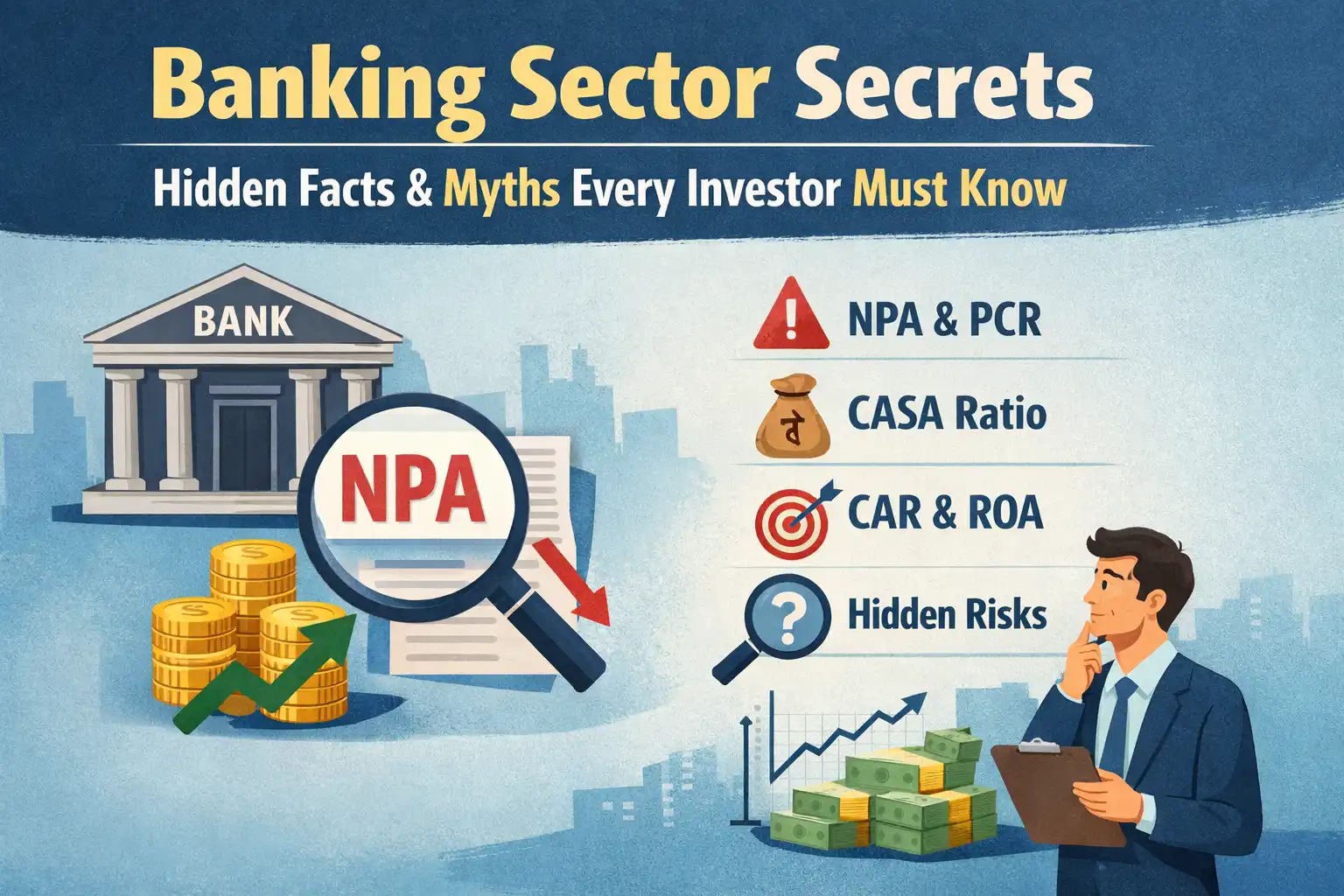
In this article, we’ll reveal hidden facts and myths that few people know, and show how to identify which banks are safe and which are risky for investment.
NPA – The Heartbeat of a Bank
NPA (Non-Performing Asset) is a loan that is overdue for more than 90 days.
Investment perspective:
- High NPA = lower profits, higher risk
- Low NPA = safe, but sometimes artificially reduced via restructuring
Hidden Fact:
Many big banks restructure loans to reduce NPA figures.
Short-term it looks safe, but hidden risk remains.
Myth:
❌ “Low NPA means the bank is strong.”
✔️ Truth: Trend and provisions matter. One quarter of low NPA can be misleading.
Provision Coverage Ratio (PCR) – The Bank’s Safety Net
PCR shows how much money a bank has set aside to cover bad loans.
Fact:
A bank with very high PCR may look weak in the short term, but it is actually more stable in the long term.
Myth:
❌ “Low PCR bank seems cheap and safe.”
✔️ Truth: Low PCR means the bank hasn’t prepared for losses yet → risky!
Capital Adequacy Ratio (CAR) – The Bank’s Armor
CAR = The bank’s ability to absorb future losses.
Hidden Fact:
Some investors blindly invest in big PSU banks.
But if CAR is low and NPA is high → capital crunch is possible anytime.
Investment Tip:
- CAR 13–15%+ = Strong Bank
- CAR < 10% and high NPA = Avoid
CASA Ratio – The Bank’s Secret Weapon
CASA = (Current Account + Savings Account) ÷ Total Deposits
Fact:
High CASA = cheap funds → higher profit margin
Low CASA = reliance on expensive deposits → lower profit
Myth:
❌ “Private banks always make higher profits.”
✔️ Truth: CASA ratio determines whether the bank’s funds are cheap or expensive.
ROA & ROE – The Numbers That Matter
- ROA: Profit generated from assets
- ROE: Profit generated from shareholder equity
Hidden Fact:
Sometimes high ROE is just due to leverage (borrowed money).
So even high ROE can be risky if you don’t check asset quality.
Credit Growth vs NPA Trend
Fact:
- If a bank’s credit is growing fast but NPA is also rising → ⚠️ Red Flag
- Healthy growth = moderate credit growth + declining or stable NPA
Myth:
❌ “Fast-growing bank is always good.”
✔️ Truth: Both growth and asset quality must be considered.
Management & Policy Insight
Hidden Fact:
- PSU banks sometimes turn profitable loans into NPAs due to political pressure.
- Private banks may take aggressive lending decisions, which can be risky.
Investment Tip:
Always read quarterly reports and management commentary — don’t rely only on numbers.
Hidden Facts & Myths Most People Don’t Know
Hidden Facts:
- NPAs can be reduced through loan restructuring → short-term looks safe, but real risk remains.
- Banks with high provisions may appear weak short-term, but are long-term stable.
- CASA ratio shows whether bank funds are cheap or expensive — often ignored by investors.
Myths:
- ❌ “Private banks are always safe.” → Wrong. Management and asset quality matter.
- ❌ “Low NPA = Strong bank.” → Trends and provisions are more important.
- ❌ “Big banks never fail.” → Wrong. Any bank can fail if loans and capital are weak.
Investor’s Quick Checklist for Banking Sector
- NPA Trend – Downward trend is best
- PCR – Higher is safer
- CAR – Must be above regulatory minimum
- CASA Ratio – Higher = cost-efficient funds
- ROA & ROE – Check profitability
- Credit Growth vs NPA – Look for healthy growth
- Management Commentary – Transparent leadership matters
Outcome
Investing in the banking sector is like being a numbers detective.
- Understanding hidden facts and myths can protect your money.
- Don’t get trapped by flashy headlines — focus on trends, ratios, and real metrics.
“A bank that looks weak short-term but has strong provisions + CASA + CAR can be the jackpot for long-term investors.”