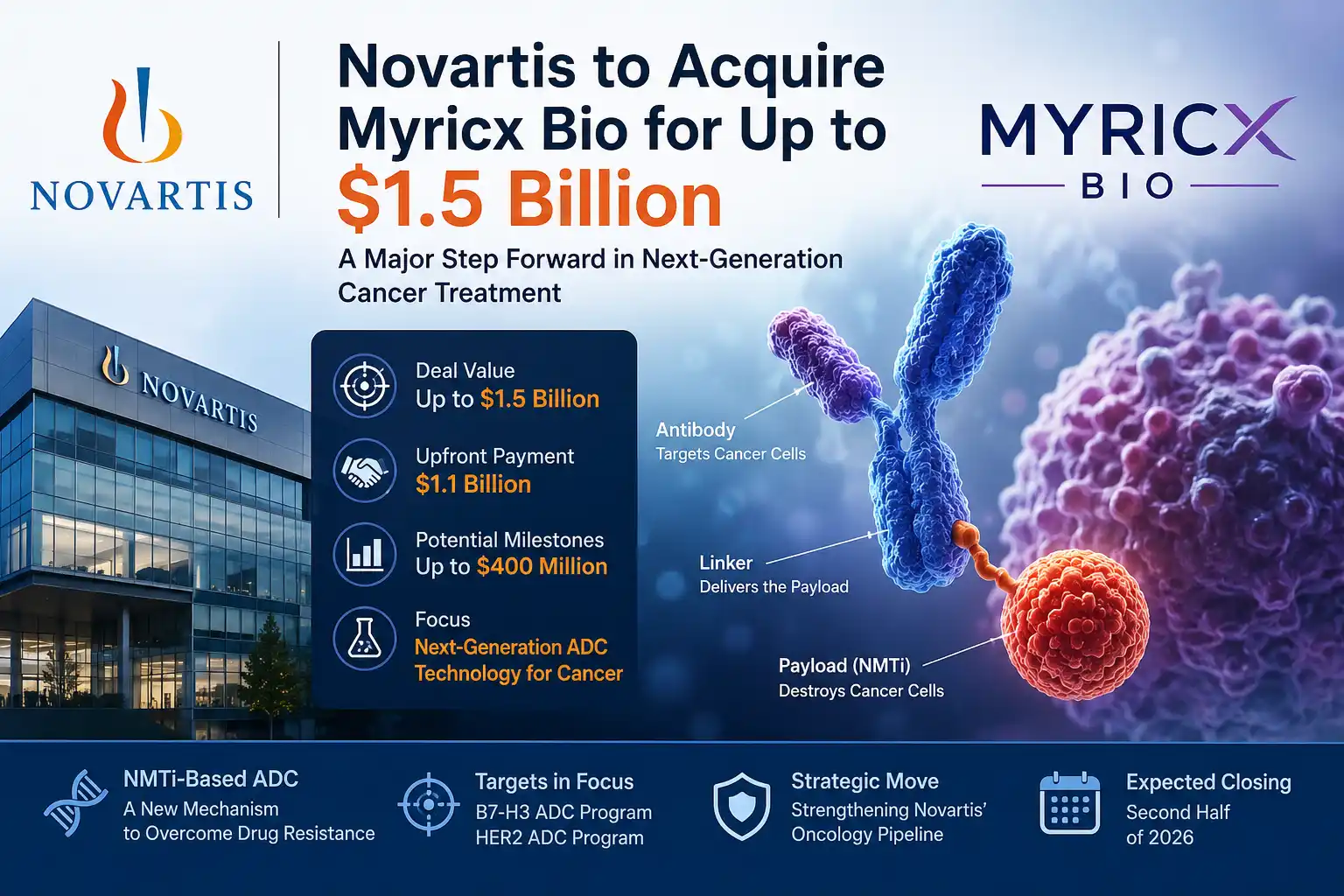
Swiss pharmaceutical giant Novartis has agreed to acquire UK-based biotechnology company Myricx Bio in a deal worth up to $1.5 billion.
Under the agreement, Novartis will pay $1.1 billion in upfront cash, while up to $400 million in additional milestone payments could be paid depending on the achievement of certain development and other milestones.
The deal was announced on July 6, 2026, and is expected to close in the second half of 2026, subject to customary closing conditions and regulatory approvals.
The acquisition is important because Myricx Bio has developed a potentially new type of antibody-drug conjugate (ADC) payload based on N-myristoyltransferase inhibitors, or NMTi.
Novartis believes this technology could help expand its cancer-treatment pipeline and provide new options for patients, particularly in areas where resistance to existing cancer therapies is a challenge.
Novartis–Myricx Bio Deal at a Glance
| Key Point | Details |
| Acquirer | Novartis |
| Target | Myricx Bio |
| Deal Type | Acquisition |
| Announcement Date | July 6, 2026 |
| Upfront Payment | $1.1 billion |
| Potential Milestone Payments | Up to $400 million |
| Maximum Deal Value | Up to $1.5 billion |
| Target Country | United Kingdom |
| Industry | Biotechnology / Oncology |
| Technology | NMTi-based ADC payloads |
| Main Focus | Cancer Treatment |
| Deal Status | Agreement signed, closing pending |
| Expected Closing | H2 2026 |
Why Is Novartis Acquiring Myricx Bio?
To understand this acquisition, it is important to look at what Novartis is actually buying.
Myricx Bio is not a large commercial pharmaceutical company. Its main value comes from its research, drug-development technology and ADC platform.
Novartis already has a strong position in cancer treatment. Its oncology business generated approximately $16.8 billion in sales in 2025, up 18% from the previous year.
Major oncology products include:
- Kisqali
- Pluvicto
- Scemblix
- Tafinlar + Mekinist
The Myricx acquisition gives Novartis access to a new potential ADC payload mechanism.
The company hopes that this technology could complement its existing oncology portfolio and help create future cancer medicines.
What Is an ADC? An Easy Explanation
ADC stands for Antibody-Drug Conjugate.
It can be thought of as a targeted delivery system for cancer treatment.
Traditional chemotherapy can affect both cancer cells and healthy cells because the medicine travels throughout the body.
An ADC is designed to deliver a powerful drug more specifically to cancer cells.
An ADC generally contains three main components:
1. Antibody
The antibody identifies a specific target found on cancer cells.
2. Linker
The linker connects the antibody to the drug payload.
3. Payload
The payload is the cancer-killing drug.
In simple terms:
Antibody → Finds the Cancer Cell → Delivers the Payload → Payload Damages the Cancer Cell
This targeted approach is one reason ADCs have become an important area of cancer-drug development.
What Is Different About Myricx Bio’s Technology?
Myricx Bio focuses on N-myristoyltransferase, or NMT, enzymes.
The company has developed molecules that inhibit these enzymes. These molecules are known as NMT inhibitors, or NMTi.
Myricx is developing NMT inhibitors as potential ADC payloads.
In simple terms, the idea is:
Antibody finds the cancer cell → ADC delivers the NMT inhibitor → NMT is blocked → cancer-cell survival is disrupted.
Myricx says its NMTi mechanism is different from commonly used ADC payload classes such as topoisomerase-1 inhibitors and tubulin inhibitors.
That difference could potentially provide another treatment mechanism for cancers that develop resistance to existing approaches.
However, this remains a potential advantage, not a proven clinical benefit yet.
What Is NMT?
NMT stands for N-myristoyltransferase. It is an enzyme family involved in several biological processes inside cells. Myricx researchers have spent years studying NMT biology and its potential role in cancer.
The company is now using that research to develop NMT inhibitors as targeted cancer-treatment payloads. The basic idea is to interfere with biological processes that cancer cells need for survival. This is the scientific foundation behind Myricx’s ADC platform.
Myricx Bio’s Lead ADC Programs
According to Novartis’ Q2 2026 materials, Myricx has two lead ADC programs targeting B7-H3 and HER2.
B7-H3 Target
B7-H3 is a protein that can be highly expressed in several types of cancer. Because of this, researchers are investigating B7-H3 as a potential target for cancer therapies. Myricx’s technology is designed to use B7-H3 targeting to deliver its NMTi payload to cancer cells.
HER2 Target
HER2 is another well-established cancer target. HER2-targeted therapies are already used in several cancers, including certain forms of breast cancer. Myricx is combining this established target with its new NMTi payload mechanism.
The goal is to create a different type of HER2-targeted ADC.
The Biggest Attraction: A New ADC Payload
The most important part of this acquisition is not simply the two experimental drug programs.
It is the NMTi payload platform.
If the technology proves successful, Novartis could potentially use the platform with different antibodies and cancer targets.
That means Novartis could potentially develop multiple ADC medicines using the same underlying technology.
Therefore, the acquisition could provide Novartis with a platform technology, rather than just a single drug candidate.
Why Is Drug Resistance Important in Cancer Treatment?
One of the biggest challenges in cancer treatment is drug resistance.
A cancer medicine may initially work well, but cancer cells can sometimes adapt and become resistant to treatment. This can eventually reduce the effectiveness of the medicine. Many ADCs use established payload mechanisms. Myricx’s NMTi technology works through a different biological mechanism.
That creates the possibility of developing treatments for some cancers that may not respond adequately to existing payload classes.
However, this potential still needs to be demonstrated through clinical trials.
Who Is Myricx Bio?
Myricx Bio is a UK-based biotechnology company headquartered in London. The company was founded in 2019 and is based on scientific research originating from Imperial College London.
Its founders include Professor Ed Tate, Dr Andrew Bell and Dr Roberto Solari. The company initially focused on NMT biology and later developed this research into a potential cancer-treatment platform.
Its current focus is on developing next-generation ADCs using NMT inhibitors as payloads.
How Much Funding Did Myricx Bio Raise?
Before the Novartis acquisition, Myricx had already attracted significant institutional investment.
In 2024, the company raised approximately £90 million, or around $114 million, in Series A financing.
The financing was co-led by Novo Holdings and Abingworth, with participation from other investors including the British Business Bank and Eli Lilly. This funding allowed Myricx to advance its NMT inhibitor and ADC programs.
The level of institutional funding also indicates that investors saw significant potential in the company’s underlying technology before Novartis agreed to acquire it.
What Is Novartis?
Novartis is a Switzerland-based global pharmaceutical company headquartered in Basel.
The company focuses on innovative medicines across several major therapeutic areas, including:
- Oncology
- Immunology
- Neuroscience
- Cardiovascular, Renal and Metabolic diseases
In 2025, Novartis reported approximately $54.5 billion in net sales from continuing operations.
The company also generated approximately $17.6 billion in free cash flow.
This strong cash-generation capability gives Novartis significant financial flexibility to invest in promising biotechnology companies and technologies.
Why Is Oncology So Important for Novartis?
Oncology is one of Novartis’ most important growth areas. The company’s oncology business generated approximately $16.8 billion in sales in 2025, representing 18% growth.
Some of its major oncology products include:
Kisqali:
2025 sales: approximately $4.8 billion
Pluvicto:
2025 sales: approximately $2.0 billion
Scemblix:
2025 sales: approximately $1.3 billion
Tafinlar + Mekinist
2025 sales: approximately $2.2 billion
The Myricx acquisition fits directly into this broader oncology strategy.
Why Is Novartis Paying $1.1 Billion Upfront?
At first glance, paying $1.1 billion upfront for a biotechnology company with early-stage programs may seem expensive. However, pharmaceutical companies often acquire promising biotech platforms before they reach commercial success.
The logic is relatively simple:
Buy promising technology today → invest in development → potentially create valuable medicines in the future.
If Myricx’s technology eventually produces successful cancer medicines, the future commercial opportunity could be much larger than the acquisition price.
But the opposite is also possible.
If the clinical programs fail, Novartis may not receive the expected return on its investment.
Why Are There Up to $400 Million in Milestone Payments?
Novartis is not paying the entire potential $1.5 billion immediately.
The structure is approximately:
$1.1 billion → Upfront payment
Up to $400 million → Future milestone payments
This structure helps link part of the acquisition cost to future performance.
If Myricx’s programs achieve specified development or other milestones, additional payments may become payable.
This can reduce some of the risk associated with acquiring an early-stage biotechnology platform.
Why Is This Deal Strategically Important for Novartis?
There are four major strategic reasons.
1. Strengthening the Oncology Pipeline
Novartis already has a major oncology business. Myricx adds another potential technology to that pipeline.
2. Expanding Its ADC Capabilities
ADCs are an important and rapidly developing area of cancer-drug research. Myricx gives Novartis access to a differentiated potential ADC payload.
3. Adding a New Mechanism of Action
NMT inhibition works differently from several commonly used ADC payload mechanisms. That could become valuable if existing treatments face resistance.
4. Potential Platform Value
The technology could potentially be used across multiple cancer targets. This creates the possibility of developing more than one medicine from the underlying platform.
What Are the Risks?
The acquisition also carries significant risks.The biggest risk is that Myricx’s technology is still in early-stage development. Promising laboratory results do not guarantee that a drug will be safe or effective in humans.
A typical drug-development pathway is:
Preclinical Research → Phase 1 → Phase 2 → Phase 3 → Regulatory Approval → Commercial Launch
A drug candidate can fail at any of these stages.
Therefore, the $1.5 billion maximum deal value should not be considered guaranteed value.
The Biggest Risk: Clinical Validation
The major question for Novartis will be whether the NMTi technology can deliver strong results in human clinical trials.
Investors will eventually need to watch:
- Phase 1 safety data
- Dose selection
- Pharmacokinetics
- Tumor response
- Resistance data
- Phase 2 efficacy
- Phase 3 results
- Regulatory decisions
These factors will determine whether Myricx becomes a commercially valuable platform or simply an unsuccessful research investment.
Will Novartis Get a New Cancer Drug Immediately?
No.
This is an important point.
The acquisition is not primarily about buying an already-approved blockbuster cancer drug. Novartis is acquiring early-stage technology and development programs.
If the research and clinical development are successful, the technology could eventually lead to new cancer medicines.
Therefore, the financial impact of this deal is more about long-term pipeline value than immediate revenue.
What Is Novartis Actually Getting From Myricx?
The acquisition can be understood through four major assets:
1. NMTi Technology
A potential new ADC payload mechanism.
2. B7-H3 ADC Program
A program targeting a cancer-associated protein.
3. HER2 ADC Program
A new payload approach using the established HER2 target.
4. Scientific Expertise
Specialized knowledge in NMT biology and ADC development.
What Could This Mean for the Pharmaceutical Industry?
The acquisition highlights a broader trend in the pharmaceutical industry.
Large pharmaceutical companies are increasingly looking beyond already-approved drugs and investing in early-stage biotech platforms, novel drug targets and next-generation technologies.
In oncology, major areas of development include:
- Antibody-drug conjugates
- Targeted therapies
- Radioligand therapies
- Precision medicine
- New cancer-cell killing mechanisms
Novartis is already a major player in radioligand therapy through products such as Pluvicto.
Adding Myricx’s ADC technology could further diversify its cancer-treatment pipeline.
What Does the Deal Mean for Investors?
For Novartis shareholders, the Myricx acquisition is primarily a long-term pipeline investment, rather than an immediate earnings driver.
The $1.1 billion upfront payment is relatively manageable for a company of Novartis’ size, particularly given its strong cash generation.
However, the ultimate value of the acquisition will depend on clinical performance.
If NMTi technology successfully produces effective cancer treatments and the platform can be expanded across multiple targets, the acquisition could generate significant long-term value.
If clinical development fails, the expected return could be much lower.
Overall Analysis
The Novartis–Myricx Bio transaction is more strategically important than its size alone might suggest.
The three most important aspects are:
First, Novartis is gaining access to a potentially new ADC payload mechanism.
Second, the acquisition adds B7-H3 and HER2-focused programs to its oncology pipeline.
Third, the NMTi technology could potentially become a broader ADC platform rather than being limited to a single drug.
However, the technology is still in early development, so investors should not treat the $1.5 billion maximum deal value as guaranteed value.
The key question is what happens after the acquisition closes and how the technology performs in clinical trials.
Simple Conclusion
In simple terms:
Novartis is acquiring Myricx Bio because it believes Myricx’s NMT inhibitor technology could help create a new generation of targeted cancer treatments using ADCs.
Novartis will pay $1.1 billion upfront, with the total transaction potentially reaching $1.5 billion if future milestones are achieved.
Source: norvatis news