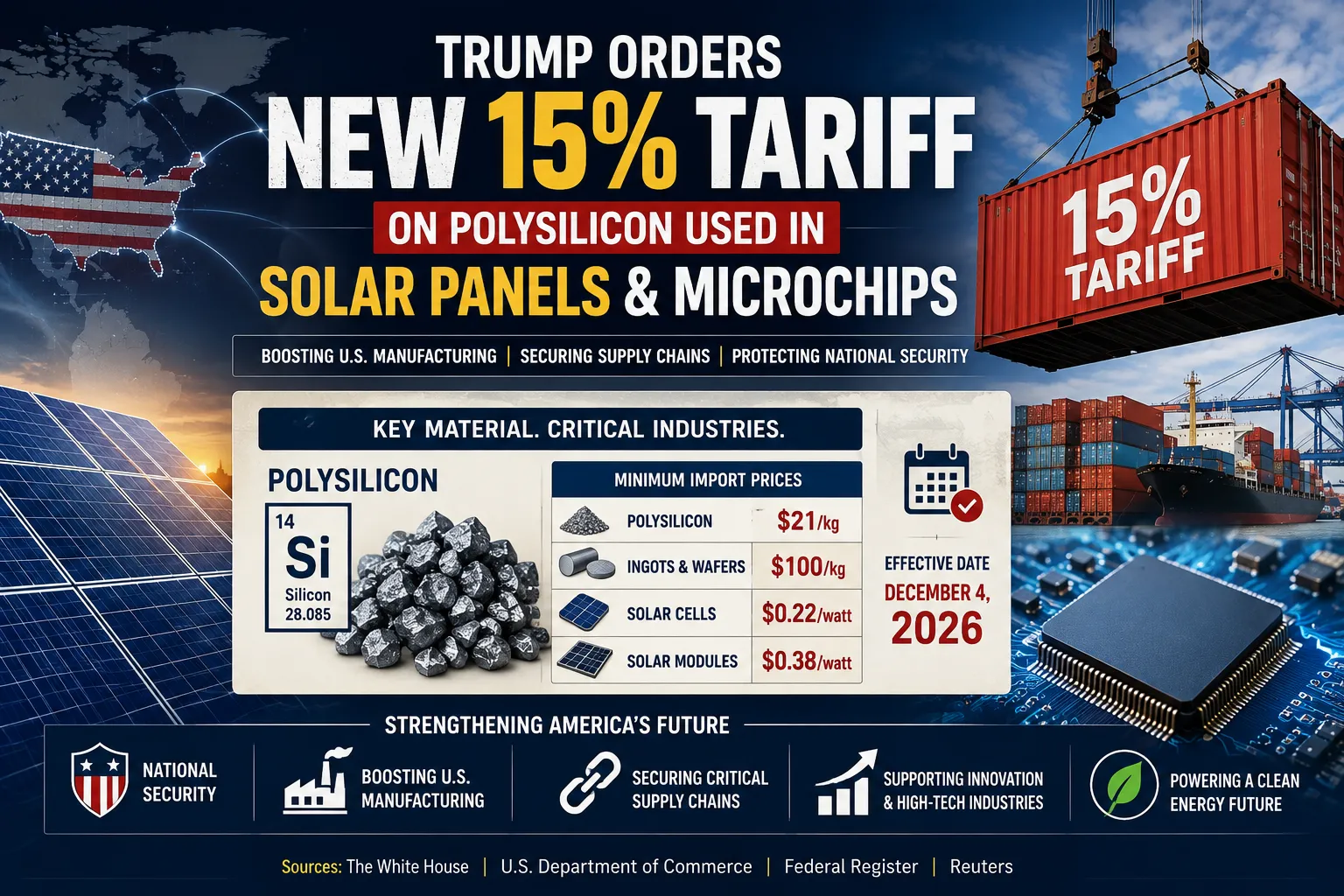
U.S. President Donald Trump has ordered a new 15% tariff on imported polysilicon derivatives, along with minimum import prices for several related products. The move is aimed at protecting U.S. manufacturers and reducing America’s dependence on foreign supply chains, particularly those linked to China.
The new measures are scheduled to take effect on December 4, 2026.
The decision is important because polysilicon is a key material used in the solar industry as well as semiconductor manufacturing. This means the new policy could affect not only solar panels but also parts of the broader technology and chip supply chain.
What Is Polysilicon and Why Is It Important?
Polysilicon is a highly purified form of silicon. It is mainly used in two major industries:
- Solar panels
- Semiconductors and microchips
In the solar industry, polysilicon is processed into ingots and wafers, which are then used to manufacture solar cells and solar modules.
In the semiconductor industry, extremely high-purity silicon is used to make wafers on which computer chips are manufactured. This makes polysilicon an important material for both clean energy and advanced technology.
Why Did Trump Impose the 15% Tariff?
One of the biggest reasons behind the decision is the high concentration of solar manufacturing in China.
China has built a dominant position across several stages of the solar supply chain. The Trump administration wants to reduce U.S. dependence on foreign suppliers and encourage more manufacturing inside the United States. The administration is also treating some of these supply chains as a matter of economic and national security.
The broader strategy is:
Foreign imports → Higher protection → More U.S. investment → Stronger domestic supply chain
The new policy uses the U.S. national-security trade framework under Section 232.
It Is More Than Just a 15% Tariff
One of the most important parts of the announcement is that the U.S. is not relying only on the 15% tariff. Minimum import prices have also been established for several products.
| Product | Reported Minimum Import Price |
| Polysilicon | $21/kg |
| Solar ingots and wafers | $100/kg |
| Solar cells | $0.22/watt |
| Solar modules | $0.38/watt |
The purpose of these price floors is to prevent foreign manufacturers from selling products at extremely low prices and putting U.S. manufacturers under pressure.
In simple terms, the policy combines:
15% tariff + Minimum import prices
That could provide stronger protection to U.S. producers than a tariff alone.
When Will the New Tariff Take Effect?
The new measures are scheduled to become effective on December 4, 2026. The delay is significant because some U.S. solar manufacturers wanted the measures to take effect sooner. There are concerns that foreign suppliers could increase shipments to the U.S. before the new rules take effect, allowing companies to build inventory ahead of the tariff. This is one reason the implementation timeline is being closely watched by the solar industry.
Why Is China a Major Target?
China has become the world’s dominant center for solar manufacturing. The solar supply chain broadly includes:
Polysilicon → Ingots → Wafers → Solar Cells → Solar Modules
The Trump administration wants to reduce China’s influence across this entire chain. This is part of a much broader U.S. strategy to reduce dependence on China for strategic materials, energy technology and advanced manufacturing.
Which U.S. Companies Could Benefit?
The new policy could benefit several U.S.-based companies involved in polysilicon and solar manufacturing.
Hemlock Semiconductor
Michigan-based Hemlock Semiconductor is an important U.S. polysilicon producer. Higher costs for imported polysilicon could improve the competitive position of domestic producers such as Hemlock.
Wacker Chemie
Germany’s Wacker Chemie operates a major polysilicon manufacturing facility in Tennessee. If U.S. demand for domestically produced polysilicon increases, companies with production capacity inside the United States could benefit.
First Solar
First Solar is another company that attracted investor attention after the announcement.
However, First Solar is different from traditional crystalline-silicon solar manufacturers because it uses thin-film cadmium telluride (CdTe) technology.
That means higher costs for conventional crystalline-silicon products could potentially give First Solar a relative competitive advantage in some parts of the U.S. market. U.S. solar stocks, including First Solar and T1 Energy, rose sharply following the announcement.
What Does This Mean for the U.S. Solar Industry?
The policy could be a double-edged sword for the U.S. solar industry.
Potential Benefits
If imported solar components become more expensive:
Imported products become more expensive → Domestic products become relatively more competitive → U.S. manufacturing investment could increase
This could lead to:
- More domestic factories
- New manufacturing investments
- More jobs
- Greater supply-chain security
- Less dependence on overseas suppliers
This is exactly what the Trump administration wants to achieve.
Potential Problems
However, U.S. solar manufacturers may also face higher input costs.
Higher prices for raw materials and components could increase:
- Solar module costs
- Solar project costs
- Utility-scale project expenses
- Costs for consumers
So while tariffs protect domestic producers, they can also increase costs across the industry.
Will Solar Panel Prices Rise?
It is important to understand that a 15% tariff does not automatically mean solar panels will become 15% more expensive. Polysilicon is only one part of the total cost of producing a solar panel.
However, if higher costs move through the supply chain, the effect could look like this:
Higher polysilicon cost
↓
Higher wafer cost
↓
Higher cell cost
↓
Higher module cost
↓
Potentially higher solar project cost
The actual impact will depend on how much of the additional cost manufacturers absorb and how much they pass on to customers.
What About the Semiconductor Industry?
This policy is not only about solar energy. Polysilicon is also important for semiconductor manufacturing because high-purity silicon is used to manufacture semiconductor wafers.
That makes the new policy relevant to the broader chip supply chain. The Trump administration has already taken several steps aimed at strengthening U.S. semiconductor and advanced-computing supply chains.
The new polysilicon policy targets an earlier stage of the supply chain:
Raw material → Silicon wafer → Semiconductor → AI chip
This is particularly important as demand for AI chips and data centers continues to grow.
How Is This Connected to the AI Boom?
This is one of the most interesting aspects of the policy.
The AI boom is driving massive investment in:
- AI chips
- Data centers
- Semiconductor factories
- Electricity infrastructure
- Renewable energy
AI data centers require enormous amounts of electricity, while AI systems require advanced semiconductors. Solar power is one of the technologies being used to meet growing electricity demand.
Therefore, the U.S. administration increasingly views materials such as polysilicon through a broader AI + semiconductor + energy security lens.
Why Did the U.S. Lose So Much Polysilicon Production?
The U.S. once had a much larger role in global polysilicon production. Over the years, however, a significant portion of production moved to Asia, particularly China. Reports indicate that the U.S. share of global polysilicon production fell from roughly 50% in 2005 to below 2% in 2024.
The Trump administration wants to reverse this trend. But rebuilding an entire supply chain will not happen overnight.
A new polysilicon facility requires:
- Billions of dollars of investment
- Skilled workers
- Large amounts of electricity
- Specialized equipment
- Advanced technology
- Reliable chemical supplies
- Several years of development
Therefore, tariffs can create an incentive for investment, but they cannot instantly create new manufacturing capacity.
The Biggest Risk: Higher Import Costs
If U.S. domestic production cannot increase quickly enough to meet demand, companies could face higher input costs.
There are three broad scenarios.
Scenario 1: Domestic Manufacturing Expands Quickly
If U.S. companies rapidly increase production capacity, the policy could strengthen America’s domestic supply chain over the long term.
Scenario 2: Imports Become Expensive but Domestic Supply Remains Limited
In this situation, solar and semiconductor manufacturers could face higher costs.
Scenario 3: China Retaliates
China could respond with additional trade restrictions or other measures, potentially increasing tensions between the world’s two largest economies.
Why Did U.S. Solar Stocks Rise?
Investors viewed the announcement as positive for some U.S. solar manufacturers. First Solar and T1 Energy were among the companies that saw strong market moves following the announcement.
The basic market logic is:
Foreign competition ↓
Domestic pricing power ↑
Domestic investment ↑
Potential margins ↑
However, investors should not assume that higher tariffs automatically mean higher long-term profits. The ultimate impact will depend on demand, production capacity, input costs and how customers respond to higher prices.
Is This Another Step in the U.S.-China Trade War?
Yes, but it would be too simple to describe the policy as just another China tariff. The new measures apply to imported polysilicon and related products more broadly. That means the impact could extend beyond Chinese manufacturers.
Companies in countries such as:
- South Korea
- Taiwan
- Vietnam
- Malaysia
- European countries
will also need to examine how the new rules affect their supply chains.
Supply-chain tracing and rules of origin could therefore become increasingly important.
How Is This Different From Earlier U.S. Solar Tariffs?
This distinction is important. The United States has already imposed various trade measures on Chinese solar products.
For example, the U.S. Trade Representative announced in December 2024 that tariffs on Chinese solar wafers and polysilicon under Section 301 would increase to 50%, effective January 1, 2025.
The new measure is different in its policy approach.
Earlier approach
China-specific trade measures
New approach
Section 232 national-security framework + 15% tariff + minimum import prices
Therefore, the latest policy should not simply be viewed as another standard solar tariff.
What Could This Mean for India?
India is also expanding its domestic solar manufacturing capacity, so the development could create both opportunities and challenges.
If the U.S. reduces its dependence on Chinese solar products, Indian manufacturers could potentially gain opportunities in the American market.
However, an important question will be the origin of the materials used by Indian manufacturers.
If Indian solar products rely heavily on Chinese polysilicon, wafers or other components, simply assembling the final product in India may not be enough to avoid future trade restrictions.
Therefore, a traceable and less China-dependent supply chain could become a competitive advantage for Indian solar companies.
What Does It Mean for Investors?
Investors should not look at the news simply as:
“15% tariff = solar stocks go up.”
The impact will vary across the industry.
1. Polysilicon Producers
U.S. domestic polysilicon producers could benefit from greater protection against low-cost imports.
2. Solar Manufacturers
Companies producing solar products inside the U.S. could gain pricing advantages if imported alternatives become more expensive.
3. Solar Project Developers
Higher equipment and material costs could put pressure on project economics.
Therefore, the same policy can create winners and losers within the solar industry.
Overall Analysis
The new polysilicon tariff is best understood as another part of the Trump administration’s strategy to reduce dependence on China and rebuild strategic supply chains inside the United States.
In the short term, U.S. polysilicon producers and some domestic solar manufacturers could benefit from greater protection.
In the long term, however, the success of the policy will depend on whether the United States can actually build enough domestic production capacity.
One important point is:
A tariff does not build a factory. It creates an economic incentive to build one.
If companies respond by investing billions of dollars in new factories, hiring workers and expanding production, the policy could strengthen America’s supply-chain resilience.
But if domestic capacity fails to grow quickly enough, the result could instead be:
Higher import costs + Higher solar costs + More expensive supply chains
And if China responds with additional trade restrictions, the policy could contribute to even greater global trade tensions.
Outcome
Trump’s new 15% tariff on polysilicon derivatives is much more than a simple tax on solar-panel materials.
It is part of a broader U.S. strategy involving solar energy, semiconductor manufacturing, AI infrastructure and national security.
Overall, the move represents a significant attempt by the U.S. to reshape the global solar and semiconductor supply chain, rather than simply increase import taxes.
Sources: The White House, U.S. Department of Commerce, Federal Register, Reuters.