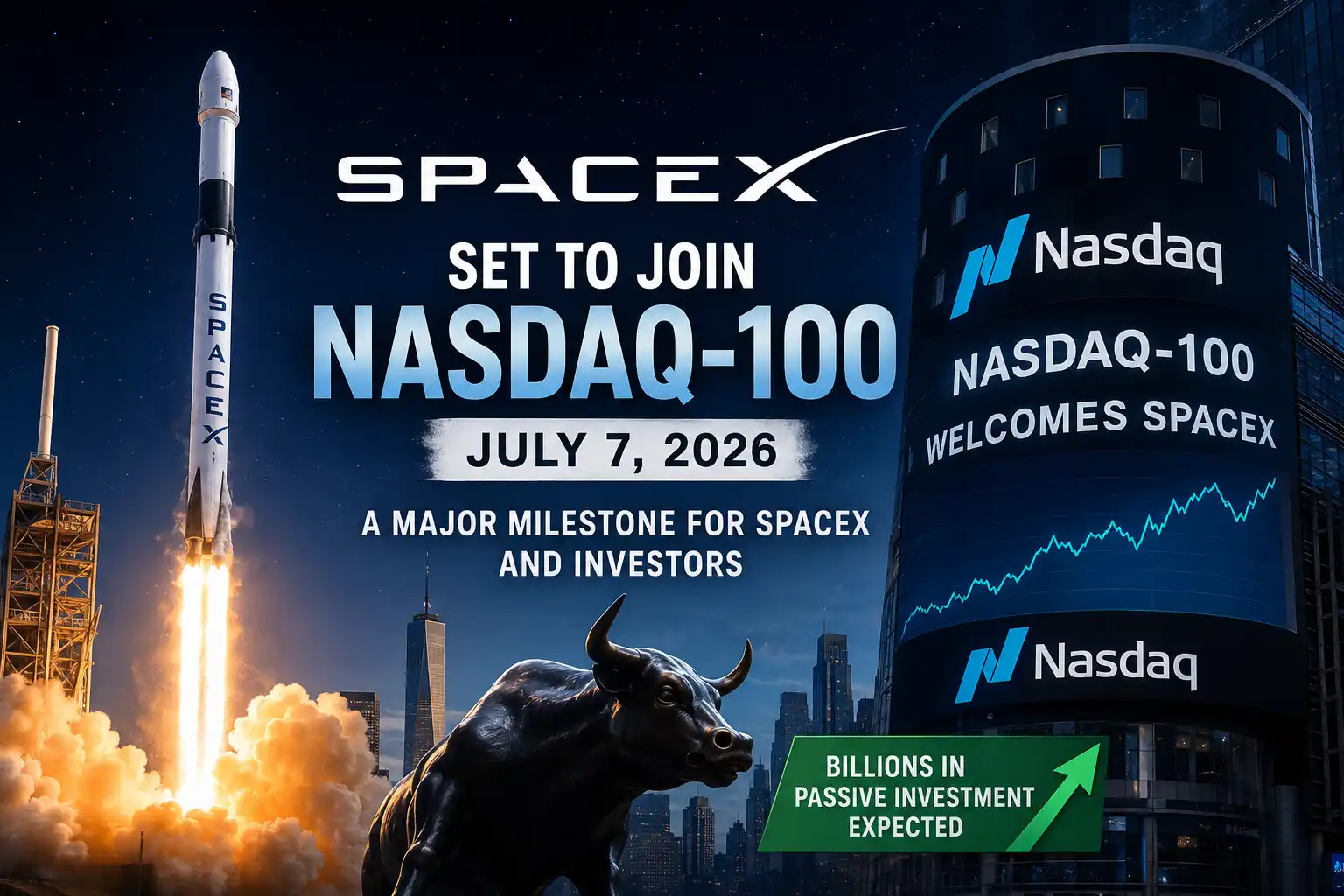
American aerospace and technology company SpaceX is set to achieve another major milestone next week. The company will officially become part of the Nasdaq-100 Index on July 7, 2026. The decision is considered highly significant because the Nasdaq-100 is one of the world’s most widely followed stock market indices, with trillions of dollars managed by ETFs and index funds that track its performance.
Following the announcement, investor sentiment turned positive, and SpaceX shares gained momentum in the market. Analysts believe that the company’s inclusion in the index could further increase demand for its stock, as many passive investment funds will be required to purchase SpaceX shares to match the composition of the Nasdaq-100.
A Major Milestone Shortly After Its IPO
SpaceX only recently made its stock market debut and has already secured a place in the Nasdaq-100, marking one of the fastest inclusions into the prestigious technology index.
Traditionally, newly listed companies were required to trade publicly for a certain period before becoming eligible for inclusion. However, Nasdaq introduced new rules earlier this year that allow large, high-market-cap companies to qualify for a Fast-Track Entry into the index.
Thanks to this policy change, SpaceX has been selected for inclusion much earlier than would have been possible under the previous rules. Market experts believe this change could also benefit future mega technology IPOs.
What Is the Nasdaq-100 and Why Does It Matter?
The Nasdaq-100 tracks the 100 largest non-financial companies listed on the Nasdaq Stock Market. It includes some of the world’s biggest technology leaders, including Apple, Microsoft, NVIDIA, Amazon, Meta, Alphabet, and Tesla.
The index serves as a benchmark for millions of investors worldwide and is followed by numerous pension funds, mutual funds, and exchange-traded funds (ETFs). As a result, becoming part of the Nasdaq-100 significantly enhances a company’s market visibility, credibility, and investor reach.
Billions of Dollars Could Flow Into SpaceX
According to market analysts, the most immediate impact of SpaceX joining the Nasdaq-100 will come from passive investment funds.
ETFs and index funds that replicate the Nasdaq-100 will be required to purchase SpaceX shares to keep their portfolios aligned with the index.
Analysts, including those at JPMorgan, estimate that approximately $4.3 billion in passive investment could flow into SpaceX as a result of the index inclusion. Such large-scale buying is expected to increase trading volumes and strengthen demand for the company’s shares.
Institutional Investor Interest Is Also Expected to Rise
In addition to ETFs, SpaceX’s inclusion in the Nasdaq-100 is likely to attract attention from major asset managers, pension funds, sovereign wealth funds, and other institutional investors.
Many large investment firms prefer allocating capital to companies that are members of major benchmark indices. As a result, SpaceX could gain access to a broader global investor base while improving its overall market liquidity.
Why Did the Stock Move Higher?
Following Nasdaq’s announcement, investors anticipated increased demand for SpaceX shares once index funds begin rebalancing their portfolios. This expectation encouraged buying activity and helped lift the company’s stock price.
However, analysts also note that SpaceX has experienced significant volatility since its IPO. After an initial surge, the stock faced profit-taking and price corrections. Therefore, while index inclusion is a positive development, it should not be viewed as a guarantee of sustained share price gains.
Why Did Nasdaq Change Its Rules?
Over the past few years, several large technology and artificial intelligence companies have entered the public markets. Under the previous eligibility rules, these companies often had to wait a considerable period before qualifying for the Nasdaq-100.
To ensure that the index reflects today’s largest publicly traded technology companies more quickly, Nasdaq revised its inclusion policy by introducing a Fast-Track Entry process for newly listed companies with substantial market capitalizations.
SpaceX has become one of the first and most prominent companies to benefit from this updated policy.
S&P 500 Inclusion Will Have to Wait
Although SpaceX is joining the Nasdaq-100 relatively quickly, the situation is different for the S&P 500 Index.
S&P Dow Jones Indices has not adopted similar rule changes. Consequently, SpaceX must remain publicly listed for approximately 12 months, while also meeting profitability, public float, and other eligibility requirements before it can be considered for inclusion in the S&P 500.
What Does This Mean for the Technology Sector?
Market experts believe Nasdaq’s decision represents more than just a milestone for SpaceX.
If major artificial intelligence and technology companies such as OpenAI, Anthropic, or other future mega IPOs go public, they may also benefit from the Fast-Track Entry rules and qualify for inclusion in the Nasdaq-100 much sooner than under the previous system.
This would allow the index to reflect the evolving technology landscape more rapidly while giving investors earlier exposure to emerging industry leaders.
What Should Investors Keep in Mind?
SpaceX’s inclusion in the Nasdaq-100 is widely viewed as a positive development, but financial experts caution investors against making investment decisions based solely on index membership.
Over the long term, a company’s performance is driven by its revenue growth, profitability, cash flow, competitive position, innovation, valuation, and execution of its business strategy. While joining a major index can improve visibility and attract institutional capital, it does not guarantee strong future returns.
Outcome
SpaceX’s inclusion in the Nasdaq-100 Index on July 7, 2026, marks a significant milestone in the company’s history. The move is expected to increase its global visibility, attract greater participation from institutional investors, and potentially bring billions of dollars in passive investment through index-tracking funds.
At the same time, Nasdaq’s new Fast-Track Entry policy signals a broader shift in how major stock market indices may accommodate large technology and AI companies in the future. Investors will now be watching closely to see whether SpaceX can convert this growing investor interest into sustained business growth and strong financial performance in the years ahead.
Source: Nasdaq news