
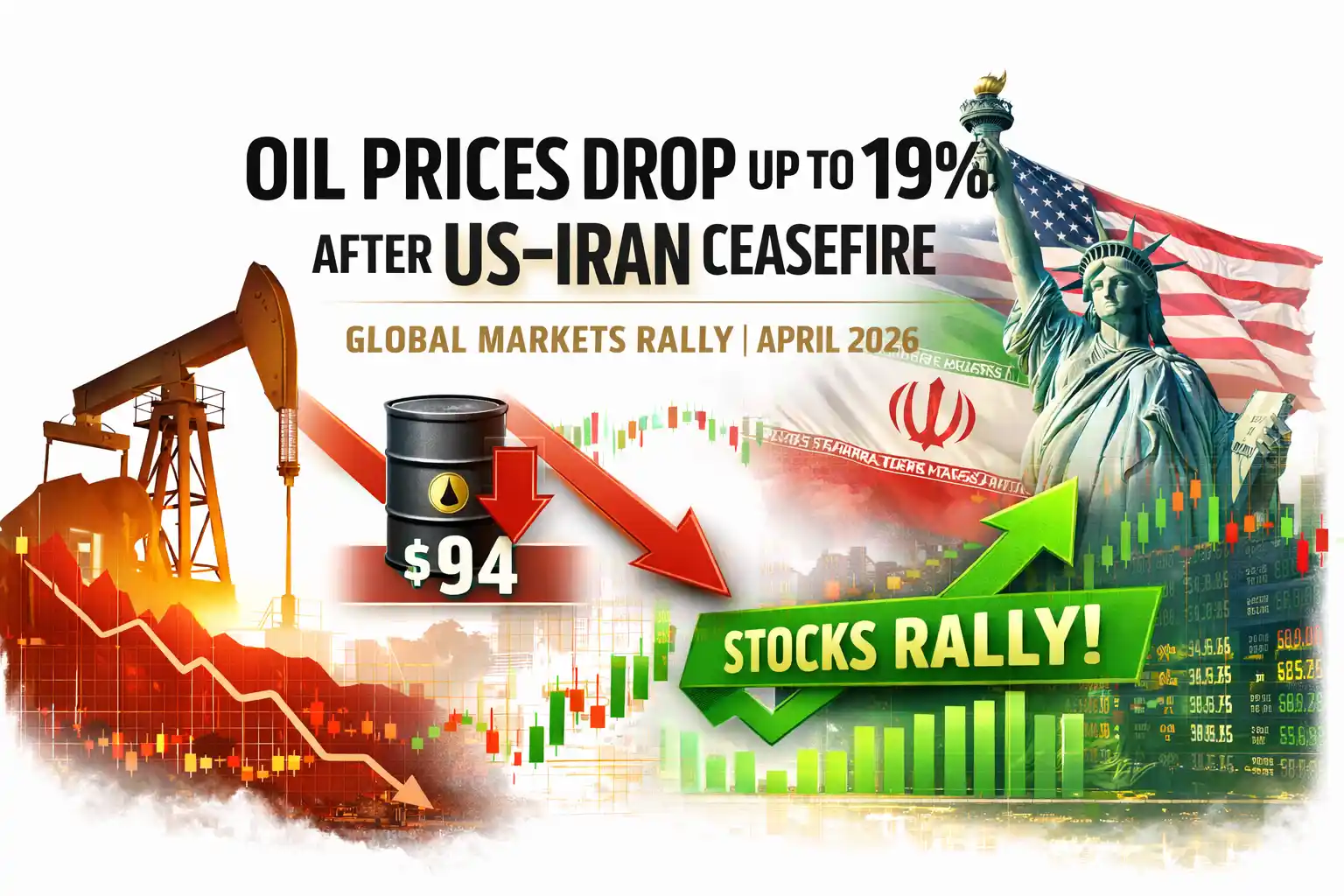
On 8 April 2026, global financial markets witnessed a major shift after news broke of a ceasefire between the United States and Iran.
This single development changed market sentiment across the world. Just a few days earlier, crude oil prices had surged to around $110–$120 per barrel, but after the ceasefire announcement, prices sharply dropped by 15%–19%.
At the same time, global stock markets saw a strong rally.
This event clearly shows how deeply geopolitics is connected to financial markets.
Latest News (8 April 2026)
- A 2-week ceasefire agreement was announced between the US and Iran
- Oil prices dropped sharply ($110 → ~$94)
- Global stock markets witnessed a strong rally
- Asian and Indian markets surged significantly
This fall in oil prices is considered one of the biggest drops in recent years.
Why Did Oil Prices Fall?
1. Supply Concerns Eased
During the conflict, there was a major fear that the Strait of Hormuz could be blocked.
This route handles around 20% of global oil supply
After the ceasefire:
- Supply disruption fears reduced
- Market panic eased
As a result, oil prices fell
2. War Risk Premium Removed
During geopolitical tensions:
- Oil prices include an extra “risk premium”
After the ceasefire:
- This premium disappeared
- Prices dropped
This is known as “risk premium unwind” in markets
3. Profit Booking by Traders
- Many traders had bought oil at higher prices
- After the ceasefire news, they started selling
This accelerated the price decline
Oil Price Movement
- War peak: $110–$120 per barrel
- After ceasefire: ~$94 per barrel
- Decline: around 15%–19%
This was a classic “panic to relief” move
Why Did Stock Markets Rally?
1. Inflation Concerns Reduced
- High oil prices = higher inflation
- Lower oil prices = lower inflation
Investors felt relieved
2. Lower Costs for Companies
Cheaper oil benefits:
- Airlines
- Transport companies
- Manufacturing firms
This improves profit expectations
3. Global Market Performance
- Japan Nikkei: ~5% up
- South Korea: ~7% up
- India Sensex: ~2800 points rally
A strong “risk-on sentiment” was seen globally
Impact on Global Markets
Equity Market
- Major indices surged
- Investors shifted towards risk assets
Currency Market
- US Dollar weakened
- Emerging market currencies strengthened
Gold
- Gold remained stable/slightly strong (safe haven demand continued)
Is the Risk Over?
1. Ceasefire is Temporary
- Agreement is only for 2 weeks
- Future situation remains uncertain
2. Oil Supply Not Fully Normal Yet
- Shipping is not fully restored
- Tanker movement remains cautious
3. Markets Still Volatile
- If tensions rise again
Oil could move back above $110
Expert Analysis
This is a short-term relief, not a long-term solution
Short-Term Impact:
- Oil ↓
- Stocks ↑
- Inflation ↓
Long-Term Risks:
- Geopolitical tensions still high
- Supply chains remain fragile
Markets are likely to stay news-driven
Impact on India
Positive Impact
- India imports ~85% of its oil
- Lower oil prices are beneficial for the economy
Stock Market Impact
- Sensex surged by ~2800 points
- Strong rally in airline and logistics stocks
Reality Check
- Petrol and diesel prices did not fall immediately
- Government pricing policies play a role
Final Conclusion
The US–Iran ceasefire has provided immediate relief to global markets. The sharp drop in oil prices and rally in stock markets clearly highlight how sensitive financial markets are to geopolitical developments.
However, this relief is temporary. Until the Middle East situation becomes fully stable, volatility in oil prices and global markets is likely to continue.
For investors, this is a phase of both opportunity and caution.