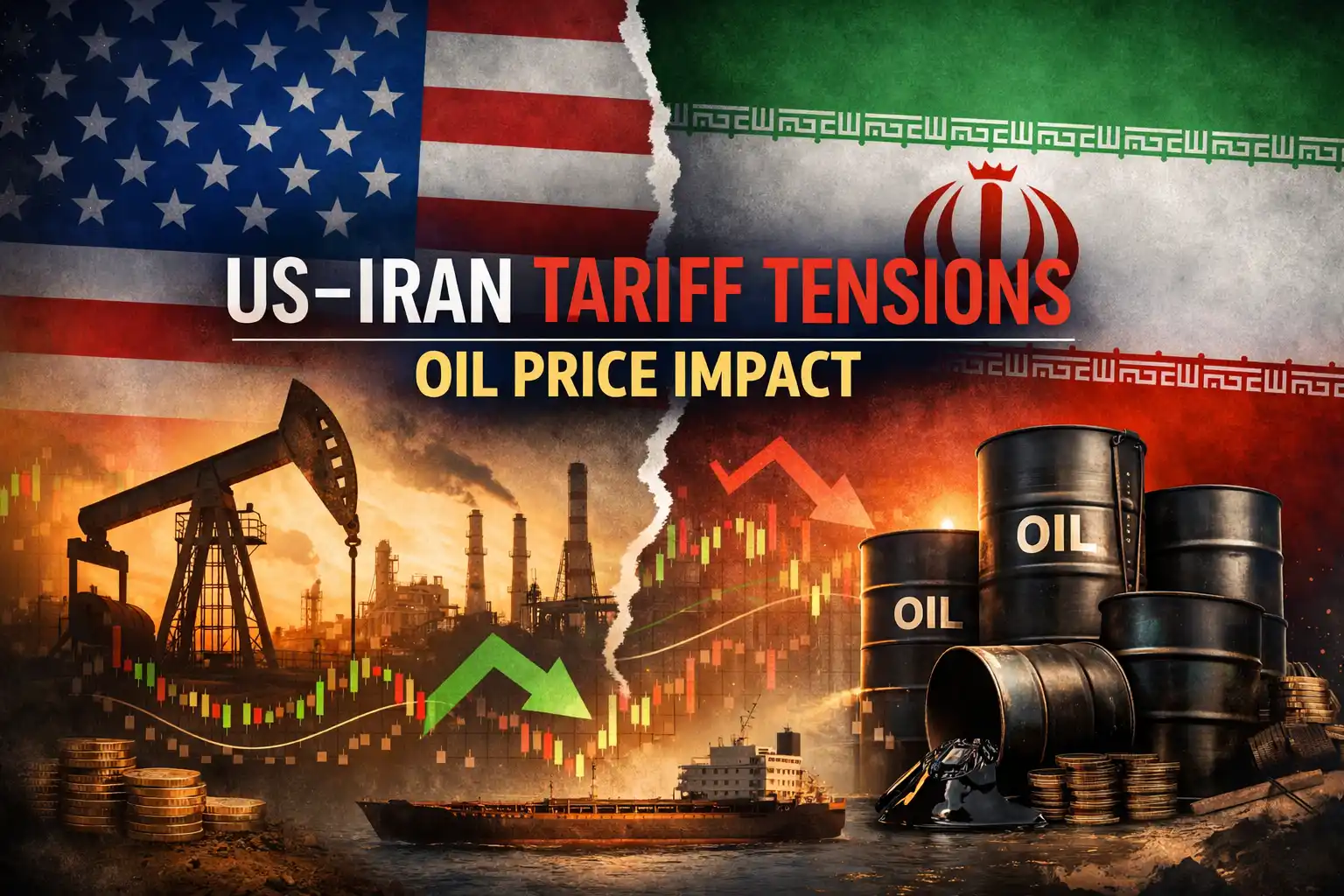
In mid-January 2026, global financial markets witnessed renewed volatility after the United States issued a strong warning related to Iran. The US administration stated that:
“Any country continuing business with Iran could face an additional 25% tariff.”
This single statement was enough to:
- Trigger a sudden rise in crude oil prices
- Increase uncertainty across global markets
- Push investors toward risk-off assets
However, within days, oil prices retreated again, raising an important question:
Why did oil rise sharply at first, and why did it fail to sustain those gains?
This article breaks down the entire development — from geopolitics to oil prices, and from global markets to India’s outlook.
Why Iran Matters in the Global Oil Market
Iran is not just a geopolitical flashpoint; it is a strategically critical energy producer.
Key reasons Iran influences oil prices:
- Iran holds one of the world’s largest proven oil reserves
- It produces millions of barrels of crude oil per day
- It has historically supplied oil to Asian economies
Strategic risk factor:
- Iran controls access near the Strait of Hormuz
- Nearly 20% of the world’s oil trade passes through this route
➡️ Any threat involving Iran immediately raises fears of supply disruption, even if no actual disruption occurs.
⚠️ Understanding the US Tariff Threat: Strategy Over Immediate Action
The US warning was not an instant policy implementation but a strategic pressure tactic.
Core objectives behind the statement:
- Restrict Iran’s oil-related revenue
- Discourage third-party nations from trading with Iran
- Increase diplomatic and economic pressure without military conflict
Critical detail:
- No immediate sanctions or tariffs were formally enacted
- Such measures require legal procedures, timelines, and international coordination
➡️ This distinction later played a key role in calming the markets.
🛢️ Crude Oil Price Movement: A Phase-Wise Breakdown
Phase 1: Before the Warning — A Stable Market
Prior to the US statement:
- Crude oil prices were trading in a narrow range
- Global demand was subdued
- Supply levels were comfortable
Market sentiment at that stage suggested:
“There is limited scope for a sustained oil rally under weak demand conditions.”
Phase 2: After the Warning — Fear-Driven Spike
As the tariff warning gained global attention:
- Traders added geopolitical risk into pricing
- Short-term investors rushed to buy
- Media coverage amplified uncertainty
📈 Result:
- Crude oil prices jumped sharply within a short span
- The rally was rapid but lacked strong volume support
➡️ This type of rise is commonly referred to as a “fear premium”, driven more by emotion than fundamentals.
Phase 3: Reality Check — Prices Cool Down
Within days, markets reassessed the situation:
- No immediate sanctions were announced
- Iranian oil exports continued
- No disruption occurred in shipping routes
📉 Result:
- Profit-booking emerged
- Crude oil prices retreated toward previous levels
➡️ Markets shifted focus from speculation back to fundamentals.
Why Oil Prices Failed to Sustain Gains: Deep Analysis
1️⃣ Tariff Threat vs Actual Supply Disruption
A tariff threat is an economic measure, not a physical supply halt.
In this case:
- Oil production continued
- Shipping routes remained open
➡️ Without a real supply shortage, prices lacked support.
2️⃣ OPEC’s Neutral Stance
- OPEC did not announce production cuts
- No emergency meeting or warning was issued
Had OPEC intervened, oil prices could have stayed elevated.
3️⃣ Weak Global Demand Environment
- Europe’s economy remains sluggish
- China’s recovery is slower than expected
- US demand growth is stable but not strong
➡️ Weak demand limits the ability of oil prices to remain high.
4️⃣ Institutional Investor Behavior
- Large funds used the spike as a selling opportunity
- Hedge funds reduced exposure to risk assets
➡️ This accelerated the price correction.
🌐 Impact on Global Equity Markets
- US and Asian markets saw short-term pressure
- Energy stocks initially gained, then weakened
- Gold and the US dollar experienced mild safe-haven buying
Importantly:
No systemic financial risk emerged from this episode.
🇮🇳 Impact on Indian Markets
Positive aspects for India:
- India’s direct oil trade with Iran is limited
- Oil prices failed to stay elevated
- Domestic demand remains strong
Potential risk scenario:
- Sustained high oil prices could impact inflation
- Rupee and current account balance could face pressure
At present:
India’s macroeconomic position remains stable and manageable.
Outlook: What Should Investors Watch Next?
Crude oil outlook:
- Likely to trade within a defined range
- Sensitive to geopolitical headlines
- A sustained rally requires actual supply disruption
Key triggers to monitor:
- Escalation of US–Iran tensions
- Developments around the Strait of Hormuz
- OPEC policy signals
- Global demand and inflation data
Key Takeaways for Investors
- Do not overreact to geopolitical headlines
- Markets often price fear quickly but correct just as fast
- Long-term investing decisions should rely on fundamentals, not noise
➡️ Successful investors focus on:
- Patience
- Risk management
- Long-term economic trends
Outcome
The US–Iran tariff warning episode clearly demonstrates how markets behave during geopolitical uncertainty:
Markets panic first,
analyze later,
and ultimately return to fundamentals.
While the statement temporarily shook oil prices and sentiment, it lacked the substance to alter long-term market direction.
For investors, the lesson is clear:
short-term volatility is inevitable, but long-term value creation depends on discipline, not headlines.
This analysis is based on publicly available media reports and market data. It reflects market reaction at the time and is subject to change with new developments.