
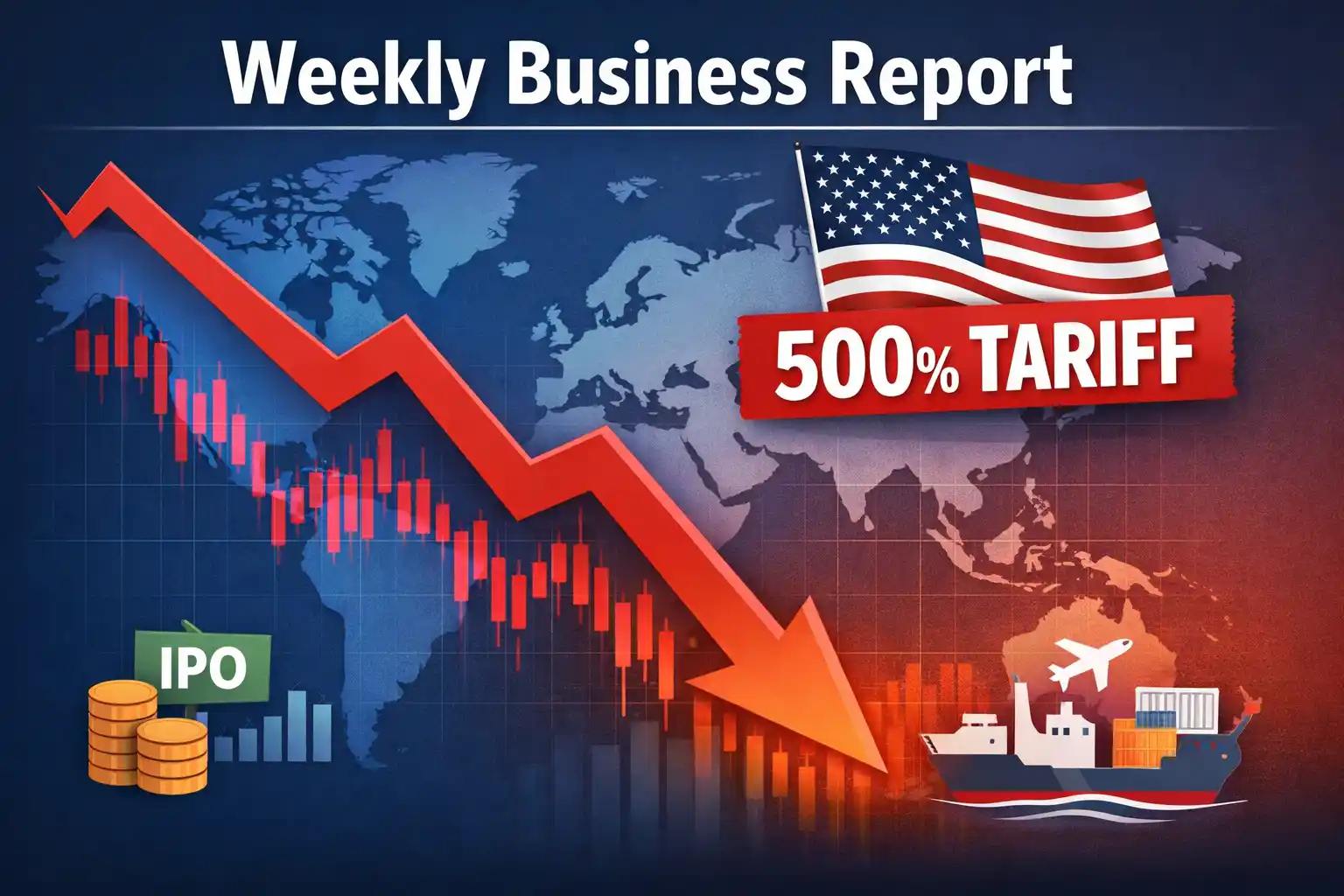
Weekly Global & Indian Business and Market Report (5 Jan 2026 to 9 JAn 2026)
This week was very important for markets and business confidence worldwide.
Stocks did not just fall randomly — it was triggered by policy uncertainty, especially an unexpected proposed 500% tariff threat from the United States, which raised fears about global trade and exports. At the same time, foreign investors reduced their exposure, and domestic markets reacted sharply.
We will explain:
👉 Why markets fell (with real reasons)
👉 What big IPO and policy events happened
👉 Which corporate deals were in focus
👉 How different sectors were affected — all in simple language.
Main Reason Markets Fell — 500% US Tariff Threat
In the first week of January, fresh political and trade policy news hit markets:
• A US bipartisan bill was proposed that could impose tariffs as high as 500% on countries importing Russian oil, including India.
This was not a normal tariff. It was a shock proposal linking energy and trade policy — making export costs for many countries extremely high. (If the tariff is applied, it would raise the cost of exporting certain goods into the US dramatically, pushing buyers away.)
Why It Shook Global Markets
• These proposed tariffs raised fears of a global trade war — worse than before
• Export-dependent sectors (textiles, garments, seafood, engineering goods) were hit hard
• Global investors became scared of supply chain disruption and rising costs
• Markets hate uncertainty — especially policy uncertainty that affects real business profitability
News reports showed that export-oriented stocks slid, while broad market indices (Sensex, Nifty) lost ground due to this trade uncertainty.
How Big an Impact?
• Indian markets logged their steepest weekly drop in months — Sensex and Nifty fell for several days in a row.
• Traders feared that if tariffs hit exports, companies selling garments, textiles, shrimp and other goods to the US could face huge cost increases — making India less competitive than neighbors like Bangladesh.
Business Meaning:
This was policy-driven selling, not weak earnings. It affected projected cash flows of exporters and weighed heavily on sentiment.
How Indian Markets Reacted
Sensex & Nifty Weekly Movement
• Markets opened mixed but quickly turned red as tariff concerns spread.
• Negative sentiment intensified after reports about US Supreme Court tariff rulings and uncertainty.
• Heavy selling from foreign institutional investors (FII) continued to add to pressure.
Impact in simple terms:
📉 Indian stock benchmarks fell the most in weeks, reversing earlier optimism.
📉 Export-oriented stocks saw deeper losses.
📈 Defensive sectors like Energy and IT performed relatively better.
Business View:
FII selling plus policy fear is a double hit — when foreign money exits and buyers turn cautious due to uncertainty, markets drop faster than usual.
Major IPO News
Despite a weak market mood, the IPO pipeline remained active — which shows that long-term business confidence is still there.
Bharat Coking Coal IPO (BCCL)
• BCCL’s IPO opened during this week — it was the first big mainboard IPO of 2026.
• Price band: ₹21–₹23 per share
• The issue size was over ₹1,068 crore.
• Day-1 interest was strong with good subscription and positive GMP signals.
Business Meaning:
Even when markets were nervous, institutional and retail investors showed interest in quality IPOs — indicating belief in future growth.
Upcoming Big IPO Plans
• Reliance Jio Platforms is reportedly planning a 2.5% stake sale IPO worth up to $4.5 billion later in 2026. This could become one of India’s largest IPOs ever.
• SEBI was also set to issue clearance for the NSE IPO (National Stock Exchange) — a major milestone which could boost market structure and liquidity once it happens.
• Other IPOs approved by SEBI this week included companies like Kissht, Alcobrew Distilleries, Aastha Spintex, Indo MIM and Kusumgar, showing a variety of sectors gearing up to raise capital.
Business Takeaway:
Despite short-term selling pressure, the primary market (IPOs) remains strong and investors are still willing to invest in good growth stories.
Major Deals & Corporate Activity
While policy uncertainty dominated headlines, corporate capital markets continued to see important movement:
Debt Market Fundraising:
Torrent Pharmaceuticals planned a ₹12,500 crore debt issue to help fund its acquisition of JB Chemicals — showing debt markets remained active for strategic buyouts.
Diverse IPO approvals signal that companies are positioning for future growth, often a sign of renewed business confidence ahead of economic recovery.
SEBI’s clearance for NSE IPO is a key corporate event — the listing of NSE, one of the world’s biggest derivatives exchanges, will be transformative for India’s financial markets.
Context:
Even when markets fall short-term, corporate asset raising and strategic deals continue because companies look at long-term growth, not daily price moves.
Policy Developments That Influenced Markets
🇺🇸 US Trade Policy (Biggest Factor)
• The possible US tariff of up to 500% on some imports created massive uncertainty — especially for countries dependent on oil imports and exports to the US market.
• Traders feared that it could lead not only to higher costs but also to weaker global trade, hurting export-driven companies.
US Supreme Court Tariff Ruling
Markets were also waiting for clarity on whether a key tariff policy was legal or not — this uncertainty further suppressed risk appetite.
🇮🇳 India Market Policy Movement
SEBI’s decision to move ahead with NSE’s IPO clearance was seen as a positive structural reform.
Business Understanding:
• Policy uncertainty — especially unexpected or dramatic proposals — often affects markets immediately and sharply, even if the actual economic impact might take months.
• Clear policy signals (like SEBI’s approval for a big IPO) give long-term confidence.
Investor Sentiment & Risk Perception
This week showed a clear shift in mood:
✔ Risk appetite fell sharply due to tariff policy fears.
✔ FIIs sold equities to manage risk exposure after big foreign outflows in late 2025.
✔ Domestic investors remained more focused on quality companies and long-term trends.
Sentiment analysis indicates that markets react faster to policy fear than to earnings growth — a common pattern when political risk rises suddenly.
Sector Impact — Who Fell Most and Why
Sectors Most Affected by Tariff Fear:
• Exports & Trade-linked: Textiles, Garments, Shrimp, Seafood
• Commodities & Metals: Slumped as export costs rose
• Banking & Financials: Impacted by FII selling
Sectors That Resisted Downside:
• Energy: Because oil prices stayed firm
• IT/Pharma: Seen as export-resistant
• Utilities & Consumer Staples: Lower volatility
Weekly Summary (Quick)
| Category | This Week’s Trend |
| Main Market Move | Down due to tariff fear & risk aversion |
| Main Trigger | 500% US tariff uncertainty |
| Major IPO | Bharat Coking Coal + strong IPO pipeline |
| Policy Impact | US trade uncertainty + SEBI moving NSE listing |
| Deals / Capital Markets | Debt fundraising + diverse IPO approvals |
| Investor Impact | FII selling, cautious sentiment |
Markets Fell for Real Reasons, But Businesses Are Still Investing
This was not a random market fall — markets fell because of clear policy uncertainty (especially the 500% tariff threat) that affected investor confidence. Export-dependent stocks and global risk assets were hit first, and Indian markets felt the pain because of global linkage and foreign selling.
But at the same time:
✔ The IPO pipeline remained strong
✔ SEBI’s actions signal policy progress
✔ Companies continued to raise debt for expansion
✔ Domestic investors remained geared toward quality
Final Business Insight
Short-term volatility driven by trade policy fear does not mean a long-term economic downturn. Instead, it highlights how political decisions and trade policies can suddenly shape markets — and why businesses must build strategies that withstand both short-term shocks and long-term growth.
Analysis based on last week’s global and Indian market data, policy developments, IPO activity, and business trends.

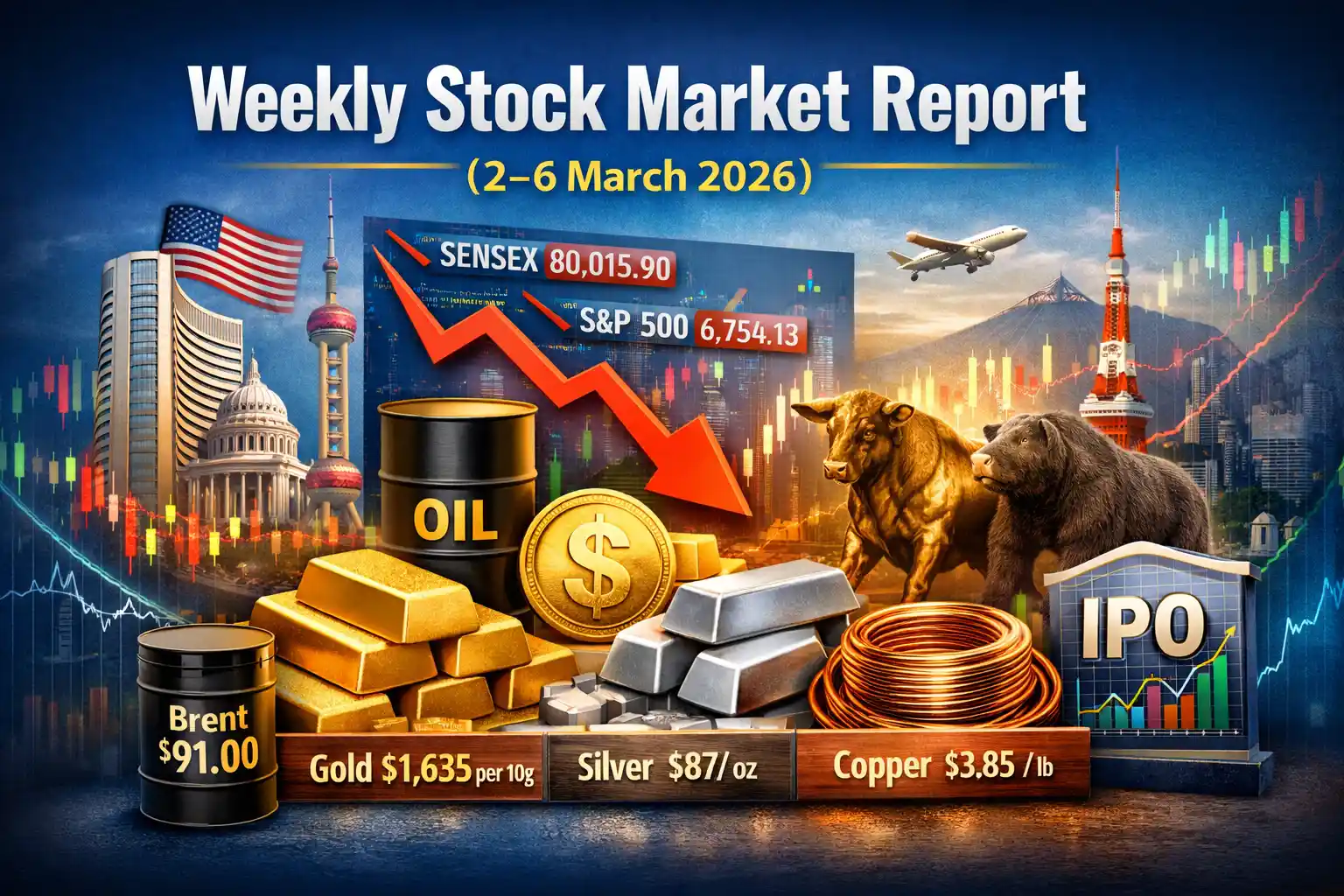
























































)
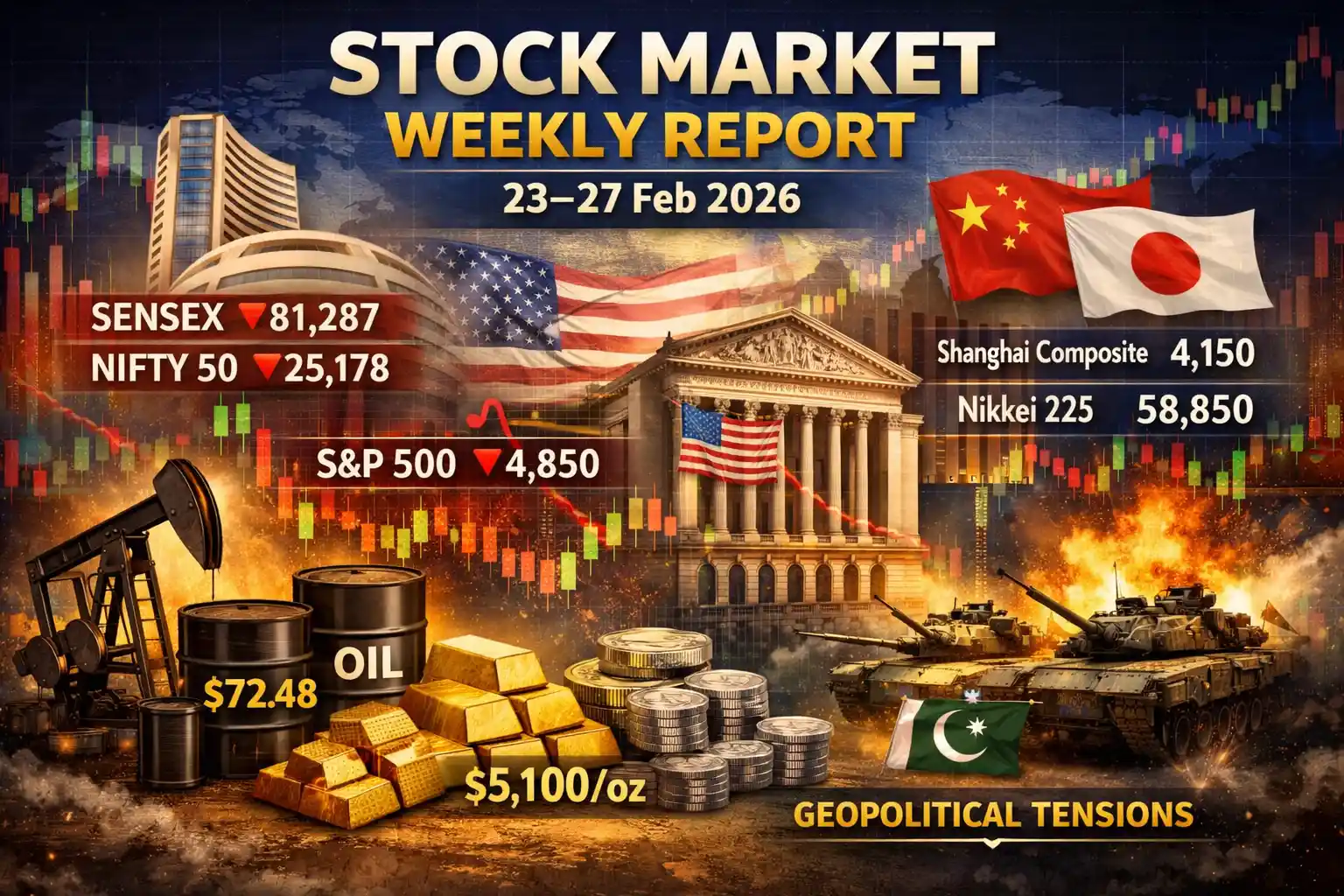
:%20Sensex,%20Nifty,%20Oil%20&%20Gold%20Update)