As the world struggles with climate change, rising fuel prices, and heavy dependence on oil and gas, scientists are turning their attention to an energy source that does not grow on farmland, does not require forests to be cleared, and yet can produce fuel.
This promising solution is microalgae — tiny, plant-like organisms that live in water and use sunlight to generate energy.
Across the globe, researchers are asking an important question:
Can microalgae become a clean, sustainable fuel for the future?
To find the answer, intense research is underway in many countries.
🌱 What Are Microalgae?
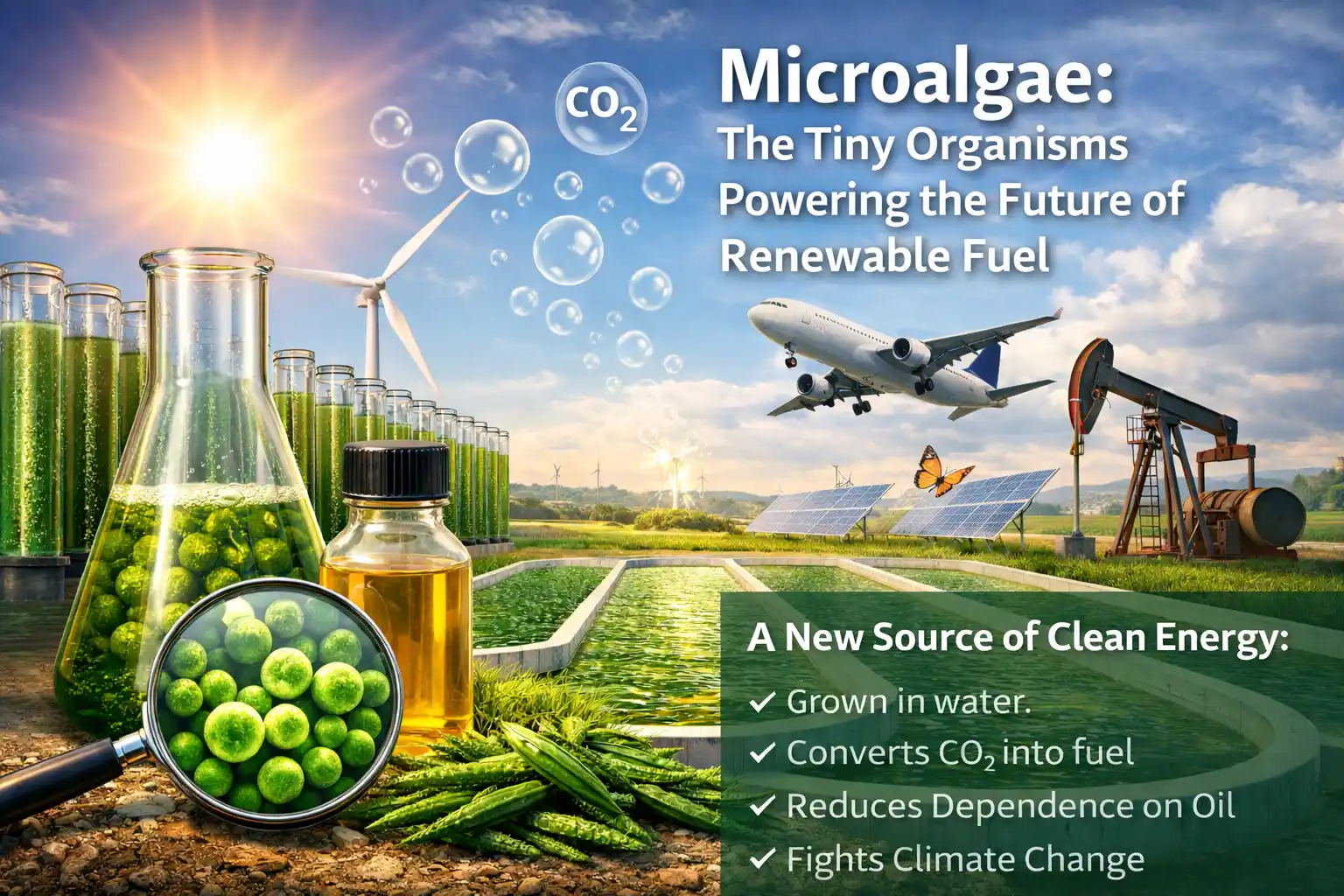
Microalgae are microscopic, plant-like organisms that mostly live in water. Although they are extremely small, their energy potential is very large. These organisms absorb carbon dioxide (CO₂) from the air and, using sunlight, convert it into oil, biomass, and useful organic compounds.
In simple terms, microalgae perform photosynthesis just like trees, but they grow much faster. This rapid growth and high oil content are the main reasons scientists see microalgae as a strong candidate for future renewable energy.
🔬 How Is Renewable Fuel Produced from Microalgae?
Microalgae are grown in open ponds, tanks, or special bioreactors filled with seawater, brackish water, or even wastewater. They do not need fertile land or freshwater. When sunlight and CO₂ are supplied, microalgae grow rapidly and store oil inside their cells.
Once mature, the algae are harvested and their oil is extracted. This oil can then be converted into
- Biodiesel
- Sustainable Aviation Fuel (jet fuel)
- Biogas
The key advantage of this process is that it recycles carbon dioxide, making it far cleaner than fossil fuels.
🧪 Latest Global Research and Scientific Progress
🌍 University of Hawaiʻi Research
Recent research from the University of Hawaiʻi shows that microalgae could play a major role in the renewable energy future. Scientists found that marine microalgae can be genetically optimized to produce more oil in less time.
This research suggests that a single algae farm could generate not only fuel but also valuable by-products such as medicines and nutritional supplements. This multi-use approach can significantly reduce production costs and improve commercial viability.
🇺🇸 Use of Nanotechnology in the United States
In the United States, researchers are using nanotechnology to improve fuel extraction from microalgae. Nanomaterials help break down algae cell walls more efficiently, making oil extraction faster and cheaper.
This development is especially important for large-scale applications such as transportation and aviation, where massive amounts of clean fuel are required. While still in the research phase, early results are considered highly promising.
🇮🇳 Microalgae Research in India
India is also actively researching microalgae-based fuels through IITs and other scientific institutions. Indian researchers are focusing on low-cost cultivation methods and higher fuel yields suitable for local conditions.
For a country like India, this technology is particularly valuable because land availability is limited, fuel imports are expensive, and energy demand is growing rapidly. Successful implementation could greatly support India’s goal of energy independence.
✅ Major Advantages of Microalgae-Based Fuel
✔️ No Agricultural Land Required
Microalgae can be cultivated in seawater, saline water, or wastewater, meaning they do not compete with agriculture for land. This ensures food production remains unaffected while energy production increases.
✔️ Reduces Carbon Emissions
Microalgae absorb CO₂ as they grow, helping reduce greenhouse gases in the atmosphere. When used as fuel, the overall carbon cycle remains much cleaner compared to fossil fuels, making it an effective tool against climate change.
✔️ Extremely Fast Growth Rate
Unlike traditional crops that take months to mature, microalgae can be harvested within days. This rapid growth allows continuous fuel production throughout the year.
✔️ No “Food vs Fuel” Conflict
Many biofuels rely on edible crops, which can increase food prices. Microalgae avoid this issue entirely, as they are not used as staple food crops.
⚠️ Key Challenges and Limitations
Despite strong potential, large-scale production of microalgae fuel is still expensive. Harvesting algae, extracting oil, and maintaining infrastructure remain costly at commercial scale.
Another challenge is scaling up from laboratory success to industrial-level production. While small projects have proven effective, building systems capable of meeting global fuel demand requires further innovation and investment.
What Do the Latest Developments Indicate?
Recent studies and news reports suggest that microalgae are no longer seen as just an experimental idea. They are increasingly viewed as a long-term energy solution, especially for sustainable aviation fuel and net-zero emission strategies.
Many countries are now aligning microalgae research with their climate and renewable energy targets, strengthening confidence in this technology’s future.
The Future Role of Microalgae in Energy
In the coming years, microalgae could
- Supply clean fuel for aviation and heavy transport
- Reduce dependence on oil imports
- Support carbon-neutral energy systems
For coastal and warm-climate countries, microalgae could become a game-changing renewable energy source.
Outcome
Microalgae may be tiny, but their potential is enormous. They can produce fuel using sunlight, water, and carbon dioxide—without damaging farmland or forests. Although challenges remain, the rapid pace of research suggests that microalgae could become a key pillar of the future renewable energy mix.
👉 One day, the fuel powering cars and aircraft may come from organisms that are growing quietly in water today.