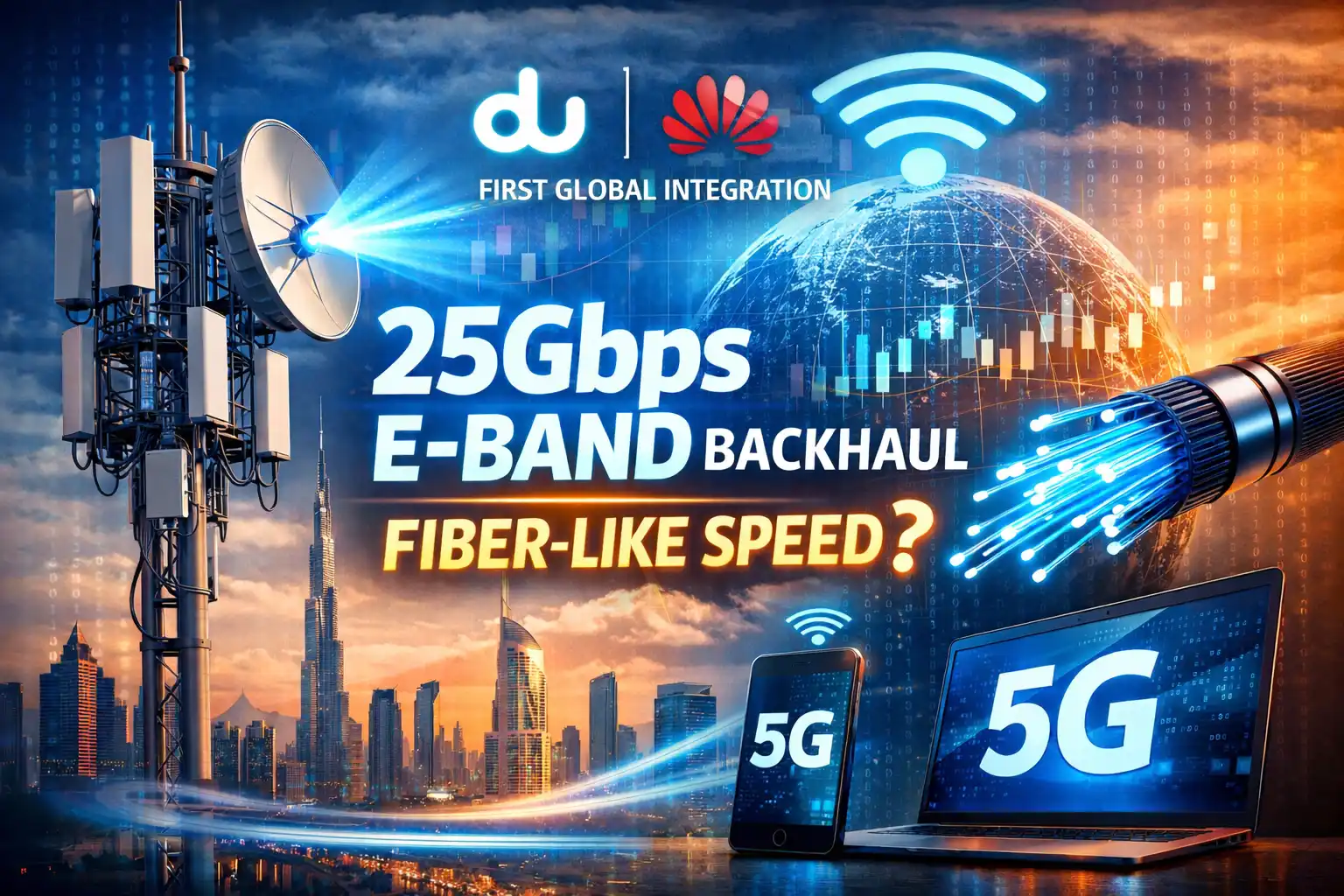
Recently, UAE’s leading telecom operator du and global technology giant Huawei successfully integrated the 25Gbps E-band microwave backhaul technology into their 5G-Advanced (5G-A) network.
This advancement is considered a significant milestone, as it pushes the 5G network’s speed and capacity closer to what fiber networks currently deliver. However, this also raises a crucial question:
Can end-users now experience fiber-like high-speed connectivity on Wi-Fi or mobile internet?
In this article, we explore this question in depth and explain how this technology impacts the user experience, network efficiency, and the future of telecom.
What is 25Gbps E-band Technology?
E-band backhaul is a high-speed wireless microwave link that connects mobile towers to the core network infrastructure.
Key points:
- Frequency Band: E-band (approximately 70–80 GHz)
- Data Capacity: Up to 25Gbps of data transfer
- Design: Developed by Huawei with 2T2R (Dual Transmit Dual Receive) technology and Intelligent Beam Tracking (IBT)
- Purpose: Provides a high-capacity data link between the tower and the main network
Simply put, this technology delivers fiber-like capacity to towers without physically laying fiber, enabling 5G networks to reach their full potential.
Roles of du and Huawei
It’s important to understand the distinct roles of each company:
- Huawei
- Technology Developer: Designs and manufactures the hardware, software, antennas, and backhaul solution.
- du (UAE telecom operator)
- Network Operator: Deploys Huawei’s technology in its 5G-Advanced network to deliver services to users.
In short, Huawei created the technology, and du is applying it to deliver enhanced network experience to its customers.
Does This Technology Deliver Fiber-like Speeds to Wi-Fi or Mobile Users?
There is often confusion about this. Simply:
- No, it does not directly provide fiber-like speeds to end-users.
Why?
- The last mile (mobile or Wi-Fi connection) is limited by:
- Device capability
- Network congestion
- Signal interference
Therefore, the 25Gbps capacity exists within the network backbone, not at the user device.
The Importance of Backhaul
What is Backhaul?
- It is the connection between mobile towers and the core network
- Determines how much data a tower can transmit and receive
The Situation Before:
- Towers without fiber links experienced network congestion and speed bottlenecks
After 25Gbps E-band Deployment:
- Wireless backhaul now provides fiber-like capacity to towers
- Network congestion is minimized even with thousands of connected users
- Result: Full potential of 5G and 5G-A can be realized
Improvements in User Experience
Even though the raw speed may not match fiber, the user experience improves significantly:
- Stable Connectivity: Peak hours no longer cause slowdowns
- High-Definition Streaming: 4K and 8K video play smoothly without buffering
- Online Gaming: Low latency enables lag-free gameplay
- Smart Cities & IoT: Multiple devices can simultaneously utilize high-speed data
- Remote Areas: Faster, more reliable connectivity even where fiber is unavailable
In other words, the speed numbers may not match fiber, but real-world experience approaches fiber-like smoothness.
🆚 Fiber vs 5G-A (E-band Backhaul)
| Fiber Internet | 5G-A + 25Gbps E-band |
| Reaches the home via cables | Reaches the tower via high-capacity wireless link |
| Dedicated speed for each user | Shared network, but high-capacity |
| Extremely stable | High-capacity with low latency |
| Costly and time-consuming to deploy | Flexible and faster deployment |
| Fixed location | Mobile & scalable |
Summary: Fiber provides last-mile speed, whereas E-band backhaul provides tower-level capacity equivalent to fiber.
Why This Technology Matters for the Future
- Essential to fully realize the capabilities of 5G-Advanced
- Lays the foundation for future 6G networks
- Enables fast network deployment in rural and remote areas
- Reduces dependency on fiber installation
- Supports smart city projects and Internet-of-Things (IoT) infrastructure
This technology could transform the quality of mobile internet in the coming years.
💬 Expert Opinions
- Saleem Alblooshi (CTO, du):
“Deploying the world’s first 25Gbps E-band microwave in our 5G-A network is a milestone. It will provide better coverage and high-quality connectivity across the UAE.”
- James Zeng (President, Huawei Microwave Product Line):
“High-capacity E-band backhaul is critical for the future. It allows us to deliver fast, reliable, and scalable network solutions to our customers.”
Outcome
- The 25Gbps E-band technology is not a replacement for fiber
- It delivers fiber-like capacity to the network backbone
- End-users benefit from faster, more stable, and reliable internet experience
- It is a critical step for 5G-Advanced and upcoming 6G networks
While peak speeds on Wi-Fi or mobile may not match fiber, the smoothness, reliability, and capacity of the network will feel fiber-like, making it a game-changer for mobile internet services.
Source: Huawei news
Join our chatroom Bizchat for professional talks and more!