Nowadays, we watch videos, photos, and audio clips every day on platforms like YouTube, Instagram, or WhatsApp. But be honest—can you always trust that the media you see is real?
AI has become so advanced that it can replicate a person’s face and voice perfectly, making them appear to say or do things they never actually did.
This technology, known as deepfake, allows anyone’s face, voice, or expressions to be digitally manipulated without consent, potentially spreading false information, identity misuse, scams, and social confusion.
So the big questions are:
👉 How do we identify media that is fake yet believable?
👉 And once detected, how can we prevent its spread?
This is the focus of Deepfake Detection & Mitigation, one of the most critical areas of technology research today.
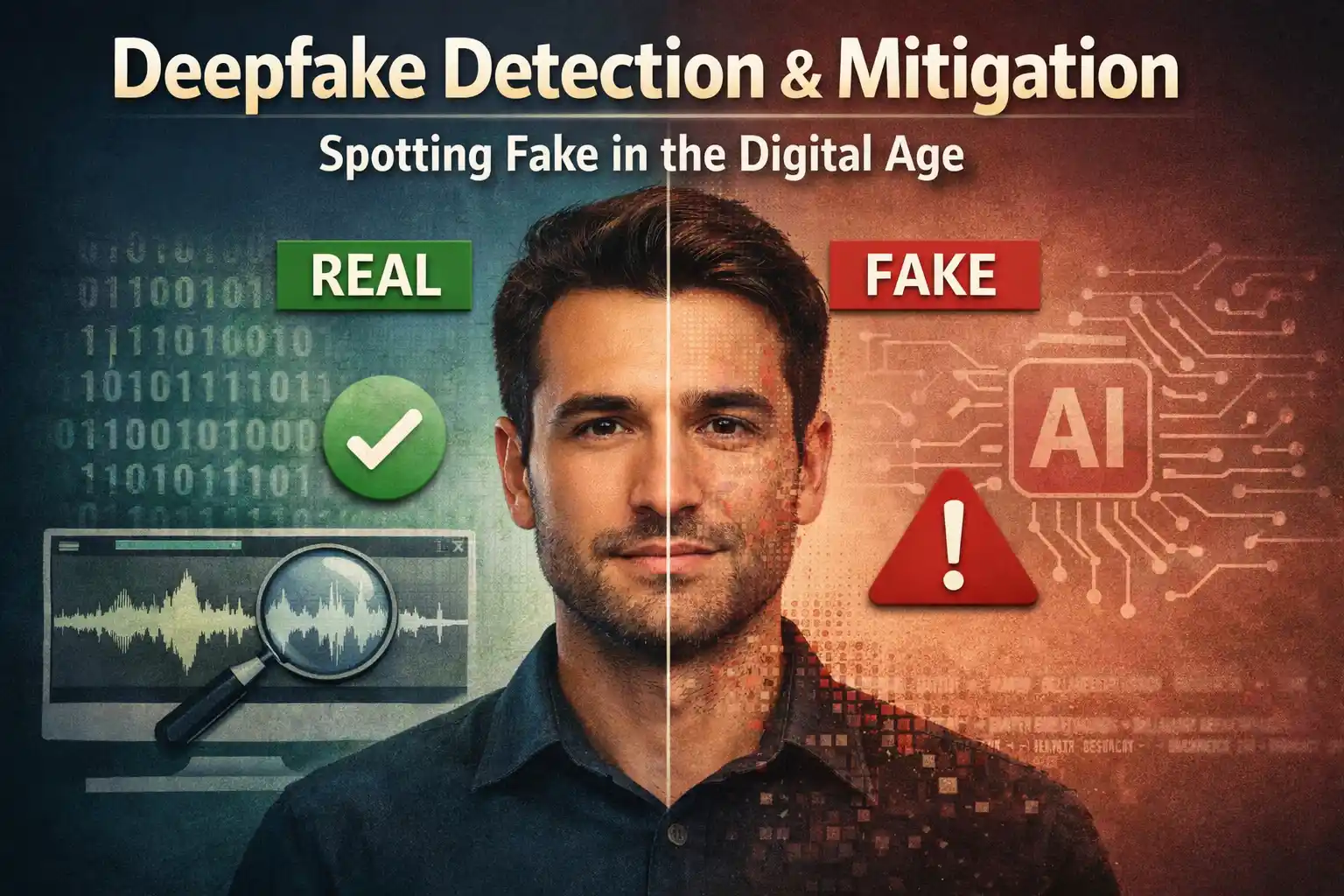
Deepfake Detection and Mitigation
💡 Deepfake Detection = Identifying whether media is real or fake
💡 Mitigation = Once detected, preventing the fake from spreading, removing it, or correcting its impact
Detection is just about recognition;
Mitigation is about reducing the real-world consequences of fake content.
Example:
Imagine a deepfake video of your friend going viral in which they appear to say something offensive.
- The detection system flags it as fake.
- Mitigation measures label the content and prevent further spread, protecting both your friend and the audience.
Why Deepfakes Are Dangerous
Deepfakes aren’t just entertainment—they can have serious real-world consequences:
📌 Financial Fraud:
In one case, an employee transferred $39 million to a fraudster due to a convincing deepfake video call of the CEO.
📌 Political Misinformation:
Fake speeches or videos can manipulate voters during elections.
📌 Identity Theft & Privacy Violations:
Faces or voices can be manipulated to create fraudulent posts, messages, or videos.
This is why detecting and mitigating deepfakes is considered one of the biggest challenges in digital safety.
How Deepfake Detection Works — With Simple Examples
a) Deep Learning Models
AI systems like CNNs, RNNs, and Transformers detect subtle differences between real and fake media by analyzing pixel patterns, facial textures, and motion inconsistencies.
Example:
A deepfake video may show slightly unnatural blinking patterns—AI can spot this anomaly.
b) Multimodal Analysis
This approach examines face, audio, lip-sync, movement, and context together to detect fake media.
It works not only for videos but also for audio deepfakes.
Example:
If lip movements don’t perfectly match the voice, the AI flags it as suspicious.
c) Metadata and Fingerprinting
Every media file has metadata:
- Original camera information
- Timestamps
- Creation patterns
Deepfakes often fail to replicate this metadata accurately, which detection tools can identify.
🔐 Advanced Research Trends in Detection
🛡️ a) Zero-Shot Detection Systems
Researchers are developing AI that can detect unseen deepfakes—even those it hasn’t been trained on.
This is the future of preemptive detection, catching fakes before they go viral.
🧠 b) Explainable AI (XAI)
Some AI systems now explain why they flagged content as fake, not just whether it is fake.
This increases transparency and helps humans understand the reasoning behind detection.
💡 c) Multi-Dataset & Robust Models
Studies show many current detectors fail with real-world deepfakes.
Future systems will be multi-source, context-aware, and signal-integrated for higher accuracy.
Real-Life Scenario — Easy Story
Imagine seeing a celebrity video saying something shocking:
- Your detection app scans it.
- AI notices lip-sync mismatches, unnatural face textures, and odd audio timing.
- App labels it “FAKE VIDEO – VERIFIED BY AI DETECTOR”.
You avoid sharing it further, preventing misinformation spread.
🛡️Mitigation — Stopping the Spread
Detection is only the first step. Mitigation strategies include:
🔹 Watermarking & Verification Tools – Protect content authenticity
🔹 Platform takedowns – Remove fake videos quickly
🔹 Public Awareness Campaigns – Teach people to identify fakes
🔹 Legal & Policy Measures – Enforce penalties for fake content
🔹 Digital Literacy Education – Train users for cyber safety
UN and global tech leaders advocate for digital authentication standards to protect users worldwide.
The Responsibility of Technology
We live in a world where the line between real and fake is increasingly blurred.
AI is transforming life, but it can also threaten privacy, money, trust, and security. Deepfake detection & mitigation isn’t just a tech problem—it’s a mission to protect society, digital trust, and truth.
As experts emphasize, we need smarter algorithms, better tools, and public awareness to build a digital world where reality is safe and verifiable.
Because truth and trust remain our greatest power—and technology is only useful when it safeguards humanity.