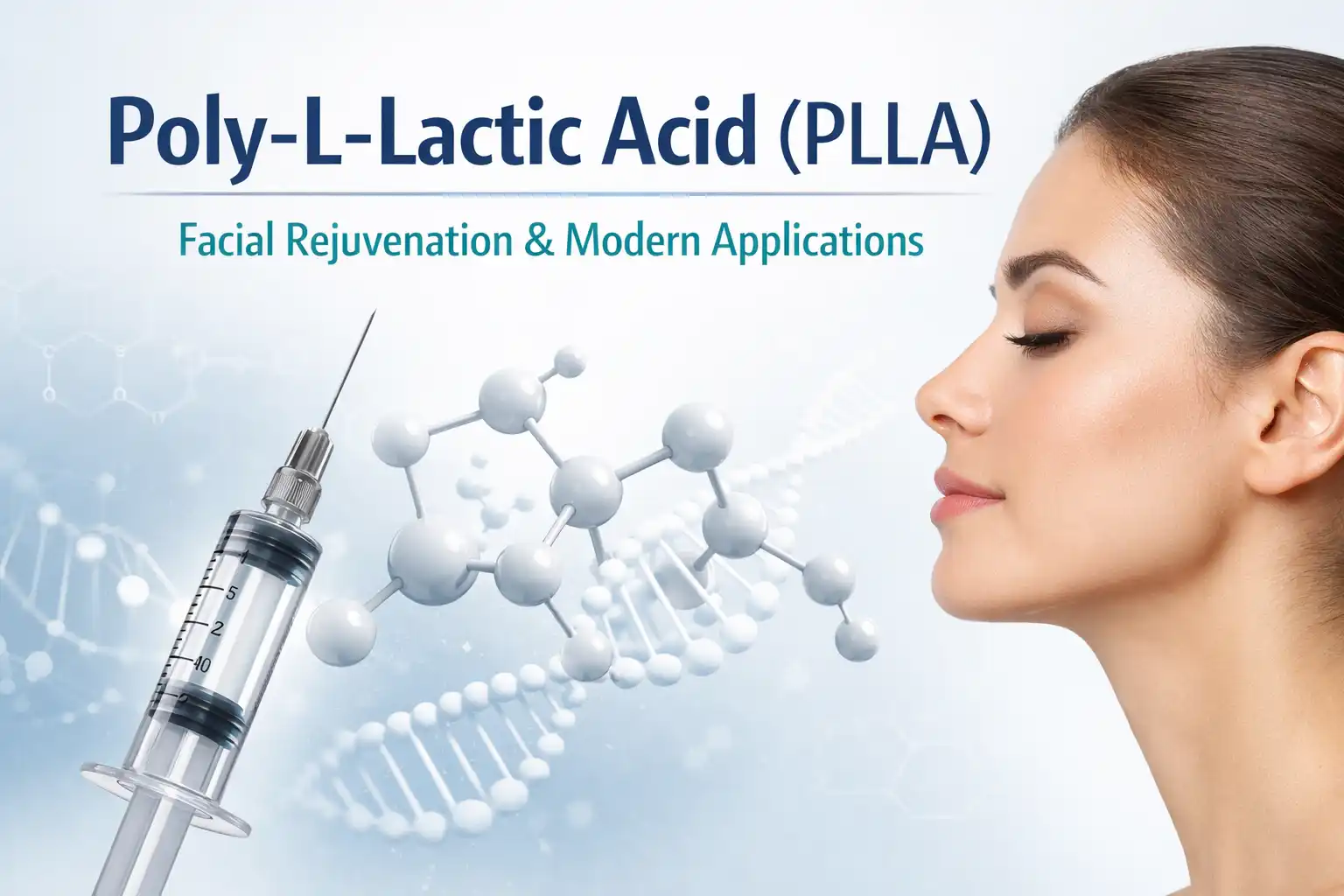
Today, people don’t just seek cosmetic procedures to enhance their appearance—they want natural, gradual, and long-lasting results.
Poly-L-Lactic Acid (PLLA) perfectly meets this demand. It is a biodegradable polymer that gradually stimulates collagen production, improving skin texture, elasticity, and facial volume over time.
PLLA is not only used in facial rejuvenation, but it has also become a key material in biomedical research and advanced technology applications. In this article, we will explain PLLA in detail, covering its history, uses, mechanism, cosmetic and technological applications, and current trends.
What is PLLA?
- Full Form: Poly-L-Lactic Acid
- Definition: PLLA is a synthetic, biodegradable polymer derived from lactic acid.
- Function: Once injected, PLLA stimulates collagen regeneration, gradually restoring volume and firmness in the skin.
- Cosmetic Use: It is widely used as an injectable filler, with Sculptra being the most popular commercial brand.
Explanation: Unlike traditional fillers, PLLA does not provide instant results. Instead, it works with the body’s natural processes, producing long-lasting, natural-looking facial rejuvenation.
History and Origin of PLLA
- 1780: Lactic acid was first discovered by Swedish chemist Carl Scheele.
- 1930–40: Scientists at DuPont developed techniques to polymerize PLA/PLLA, laying the foundation for its commercial and medical applications.
- 1999: PLLA received FDA approval for cosmetic injectable use under the brand Sculptra.
- Present: Today, PLLA is studied extensively for biomedical, tissue engineering, and drug delivery applications.
Explanation: Over the decades, PLLA evolved from a simple polymer to a versatile material with applications beyond cosmetics. Its biodegradable and biocompatible nature makes it highly valuable in medical science.
How Does PLLA Work? (Mechanism of Action)
- Step 1: After injection, PLLA particles are evenly distributed in the skin.
- Step 2: The body recognizes them as foreign material and triggers collagen production.
- Step 3: Gradually, facial volume, skin firmness, and elasticity improve over time.
- Step 4: Peak results are visible in 4–6 months, and effects can last up to 2 years.
Explanation: Unlike hyaluronic acid fillers, PLLA works from within the skin, promoting long-term improvement rather than immediate volume. This makes the results appear natural and progressive.
Applications in Facial Rejuvenation
PLLA is commonly used in the following areas:
- Cheeks and Mid-Face Volume Loss: Restores natural fullness lost due to aging.
- Temples (Hollow Areas): Improves the appearance of sunken temples.
- Jawline Definition: Creates a more defined and youthful jawline.
- Nasolabial Folds: Softens deep smile lines.
- Marionette Lines: Reduces the sagging appearance around the mouth.
Explanation: PLLA works gradually and naturally, making it a popular choice among individuals who want subtle facial improvements without looking overfilled.
Traditional Fillers vs PLLA
| Feature | PLLA | Hyaluronic Acid (HA) |
| Result | Gradual, natural | Immediate |
| Duration | 18–24 months | 6–12 months |
| Action | Collagen stimulation | Volume filling |
| Look | Subtle, progressive | Instant, sometimes exaggerated |
Explanation: While hyaluronic acid fillers give immediate results, PLLA provides gradual and longer-lasting improvements. It is ideal for patients looking for natural, anti-aging results rather than instant volume.
Side Effects and Safety
- Common Side Effects: Redness, swelling, mild bruising.
- Rare Side Effects: Nodules if the injection technique is improper.
- Safety: PLLA is FDA-approved and safe when administered by a trained professional.
Explanation: Most side effects are temporary and minor. Proper technique and patient selection are crucial to ensure safety and effective results.
New Applications and Modern Relevance
- PLLA is no longer just a cosmetic filler—it has become a key biopolymer in medical and technological research.
- Biomedical Applications: Tissue engineering, wound healing, drug delivery systems, and 3D-printed medical implants.
- Research Innovations: New formulations include PLLA combined with stem cells, PRP, or hyaluronic acid to enhance results.
- Modern Relevance: PLLA bridges cosmetic and technology applications, making it a future-ready biomaterial.
Explanation: The dual relevance of PLLA in cosmetics and biomedical technology is why it continues to appear in scientific and technology publications, even decades after its initial cosmetic use.
Who Developed PLLA and Where?
- Scientific Development: Researchers in the USA and Europe (notably DuPont) first developed PLLA.
- Commercial Production:
- NatureWorks (USA) – Ingeo PLA/PLLA
- Total Corbion PLA (Netherlands/Thailand)
- BASF (Germany)
- Medical Use: Sculptra by Dermik Laboratories / Sanofi-Aventis
Explanation: PLLA’s development was a combined effort of polymer science research and commercial scaling, which allowed it to enter both medical and cosmetic markets worldwide.
Trends and Popularity
- PLLA is popular among individuals aged 30+ who want natural, long-lasting facial rejuvenation.
- Its popularity is increasing due to social media exposure and widespread use in aesthetic clinics.
- In the technology and biomedical sector, PLLA continues to be relevant due to ongoing research in tissue scaffolds and drug delivery.
Explanation: PLLA is both an established cosmetic solution and a cutting-edge biomaterial, bridging aesthetics and scientific innovation.
Outcome
Poly-L-Lactic Acid (PLLA) is a unique solution for facial rejuvenation and modern biomedical applications.
- In cosmetics, it offers gradual, natural, and long-lasting results.
- In research and technology, it is an important biomaterial for tissue engineering, drug delivery, and medical innovation.
PLLA is perfect for those seeking subtle, safe, and enduring facial enhancement, while also serving as a future-ready material for biomedical applications.