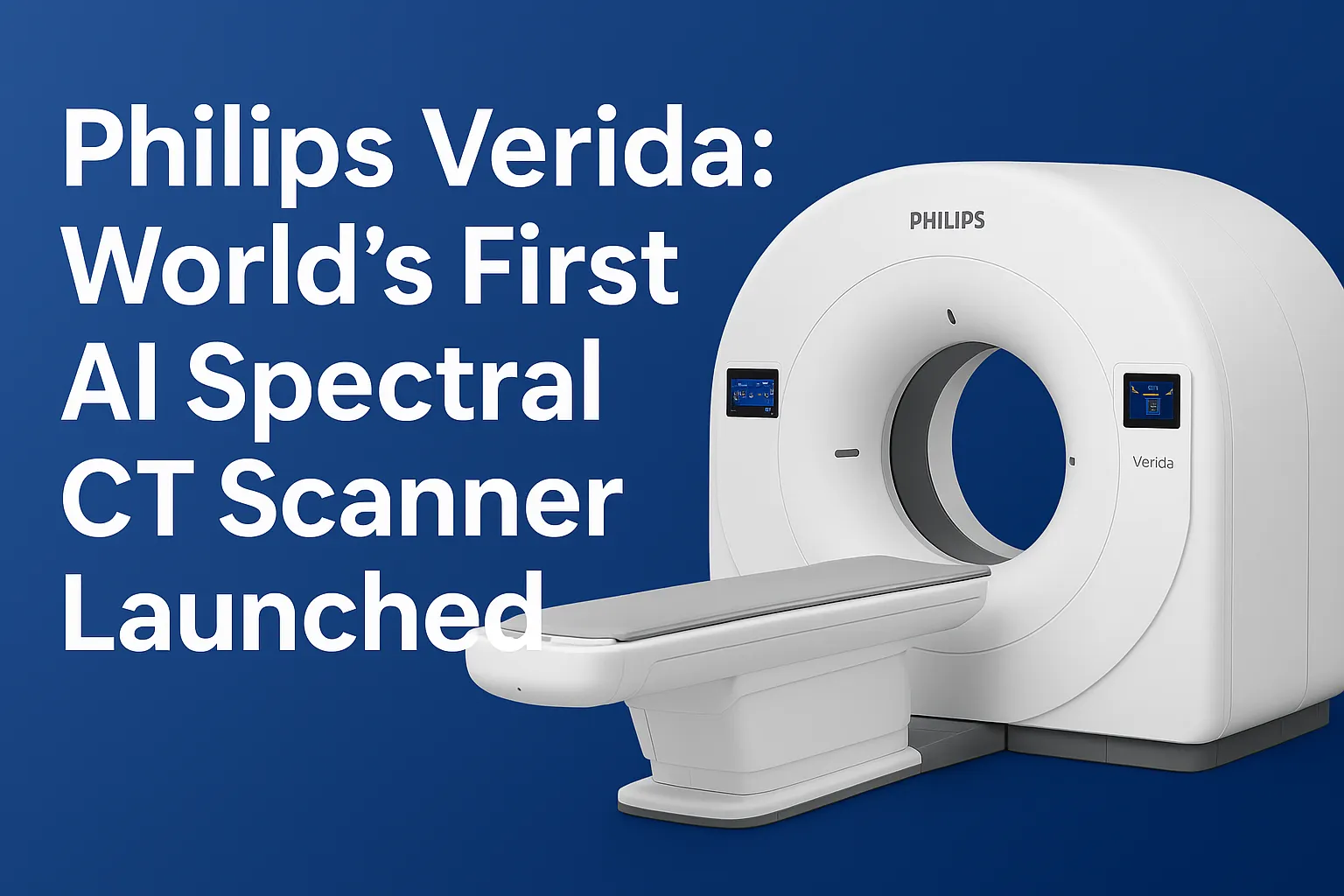
Philips has announced a major breakthrough in medical imaging with the launch of Verida, the world’s first AI-powered detector-based spectral CT scanner. According to the company, this next-generation system is designed to deliver faster, more accurate, and lower-dose diagnostic imaging, setting a new benchmark for CT technology.
Verida will roll out in select global markets by the end of the year, while its U.S. launch remains dependent on regulatory clearance.
What Is Verida? — A New Era of CT Imaging
Philips Verida is a spectral CT system built on the company’s dual-layer detector technology. Unlike conventional CT scanners, which capture only one energy level, Verida collects multiple energy levels in a single scan. This allows doctors to differentiate between various tissues and materials with much greater precision.
The biggest leap: AI is integrated across the entire imaging process — from scanning to image reconstruction — enabling faster and clearer diagnostic results.
Key Features of Verida
1. AI-Enhanced, Ultra-Clear Images
Advanced AI algorithms reduce image noise and enhance clarity, helping radiologists detect even the smallest abnormalities with more confidence.
2. One Scan, Multiple Spectral Insights
Spectral CT technology enables a single scan to produce a wide range of diagnostic data, reducing the need for repeat scans.
3. Reduced Radiation Dose
Philips claims Verida can lower radiation exposure for patients, though actual reduction depends on patient size and the specific clinical task.
4. Up to 45% Lower Energy Consumption
The system is engineered to consume significantly less power, making it a cost-effective and environmentally friendly option for hospitals.
5. Extremely Fast Workflow
- Up to 145 images per second
- Complete image set ready in under 30 seconds
- Up to 270 scans per day, according to Philips
This level of speed is especially valuable for busy hospitals and emergency settings.
Why Verida Matters — Impact on Healthcare
• More Accurate Diagnosis
Spectral imaging helps clinicians identify tissue differences that conventional CT scans cannot show, improving diagnostic accuracy in fields like oncology, neurology, and orthopedics.
• Game-Changer for Cardiac Imaging
Philips states that Verida offers deeper insights for cardiac CT, potentially reducing the need for invasive angiograms in many cases.
• Higher Productivity for Hospitals
Faster scans, lower energy use, and clearer images translate into:
- Shorter patient waiting times
- Better resource utilization
- Lower operational costs
Availability & Regulatory Status
- CE-marked for use in Europe
- 510(k) pending for the United States
- Global availability expected to expand through 2026
Expert View: Could Verida Transform the CT Market?
Industry experts believe Verida could redefine CT imaging if its real-world performance matches Philips’ claims. Its unique combination of spectral imaging + AI + high-speed processing does not currently exist in any other CT system.
If widely adopted, Verida could become the new standard for diagnostic imaging worldwide.
Outcome
Philips Verida is more than just another CT scanner — it represents a significant leap forward in medical imaging. With its AI-driven clarity, spectral precision, lower radiation, and incredible speed, Verida has the potential to reshape how hospitals diagnose and treat patients.
The coming year will reveal how quickly healthcare providers adopt this next-generation technology.
Source: Philips News