
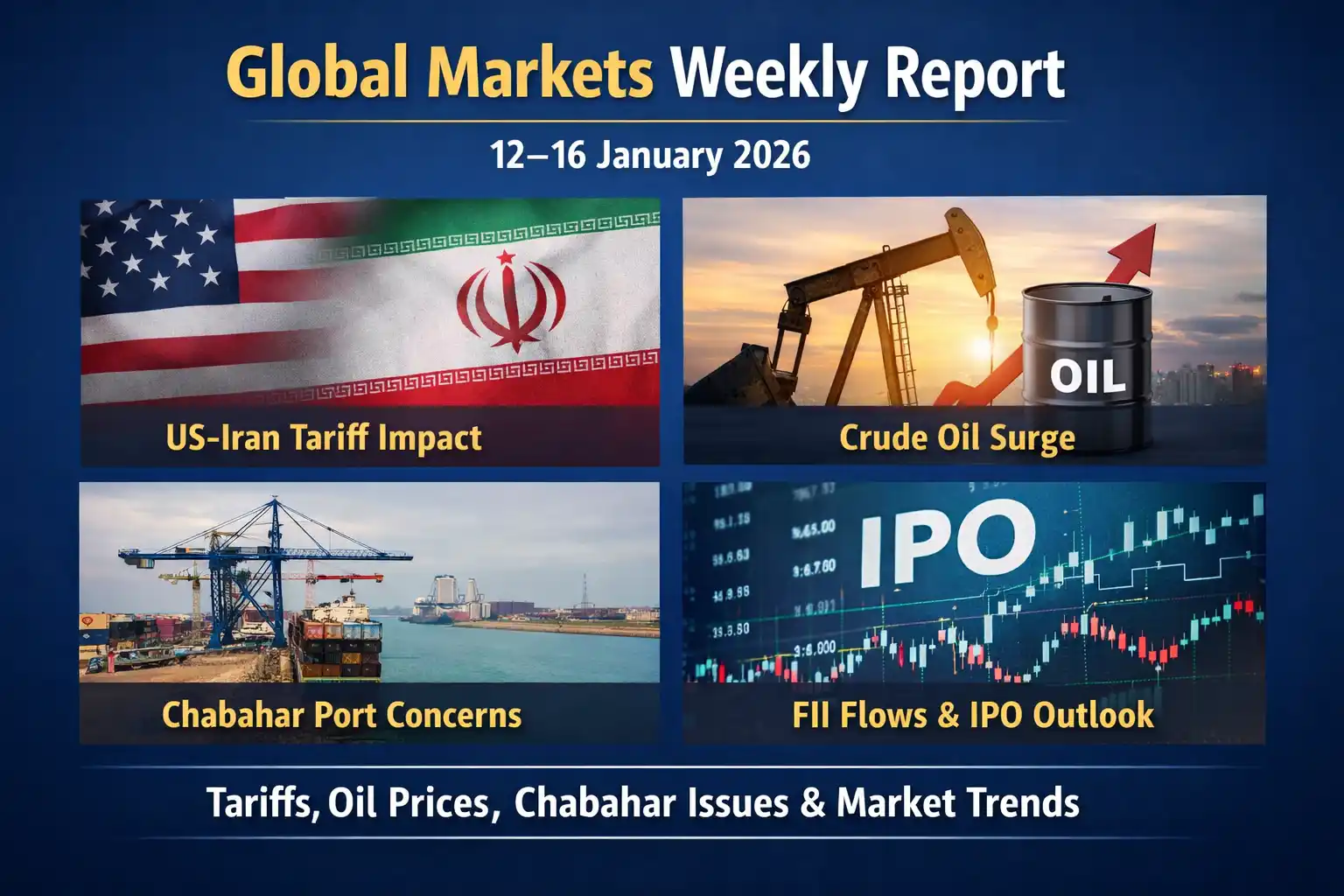
(12 Jan 2026 to 16 Jan 2026)
With Data & Real Market Drivers (Tariffs, FPI/DII Flows, Crude Oil, Exports, IPO Pipeline)
The week of 12–16 January 2026 was shaped more by policy uncertainty, capital outflows, and commodity volatility than by corporate earnings or economic fundamentals.
Instead of simply describing events, this report explains how data and policy actions moved markets, including:
- The impact of US tariff policy against trade with Iran
- Foreign investor (FII) selling and domestic (DII) support
- Crude oil price swings driven by geopolitical risk
- Export activity real effects
- IPO pipeline developments for the coming week
Let’s break it down with real data and analysis.
Tariff Policy Shock — US Imposes 25% Tariffs on Iran Trade Partners
📊 What the US Announced
On 12 January 2026, the US government declared that any country doing business with Iran will face a 25 % tariff on trade with the United States.
This policy:
- Targets countries trading with Iran
- Marks an expansion of US economic pressure beyond Tehran itself
- Affects countries including India, China, UAE, and Turkey that had active trade with Iran.
📊 Why 25% Matters
A 25 % tariff means a one-quarter additional tax on goods — higher than many normal trade tariffs. For exporters:
- The margin becomes thinner
- US importers may look for cheaper sources
- Global trade flows can be disrupted
This isn’t just a headline — it directly affects revenue and competitiveness in exports. Markets reacted because:
- Exporters’ profit forecasts changed
- Investors repriced risk in equities and currencies
📌 Export Impact: India–Iran Trade Blocked
India’s exports to Iran — especially basmati rice and pharmaceuticals — nearly stalled this week due to:
- Rising protests and economic turmoil in Iran
- Exporters’ fear of new 25 % tariffs
- Worries over payment default risks in Iran’s deteriorating economy
Indian rice exports to Iran have historically been significant, but exports fell sharply from $3.51 billion in 2018–19 to $1.24 billion in 2024–25.
In simple terms: Tariff policy uncertainty directly hit export demand because buyers became reluctant to commit purchases that could suddenly face higher duties.
Market Reaction — India’s Stocks Felt Global Policy Risk
📉 Index Performance (With Data)
Indian equity benchmarks fell decisively early in the week:
- Sensex dropped about 2.54 % over five sessions
- Nifty 50 fell around 2.45 % for the week
This was the worst week in terms of consecutive declines in months — markets reacted to tariff-related fears and continued selling.
📊 Sector Impact
Export-linked stocks (textiles, agriculture, engineering) struggled as tariff risk hit sales expectations.
Small and mid-cap stocks also showed deeper corrections, partly due to risk-off behavior.
FII and DII Flows — Capital Movement Data
📉 Foreign Portfolio Investors (FPI / FII)
Foreign investors were net sellers in Indian equities, a trend that continued into January 2026:
- ₹22,530 crore (~$2.5 billion) was withdrawn by FPIs from Indian equities between 1 and 16 January 2026.
This followed a massive outflow of ₹1.66 lakh crore (~$18.9 billion) in 2025. - In the first two trading sessions of January, FPIs alone offloaded about ₹7,608 crore of Indian stocks.
📈 Domestic Institutional Investors (DIIs)
At the same time, DIIs provided strong support by buying around ₹34,000 crore of equities.
Business Interpretation:
- FPIs were reducing exposure due to global risk, stronger US dollar, rising bond yields, and trade policy uncertainty.
- DIIs acted as stabilizers, showing confidence in India’s long-term fundamentals.
Market Effect:
FII selling created downward pressure on indices, but DII buying helped prevent sharper falls, leading to a consolidation rather than collapse in markets.
Crude Oil Price Movement — Volatility with Data
🔺 Early-Week Increase
Oil prices rose early in the week due to geopolitical risk tied to US–Iran tensions.
Brent crude climbed as high as $66.82 per barrel amid fears of supply disruption.
This was largely driven by:
- Fears of potential conflict or sanctions disrupting oil flows
- Iran’s control over the Strait of Hormuz — a key shipping route
- General risk demand for energy assets amid policy fear
🔻 Later-Week Drop
By the end of the week, prices corrected for key reasons:
- Fears of immediate US military action eased
- Diplomatic talks gained traction
- US crude inventories rose (~3.4 million barrels, higher than expected) — implying less tight supply.
Brent crude fell more than 4 % from the week’s highs by 15 January.
Impact on Indian Economy
India is a large crude importer:
- Even small percentage moves in global oil prices translate into billions of rupees of import costs.
- Higher crude prices push transportation costs, inflation, and trade deficits.
This is why oil price movements were a key market risk factor during the week.
Export Impact — Real Effects on Trade
Rice and pharmaceutical exporters were specifically affected:
- Rice exports to Iran nearly stopped due to tariff uncertainty and payment risk fears.
- Many exporters refused to finalize deals until payment assurances and tariff clarity are available.
Business Reality:
This wasn’t just sentiment — exporters lost real sales and order flows, especially to one of India’s historically major buyers.
Sector Performance — Who Gained and Who Lost
📉 Sectors Under Pressure
- Export-oriented industries: tariff risks impacted expected revenues.
- Small & mid caps: risk sell-off, higher beta assets sold first.
- Consumer durables & autos: cautious sentiment.
📈 Resilient or Defensive Sectors
- PSU banks & select financials: domestic investment support.
- Healthcare & staples: safe bets amid uncertainty.
- Energy stocks: mixed due to oil volatility support.
The sector pattern showed risk awareness rather than broad panic.
IPO Pipeline — What’s Next (19–23 January 2026)
Despite volatile markets, IPO activity remained strong and companies are preparing to raise capital.
📌 Confirmed / Expected IPOs Next Week
- Shadowfax Technologies IPO — significant mainboard issue
- Aritas Vinyl (SME)
- KRM Ayurveda (SME)
- Digilogic Systems (SME)
- Armour Security India — SME issue
In addition:
- BCCL (Bharat Coking Coal) IPO allotment and listing expected with strong grey market premium signals.
This shows corporate confidence in long-term capital raising even when markets are cautious.
Key Business Takeaways & Risks
📍 Major Drivers This Week
- US tariff policy (25 % tariff on trading with Iran) influenced risk pricing.
- FPI selling persisted — ₹22,530 cr outflows in first half of January.
- Crude prices were volatile, rising and then falling over 4 %.
- Real export slowdown occurred due to policy and payment concerns.
📍 Risks Ahead to Monitor
- Further tariff or trade policy developments
- Oil price breakout or supply shocks
- Foreign investment flow reversal or continuation
- Upcoming Union Budget data and trade negotiations
Data-Driven Market Reality
The week of 12–16 January 2026 was dominated by policy uncertainty and capital adjustments, not by economic fundamentals.
Short-term market moves were driven by:
- Actual tariff announcements (25 % on countries trading with Iran)
- Verified FII outflows (₹22,530 cr this month)
- Oil price swings (>4 % move)
- Export disruption data (India’s rice exports stalling)
But long-term expectations remained intact:
- Domestic investors provided stability
- IPOs are scheduled despite caution
- Companies continued strategic planning
Business Insight:
Markets move fast on policy fear and capital movements, but real business fundamentals (investment, exports, deals, earnings) evolve slowly. This week highlighted that difference sharply.
Analysis based on media reports and available market data.




























































)
:%20Sensex,%20Nifty,%20Oil%20&%20Gold%20Update)