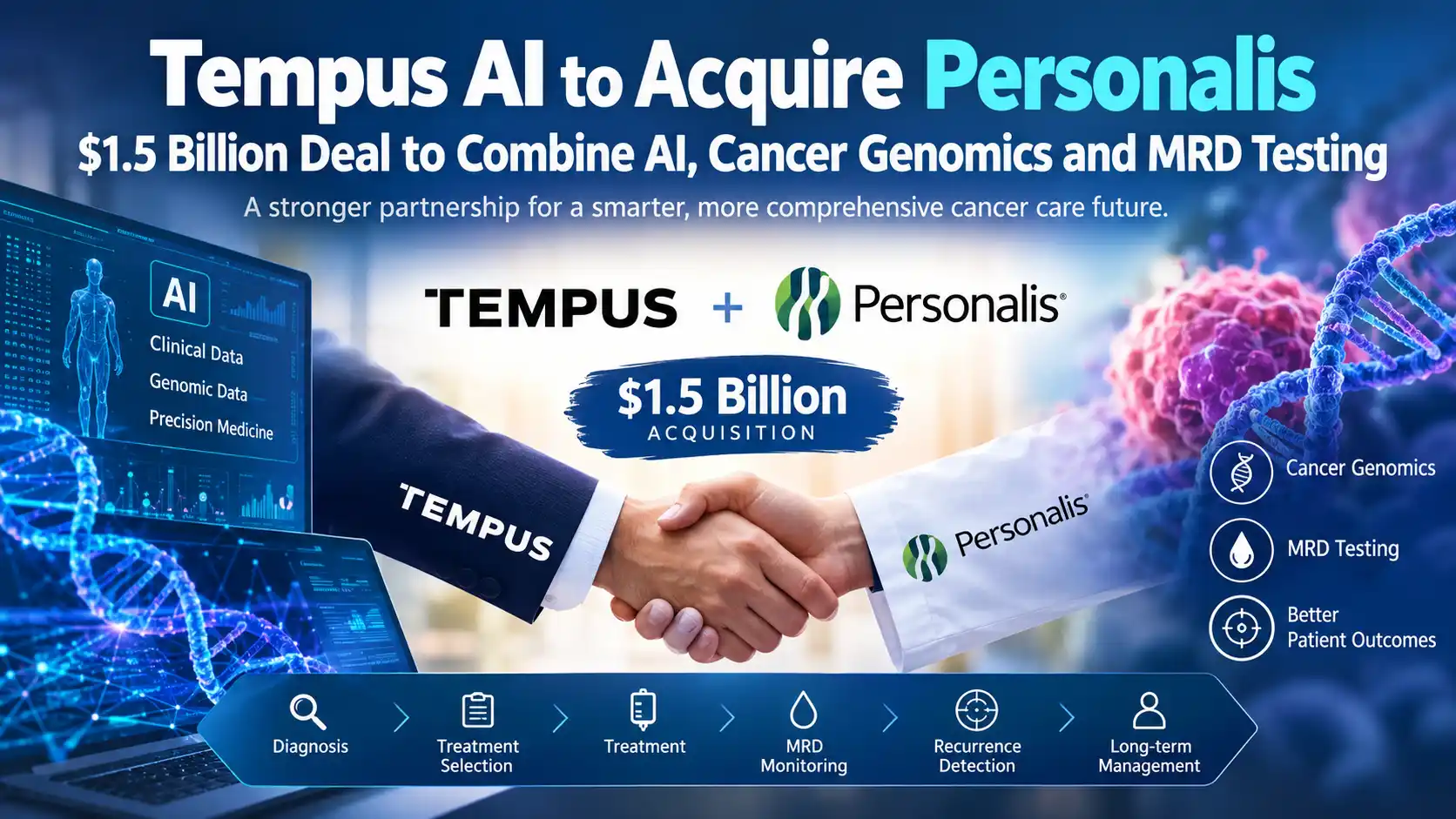
Tempus AI has agreed to acquire Personalis in a transaction valued at approximately $1.5 billion, net of Tempus AI’s existing ownership in the company. The deal was announced on July 20, 2026, and is designed to bring Personalis’ advanced cancer genomics and Minimal Residual Disease (MRD) testing capabilities more closely into Tempus AI’s artificial intelligence and precision medicine platform.
Under the agreement, Personalis shareholders will receive $16.25 per share. The offer represented approximately a 6% premium to Personalis’ July 18, 2026 closing price and about a 28% premium to its unaffected 30-day volume-weighted average price.
The transaction is structured primarily as a stock deal, although Tempus has the option to use cash for up to 50% of the consideration.
Deal Snapshot
| Deal Detail | Information |
| Acquirer | Tempus AI, Inc. |
| Target | Personalis, Inc. |
| Announcement Date | July 20, 2026 |
| Deal Value | Approximately $1.5 billion |
| Offer Price | $16.25 per Personalis share |
| Deal Type | Acquisition / Merger |
| Consideration | Primarily Tempus stock; up to 50% cash at Tempus’ option |
| Acquirer Ticker | NASDAQ: TEM |
| Target Ticker | NASDAQ: PSNL |
| Industry | Healthcare Technology / Genomics / Precision Medicine |
| Key Technology | AI, genomic data and MRD testing |
| Expected Closing | Late 2026 or early 2027 |
| Current Status | Pending shareholder and regulatory approvals |
What Does Tempus AI Do?
Tempus AI is a healthcare technology company focused on using artificial intelligence, clinical data and genomic information to advance precision medicine.
In simple terms, Tempus aims to help doctors and healthcare researchers make more data-driven decisions by combining different types of medical and molecular information.
The company’s technology can help analyze clinical and genomic data for applications such as cancer treatment, patient care and pharmaceutical research.
This makes data and AI a central part of Tempus’ business strategy.
What Does Personalis Do?
Personalis is a genomics company focused heavily on cancer testing and personalized medicine.
One of its key technologies is NeXT Personal, a tumor-informed test designed to detect Minimal Residual Disease, or MRD.
The technology analyzes a patient’s tumor and normal genetic information to create a personalized molecular profile. Blood samples can then be analyzed to look for very small amounts of cancer-related DNA.
This can provide additional information for monitoring a patient after cancer treatment.
Personalis’ cancer genomics expertise is one of the major strategic reasons behind the Tempus acquisition.
What Is MRD?
MRD stands for Minimal Residual Disease.
After cancer treatment, a very small number of cancer cells can sometimes remain in the body. These cells may be difficult to detect using conventional imaging or standard tests.
MRD testing attempts to identify very small molecular signals associated with remaining cancer.
A simplified example is:
Cancer treatment → Tumor reduction → Blood testing → Search for cancer-related DNA → Additional information for cancer monitoring
MRD testing does not itself treat cancer. Instead, it can provide doctors with additional information that may help with disease monitoring and clinical decision-making.
Tempus and Personalis Already Had a Partnership
The acquisition is not the result of a completely new relationship.
Tempus and Personalis began working together in November 2023. The companies collaborated on MRD testing and commercialization, while Tempus also invested in Personalis.
In August 2024, Tempus made an additional investment of approximately $36 million in Personalis through a combination of warrant exercises and additional share purchases.
This history is important because the proposed acquisition effectively takes an existing commercial and technology relationship to the next level.
Why Does Tempus Want to Acquire Personalis?
1. Strengthening Its Position in MRD Testing
MRD testing is a potentially large market within cancer diagnostics and monitoring.
Tempus estimates the MRD opportunity at approximately $20 billion.
By acquiring Personalis, Tempus can bring Personalis’ MRD technology more directly into its broader precision-oncology platform.
2. Combining AI With Genomic Testing
This is arguably the most important strategic element of the deal.
Tempus brings:
- Artificial intelligence
- Clinical data
- Multimodal data
- Precision medicine capabilities
Personalis brings:
- Cancer genomics
- Tumor-informed testing
- MRD technology
- Personalized cancer monitoring
Combining these capabilities could allow Tempus to create a more integrated platform for cancer care.
What Could the Deal Mean for Cancer Care?
The acquisition could expand Tempus’ capabilities across a broader part of the cancer-care journey.
A simplified view would be:
Diagnosis → Treatment Selection → Treatment → MRD Monitoring → Recurrence Monitoring → Long-Term Cancer Management
Tempus already has a strong position in AI, clinical data and precision medicine.
Adding Personalis’ MRD technology could strengthen the monitoring part of this process, particularly after a patient receives cancer treatment.
Personalis’ Business Growth Is Also Important
Personalis’ business performance was another important factor surrounding the transaction.
At the time of the acquisition announcement, Personalis reported preliminary second-quarter 2026 revenue of $22.4 million.
The company also reported 10,384 clinical tests delivered during the quarter, representing a 33% increase from the previous quarter.
For Tempus, this means the acquisition is not only about obtaining technology. It also provides access to an expanding clinical testing business.
How Is the $1.5 Billion Deal Structured?
The transaction is not a traditional all-cash acquisition.
Under the agreement, Personalis shareholders will receive consideration equivalent to $16.25 per Personalis share.
The consideration is primarily structured as Tempus stock, while Tempus has the option to use cash for up to 50% of the consideration.
The agreement also includes a floating exchange ratio, with a maximum exchange ratio of 0.3356 Tempus shares for each Personalis share.
Therefore, Tempus’ share price will also be an important factor in understanding the final economics of the transaction.
What Does the $1.5 Billion Valuation Mean?
There is an important detail investors should understand.
The approximately $1.5 billion figure refers to the transaction’s enterprise value net of Tempus’ existing ownership in Personalis.
It does not mean that Tempus is paying $1.5 billion in cash to buy Personalis from scratch.
Tempus already held an ownership position in Personalis before announcing the acquisition.
Therefore, the transaction should be evaluated by considering both Tempus’ existing stake and the consideration being offered to the remaining shareholders.
What Happens to Personalis After the Deal?
Personalis is currently a publicly traded company under the ticker PSNL.
If the transaction closes, Personalis is expected to become a wholly owned subsidiary of Tempus.
The transaction is being structured through a merger process, subject to the required approvals and closing conditions.
This means Personalis shareholders are being offered a defined consideration in exchange for their ownership as the company moves under Tempus’ control.
Why Has the Acquisition Not Closed Yet?
An acquisition agreement does not automatically mean that a transaction has been completed.
The Tempus-Personalis deal still requires several conditions to be satisfied, including:
- Personalis shareholder approval
- Required regulatory approvals
- Completion of applicable antitrust procedures
- Other customary closing conditions
The companies expect the acquisition to close in late 2026 or early 2027, assuming the necessary conditions are satisfied.
Therefore, the transaction should currently be described as a proposed acquisition, rather than a completed acquisition.
Potential Benefits for Tempus AI
AI and Genomics Integration
Tempus could integrate Personalis’ genomic testing capabilities with its existing AI and clinical-data ecosystem.
Stronger Cancer Monitoring
Personalis’ MRD technology could strengthen Tempus’ capabilities for monitoring cancer after treatment.
Larger Data Ecosystem
The combination could give Tempus access to additional genomic and clinical data that may support its AI and research activities.
Commercial Expansion
Personalis’ clinical testing business could benefit from Tempus’ broader commercial infrastructure and healthcare relationships.
Pharmaceutical Research
Combining genomic and clinical data could also support future research collaborations with pharmaceutical and biotechnology companies.
Risks Associated With the Acquisition
Although the strategic logic appears strong, the deal also carries risks.
Integration Risk
Combining two technology platforms, businesses and teams can be complicated. The expected benefits will depend on how effectively Tempus integrates Personalis.
Regulatory Risk
The transaction still requires the necessary shareholder and regulatory approvals.
Stock-Based Deal Risk
Because the transaction is primarily stock-based, changes in Tempus’ share price can affect the economics of the transaction.
Reimbursement Risk
Cancer testing businesses depend partly on insurance coverage and reimbursement policies. Changes in reimbursement could affect the commercial potential of MRD testing.
Competitive Pressure
The cancer diagnostics and MRD markets are competitive. Having advanced technology does not automatically guarantee long-term commercial success.
Strategic Analysis: Why This Deal Matters
The Tempus AI-Personalis transaction should not be viewed simply as an AI company buying a cancer-testing company.
The broader strategy is about bringing several capabilities together:
AI + Clinical Data + Genomics + Cancer Testing + MRD Monitoring
Tempus already has a significant focus on AI and precision medicine. Personalis adds specialized cancer genomics and MRD testing capabilities.
The fact that the two companies have already worked together for several years also makes the strategic rationale easier to understand.
If the acquisition closes successfully, Tempus could have a more integrated platform covering a larger portion of the cancer patient’s journey—from diagnosis and treatment decisions to post-treatment monitoring.
Overall Analysis
The Tempus AI-Personalis acquisition appears strategically complementary because the two companies bring different but connected capabilities to the table.
Tempus provides AI, clinical data and a broader precision-medicine platform, while Personalis contributes specialized cancer genomics and MRD technology.
The existing relationship between the companies is another positive factor because they have already collaborated commercially and technologically.
However, the deal’s long-term success will depend on whether Tempus can successfully integrate Personalis’ technology and scale MRD testing commercially.
For investors, three areas will be particularly important to watch:
MRD test adoption + reimbursement growth + integration with Tempus’ AI and data platform.
Most importantly, as of September 2026, the transaction has been announced but has not yet been completed.
Source: : Tempus AI Investor Relations, Personalis Investor Relations, U.S. SEC filings and company disclosures.