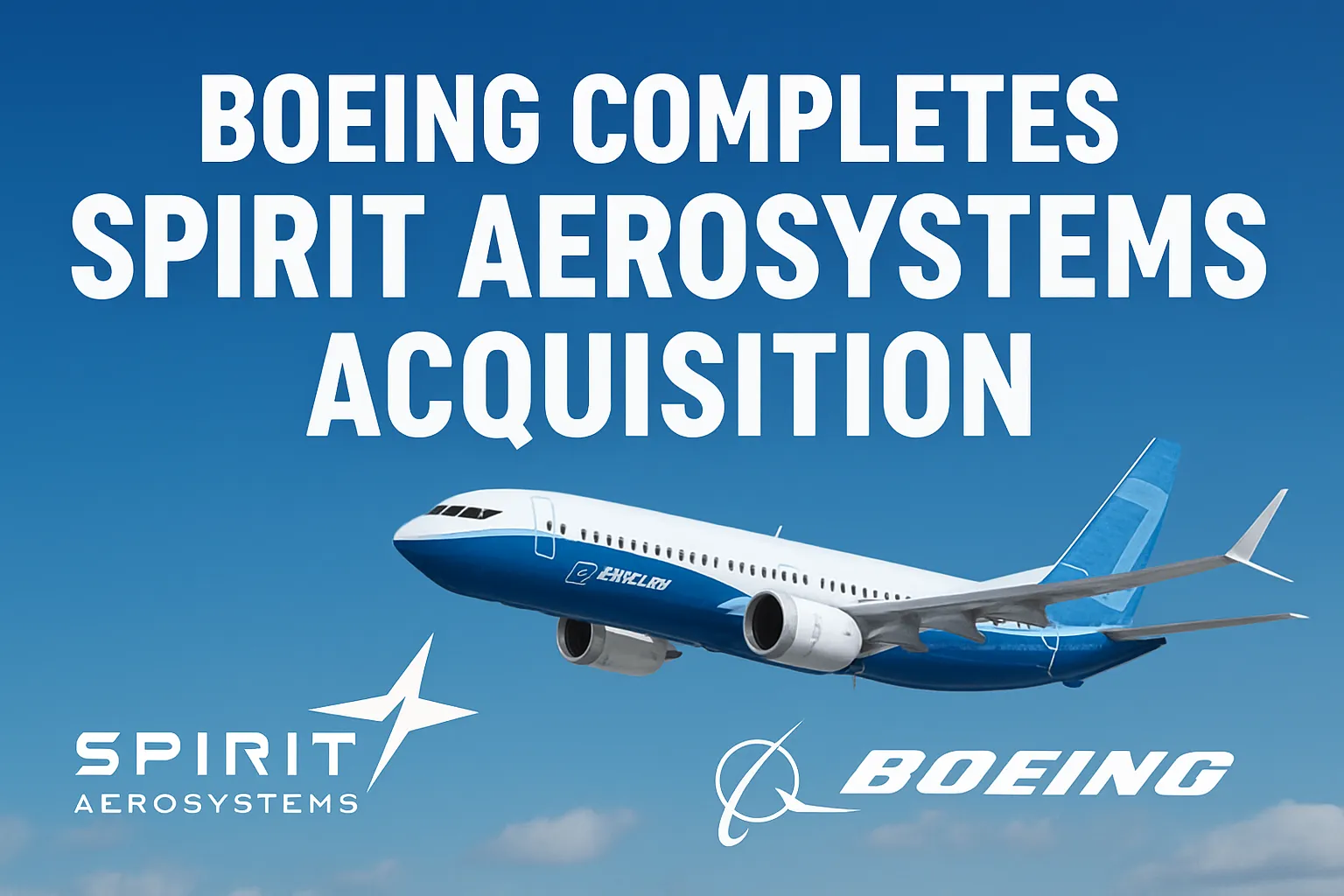
In a major restructuring move for the aviation industry, Boeing has officially completed its long-awaited acquisition of Spirit AeroSystems. The deal, valued at $4.7 billion in cash and approximately $8.3 billion including debt, is expected to bring sweeping changes to the global aircraft manufacturing ecosystem.
Why This Acquisition Matters
Spirit AeroSystems has been one of Boeing’s most important suppliers for decades, producing critical components for the 737 Max, 787 Dreamliner, and other aircraft programs.
However, Spirit has struggled with financial pressure and several quality-related issues in recent years. Boeing aims to bring key manufacturing operations back under its own control to improve quality, safety, and production stability.
Deal Structure: Which Sites Go to Boeing and Which to Airbus
Regulators in the U.S. and Europe approved the acquisition on the condition that Spirit’s certain facilities be sold to Airbus, ensuring healthy competition in the aerospace market.
The divested sites include:
- Major Spirit facilities in Europe
- Locations such as Belfast and Prestwick, where Airbus programs are already active
The remaining Spirit operations will now be integrated into Boeing.
Impact on Employees
Spirit AeroSystems employs nearly 15,000 people worldwide. As part of the transaction:
- Many workers will transition to Boeing
- Employees from the divested sites will move under Airbus
- Local unions have expressed cautious optimism but are monitoring the transition closely
Both companies have assured a smooth handover for all affected staff.
What This Means for Boeing
For Boeing, this acquisition focuses on three key objectives:
- Strengthening supply chain control to ensure timely aircraft deliveries
- Improving quality management after recent safety and inspection issues
- Reducing long-term costs by unifying production and design workflows
Analysts believe the move will give Boeing greater stability in its narrow-body and wide-body programs.
Market and Investor Reaction
Following the announcement, Boeing’s stock saw a modest rise. Analysts view the acquisition as a “long-term corrective step,” though integration challenges remain significant.
What It Means for Airbus
The transfer of selected Spirit sites to Airbus ensures:
- Continued supply for existing Airbus aircraft programs
- Stability for major European manufacturing hubs
- Reduced risk of production disruptions for Airbus models such as the A220 and A350
This strategic split ensures both aircraft giants secure their essential supply networks.
Challenges Ahead
Despite optimism, several hurdles remain:
- Integrating Spirit’s systems and workflows into Boeing
- Upgrading manufacturing processes to meet quality expectations
- Aligning supplier contracts and regulatory obligations
- Managing workforce restructuring and union negotiations
Smooth integration over the next 12–24 months will determine the real success of this acquisition.
Industry Insight
Aerospace experts say the acquisition gives Boeing a chance to “reset” its supply chain after years of disruptions, delays, and quality concerns. With Spirit’s operations now inside Boeing, the company has a clearer path to strengthening its manufacturing foundation—though the real test lies in execution.
Outcome
The Boeing–Spirit AeroSystems integration marks a turning point for the global aviation industry. While the move positions Boeing for long-term stability and improved control, the next year will be crucial to overcoming integration, quality, and workforce challenges.
For now, this acquisition signals a new chapter for one of the world’s largest aerospace companies.
Source: Boeing press
Join our chatroom Bizchat for professional talks and more!