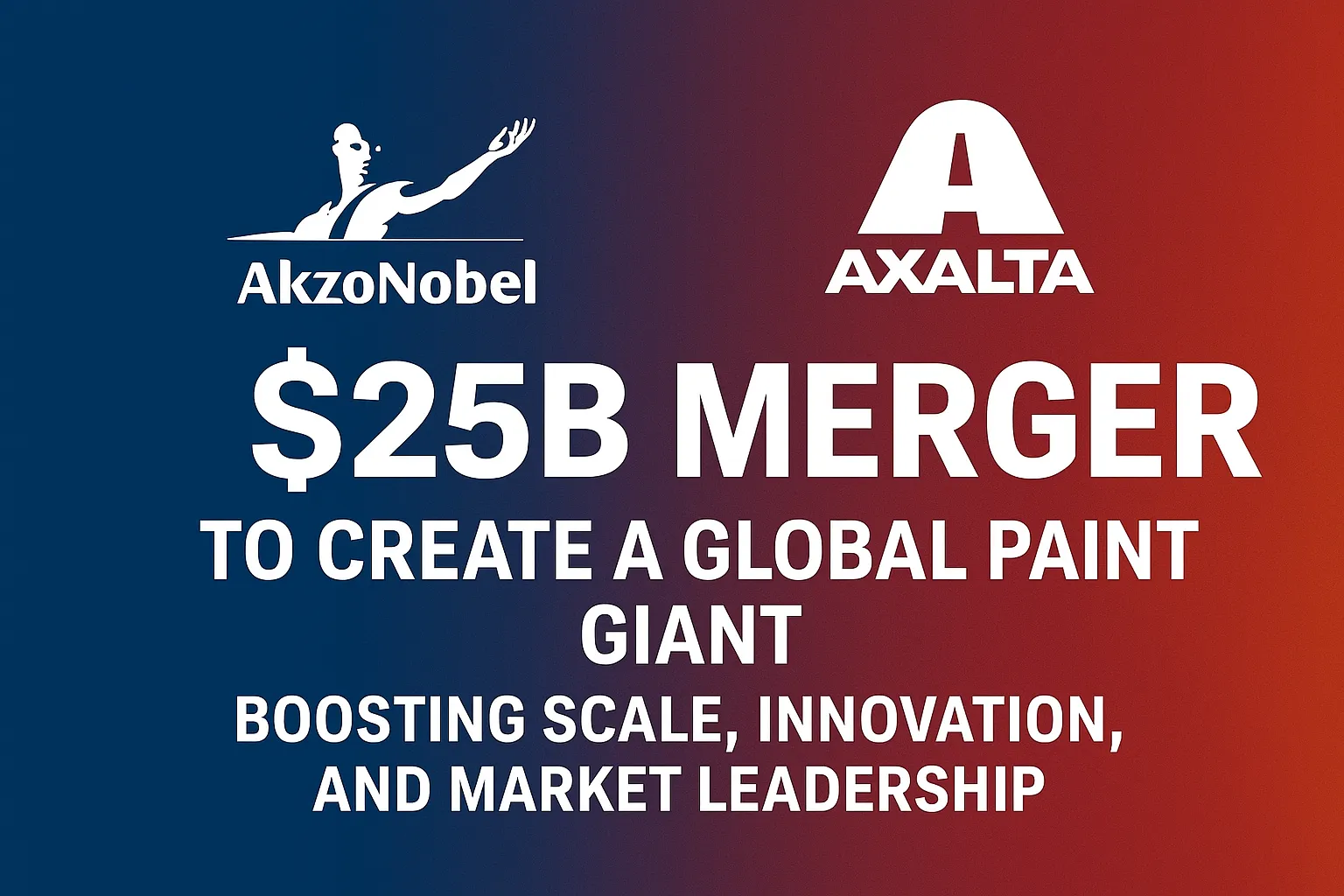
In one of the biggest deals ever seen in the global paints and coatings industry, Dutch paints major AkzoNobel has announced a $25 billion all-stock “merger of equals” with US-based Axalta Coating Systems. The combination of these two iconic companies is expected to create a powerful new global coatings leader with a broad product portfolio, deep geographical reach, and significant financial strength.
According to the companies’ joint announcement, the merged entity will command a powerful position in the global coatings market, bringing together complementary strengths, improved operational scale, and the potential for massive cost savings.
Key Highlights of the Merger
- Total Value: Approximately $25 billion enterprise value.
- Special Dividend: AkzoNobel shareholders will receive around €2.5 billion as a special cash dividend.
- Shareholding Structure: AkzoNobel shareholders will own 55%, while Axalta shareholders will hold 45% of the combined entity.
- Dual Listing: The new company will be initially listed on both Euronext Amsterdam and the New York Stock Exchange, with the potential for a single NYSE listing later.
- Headquarters: Dual HQ structure — Amsterdam (Netherlands) and Philadelphia (USA).
- Leadership:
- Greg Poux-Guillaume (CEO of AkzoNobel) will become the CEO of the merged company.
- Chris Villavarayan (CEO of Axalta) will serve as the Deputy CEO.
- Board Structure: Axalta’s Chairman Rakesh Sachdev will join as Chairman of the combined group’s Board.
- Projected Financials:
- Expected annual revenue: $17 billion
- Expected EBITDA: $3.3 billion
- Expected free cash flow: $1.5 billion
- Cost Synergies: Estimated $600 million annual savings, with 90% of synergy benefits expected within three years.
- Merger Completion Timeline: Expected between late 2026 and early 2027, subject to regulatory and shareholder approvals.
Why This Merger Matters: Industry Analysis
This merger is not just a combination of two paint companies — it is a strategic shift that can redefine the global coatings landscape for years to come. Here is an in-depth analysis:
1. A Strong Complementary Portfolio
AkzoNobel and Axalta have strengths in different segments of the coatings business:
- AkzoNobel is strong in decorative paints, industrial coatings, and marine & protective coatings.
- Axalta is a leader in automotive refinishing paints, industrial coatings, powder coatings, and high-performance systems.
By merging, the two companies will now cover nearly every major coatings segment, offering strong cross-selling opportunities and a larger product range to customers.
This broader combined portfolio also reduces risk during economic downturns, as revenue will come from multiple markets instead of relying on just a few.
2. Massive Global Presence and Scale
The new combined entity will have operations in more than 160 countries, a global R&D network, and extensive manufacturing capabilities. This allows:
- Better bargaining power with suppliers
- More efficient use of factories and logistics
- Stronger customer reach in fast-growing markets like Asia and Latin America
This scale positions the new company among the biggest players in the paints and coatings industry, able to compete more aggressively with rivals such as Sherwin-Williams, PPG Industries and Nippon Paint.
3. Significant Cost Savings and Operational Benefits
The companies expect $600 million per year in cost savings, mainly through:
- Consolidation of manufacturing plants
- Streamlined procurement
- Integrated supply chains
- A unified back-office (IT, HR, finance, logistics)
- Shared R&D functions
If these synergies are achieved, the merged company will significantly improve its profit margins, generate stronger cash flows, and unlock more financial flexibility for future expansion or acquisitions.
4. Market Reaction: Cautious but Optimistic
While the merger is strategically strong, market reaction has been mixed:
Positive Viewpoint
Analysts believe:
- The portfolio match is excellent
- The new entity will be a global powerhouse
- Cost savings can drive profitability
- Leadership from AkzoNobel provides stability
Concerns
However, several concerns were noted:
- Integration challenges: Mergers of equals often face cultural clashes.
- Long completion timeline: Closing by 2026–27 is far off, creating uncertainty.
- Regulatory scrutiny: With such a large market share, antitrust authorities may closely examine the deal before approval.
- Shareholder approval needed: Large investors on either side could raise objections if they see risks.
Even so, long-term investors view this as a transformation that could unlock significant value.
5. Leadership and Governance Structure
Leadership will play a crucial role in the success of this merger.
Greg Poux-Guillaume as CEO
Known for his strategic discipline and operational experience, he already has deep knowledge of AkzoNobel’s operations, which will help in building the unified organization.
Chris Villavarayan as Deputy CEO
His presence ensures Axalta’s management culture and strengths remain visible within the new company.
Balanced Governance
The combined board, including representatives of both companies, creates balance and reduces internal political friction.
6. Innovation and Sustainability: A Major Push Forward
A key long-term benefit of this merger is the combined R&D strength.
Innovation Opportunities
With expanded budgets and shared research capabilities, the new company can:
- Develop high-performance coatings
- Create more durable, long-lasting products
- Introduce advanced powder coatings
- Improve materials for auto, industrial and marine industries
Sustainability Focus
Both companies already invest heavily in sustainable solutions. Together, they will be able to:
- Produce eco-friendly paints
- Reduce carbon footprint
- Innovate low-VOC and water-based coatings
- Explore recyclable or renewable raw materials
This is crucial because customers worldwide — especially automotive and construction sectors — are demanding greener products.
7. Major Challenges and Risks Ahead
Despite the merger’s massive potential, certain risks cannot be ignored:
Regulatory Hurdles
Regulators may worry the merger will reduce competition, especially in specific coating segments. Delays or conditions (such as divestments) could affect the timeline.
Cultural Integration
Merging two different corporate cultures — one European and one American — may cause:
- Organizational friction
- Talent attrition
- Slow decision-making
- Delays in synergy realization
Effective communication and transparent planning will be essential.
Shareholder Concerns
Any disagreement among major shareholders, especially institutional investors, could slow down or influence deal terms.
Economic Uncertainty
Global inflation, supply chain disruptions, or volatility in raw material prices could impact margins and integration plans.
Synergy Execution Risk
The estimated $600 million savings is very high — if execution is weak, investor sentiment could turn negative.
A Transformational But Demanding Merger
The AkzoNobel–Axalta $25 billion merger represents a historic moment for the global paints and coatings industry. If executed well, it could create:
- One of the world’s most powerful coatings companies
- A diverse and complementary product portfolio
- Strong, global distribution capabilities
- Leadership in innovation and sustainable coatings
- Significant improvements in operational efficiency
However, success will depend on:
- Smooth cultural and operational integration
- Overcoming regulatory obstacles
- Delivering the promised synergy benefits
- Strong leadership coordination
- Market patience over the long merger timeline
If these elements come together, the merged company could redefine the future of the coatings industry and become a formidable global leader for decades to come.
Source: AkzoNobel Media , Axalta Press