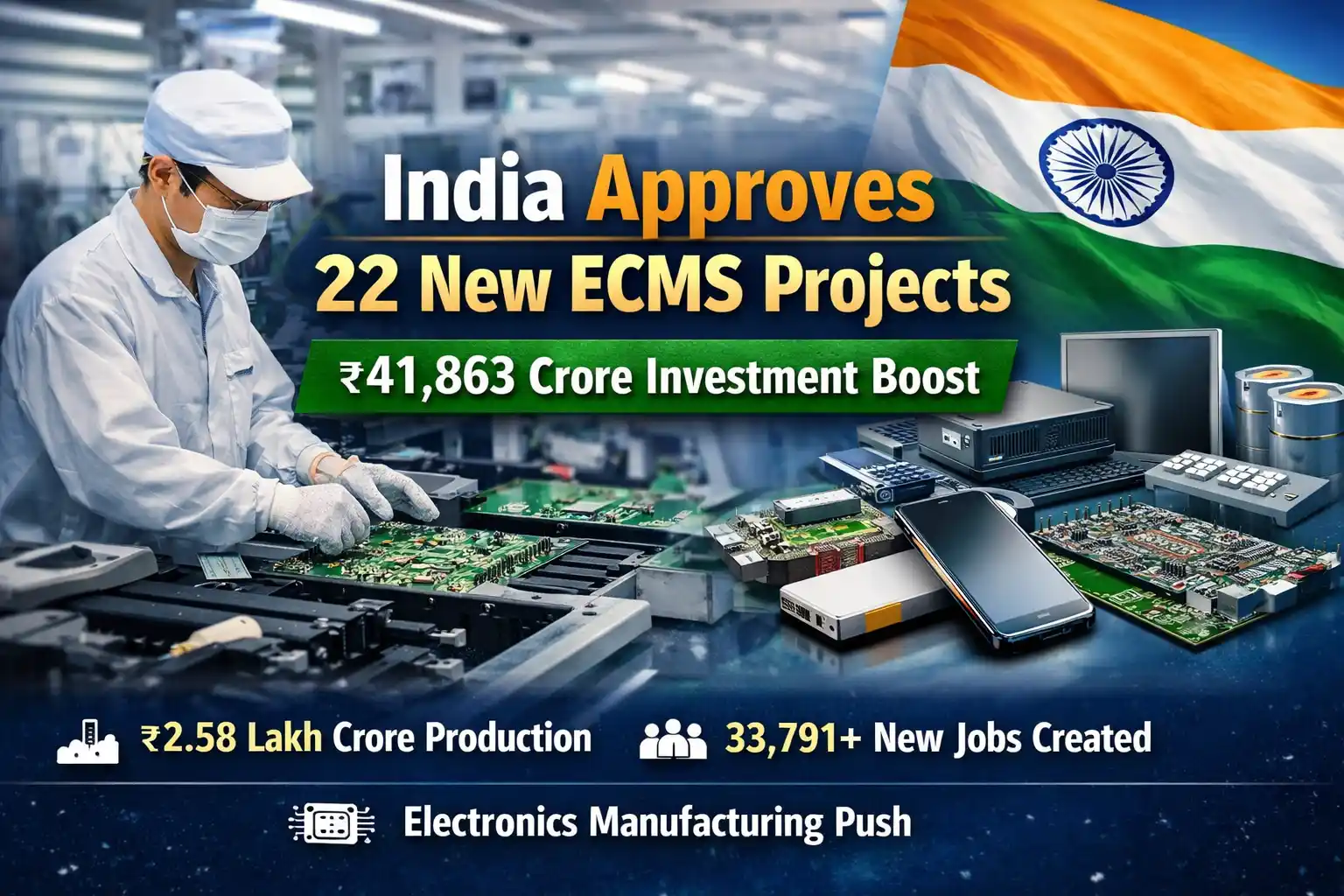
The Government of India has taken a major step to strengthen domestic electronics manufacturing by approving 22 new projects under the Electronics Components Manufacturing Scheme (ECMS). These projects involve a total proposed investment of ₹41,863 crore and are expected to significantly boost India’s electronics ecosystem.
According to official estimates, the approved projects will generate production worth ₹2.58 lakh crore and create over 33,791 direct jobs, providing a strong push to employment and industrial growth.
What Is the ECMS Scheme?
The Electronics Components Manufacturing Scheme (ECMS) is a key part of the government’s broader Production Linked Incentive (PLI) framework. The main objective of the scheme is to promote domestic manufacturing of critical electronic components, reduce import dependence, and integrate India more deeply into the global electronics supply chain.
The government believes that true “Make in India” success is possible only when core electronic components are manufactured within the country, not just assembled.
States Where the Projects Will Be Set Up
The 22 approved projects will be spread across eight Indian states, ensuring balanced regional development. These states include:
- Andhra Pradesh
- Haryana
- Karnataka
- Madhya Pradesh
- Maharashtra
- Tamil Nadu
- Uttar Pradesh
- Rajasthan
This geographical spread is expected to strengthen industrial infrastructure across multiple regions.
What Will These Projects Manufacture?
The projects cover 11 major categories of electronic components, which are essential for multiple industries. These include:
- Mobile phone and IT hardware components
- Printed Circuit Boards (PCBs)
- Connectors and passive components
- Lithium-ion battery cells
- Automotive and telecom electronics
These components are widely used in smartphones, electric vehicles, telecom equipment, and industrial electronics.
Companies Involved
Several leading Indian and global companies are participating in these projects, including Dixon Technologies, Tata Electronics, Foxconn, Samsung Display, Hindalco Industries, and the Motherson Group. Their involvement is expected to bring advanced technology, global best practices, and skill development into India’s manufacturing sector.
Impact on the Indian Economy
Experts believe the ECMS approvals will deliver multiple economic benefits, such as:
- Reduced reliance on electronics imports
- Increased employment in manufacturing and allied sectors
- Stronger domestic supply chains and MSME participation
- Improved export potential for high-value electronic components
The move comes at a time when India is actively working to expand electronics exports and attract global manufacturers.
Government’s Future Focus
Beyond manufacturing, the government plans to increase its focus on design, research, and development (R&D). The aim is to ensure that India evolves from being an assembly hub to a high-value technology and innovation center, capable of developing its own designs and intellectual property.
Outcome
The approval of 22 projects under the ECMS, backed by an investment of ₹41,863 crore, is being seen as a game-changing development for India’s electronics sector. It is expected to accelerate domestic production, generate large-scale employment, and strengthen India’s position in the global electronics manufacturing landscape.
Source: PIB