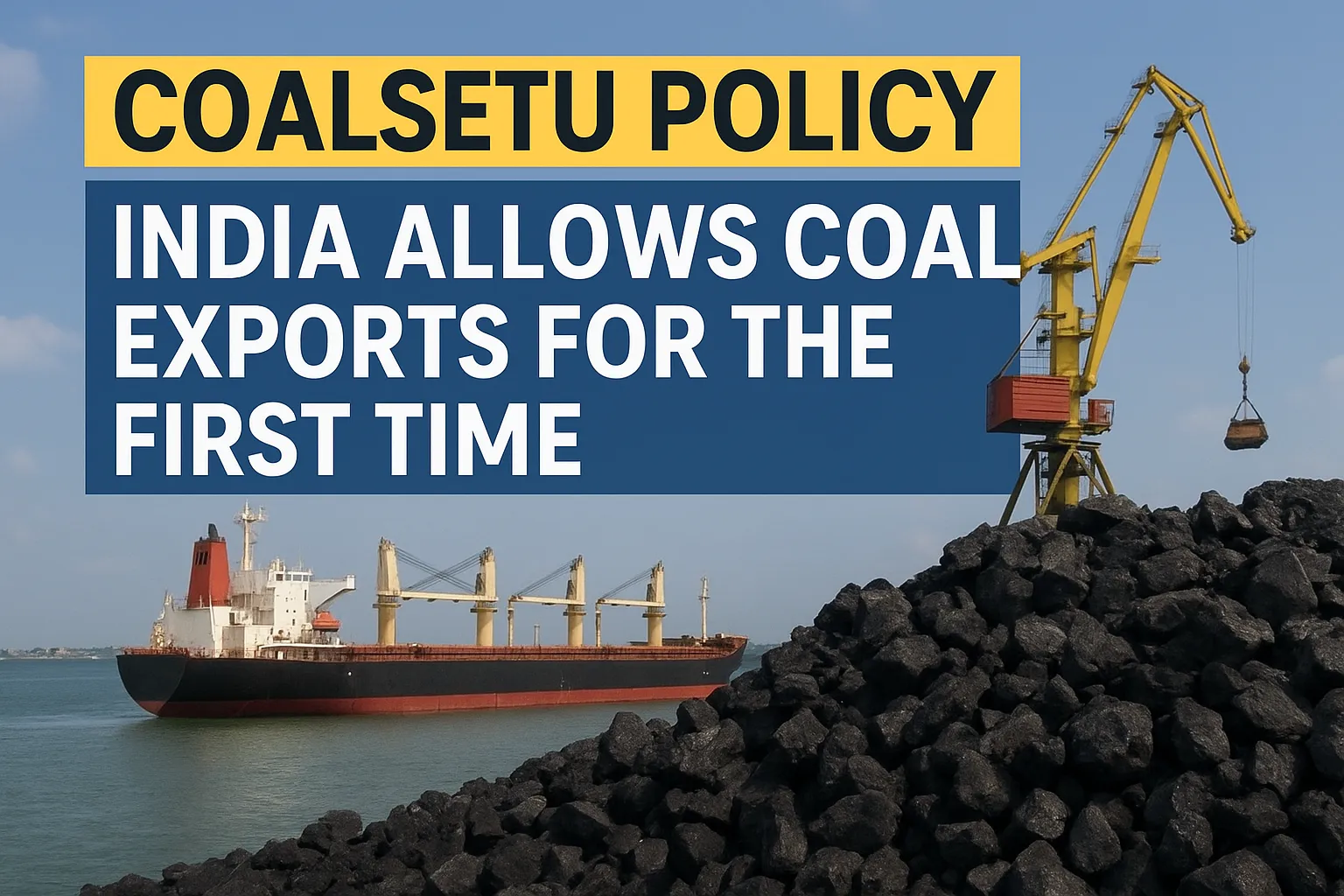
In a major policy shift in India’s energy sector, the Union Cabinet has approved coal exports for the first time. The decision was taken by the Cabinet Committee on Economic Affairs (CCEA) chaired by Prime Minister Narendra Modi, which also cleared a new policy framework called CoalSETU (Coal Linkage for Seamless, Efficient & Transparent Utilisation).
Under the new policy, coal linkage holders will be allowed to export up to 50% of their allocated coal capacity, marking a significant departure from India’s traditionally domestic-focused coal policy. Until now, coal produced in India was largely restricted to domestic consumption, especially for power generation and core industries.
A Significant Shift in India’s Coal Policy
The approval of coal exports represents a historic change in India’s energy and mining policy. Despite being one of the world’s largest coal producers, India had never formally permitted coal exports on a large scale. The government now believes that rising domestic production and comfortable stock levels justify opening export avenues.
According to officials, the move is aimed at optimising coal utilisation, improving efficiency in allocation, and allowing Indian producers to tap international markets without compromising domestic energy security.
What Is the CoalSETU Policy?
CoalSETU has been introduced as a new window under the 2016 Non-Regulated Sector (NRS) Coal Linkage Auction Policy. The policy is designed to bring greater flexibility and transparency to coal allocation while ensuring long-term supply stability.
Key features of the CoalSETU policy include:
- Long-term coal linkages of up to 15 years through competitive auctions
- Coal can be used for any industrial purpose or for exports
- Only end-use consumers are eligible; traders and intermediaries are excluded
- Greater flexibility in coal utilisation across group companies
The government said the policy would create a more market-oriented and efficient coal distribution system.
What Changes With Coal Exports?
The CoalSETU framework introduces several major changes to how coal can be used and monetised in India:
1. Export Permission Up to 50%
Coal linkage holders can now export up to half of their allocated coal quantity, giving companies access to global markets.
2. Export of Washed Coal
The policy allows the export of washed coal, which typically has higher quality and better acceptance in international markets.
3. Flexible Use of Linkages
Companies can optimise coal usage across their industrial units, improving operational efficiency.
4. Domestic Priority Maintained
The government has clarified that domestic power and industrial requirements will remain the top priority, and exports will be permitted only when domestic availability is sufficient.
Why the Government Took This Decision
The government’s decision is backed by several structural changes in India’s coal sector:
- Domestic coal production has reached record levels
- Coal stocks at mines and power plants remain comfortable
- Electricity demand growth has moderated compared to earlier projections
- Coal imports have declined, reducing reliance on overseas suppliers
With surplus availability in parts of the system, the government sees exports as a way to better manage excess supply and generate additional revenue.
Potential Impact on the Indian Economy
Industry experts believe the policy could have wide-ranging economic implications:
- Coal producers may see improved revenue realisation
- India could earn additional foreign exchange through exports
- Reduced dependence on coal imports could help conserve forex reserves
- Increased investment interest in the mining and energy sectors
Public sector major Coal India Ltd and private mining companies are expected to benefit from the policy, particularly if international coal prices remain favourable.
Market and Industry Response
The announcement was received positively by industry stakeholders. Energy and mining sector companies saw renewed investor interest, as the policy opens up new monetisation opportunities.
Industry bodies have welcomed the flexibility offered by CoalSETU but have also cautioned that exports will depend on global price competitiveness, logistics costs, and port infrastructure availability.
Market analysts noted that while the policy is structurally positive, its actual impact will depend on how effectively it is implemented.
Environmental Concerns Resurface
The decision has also sparked debate among environmental groups. At a time when many countries are accelerating their transition away from coal, allowing exports raises concerns over carbon emissions and climate commitments.
Environmental experts argue that increased coal exports could:
- Add to global carbon emissions
- Complicate India’s long-term climate goals
The government, however, maintains that energy transition will be gradual and that coal will continue to play a key role in ensuring energy security in the near to medium term.
The Road Ahead
With the approval of CoalSETU, attention now turns to implementation and monitoring. The government will need to ensure that:
- Domestic energy supply remains uninterrupted
- Environmental safeguards are enforced
- Export activity remains transparent and regulated
The success of the policy will depend on balancing economic opportunity with energy security and environmental responsibility.
Outcome
The approval of coal exports under the CoalSETU policy marks a watershed moment for India’s coal and energy sector. While the move opens new revenue and export opportunities, it also brings challenges related to sustainability and global energy transition.
In the coming months, the real impact of this policy will become clearer as India steps into a new role in the global coal market.
Source: PIB Press
Join our chatroom Bizchat for professional talks and more!