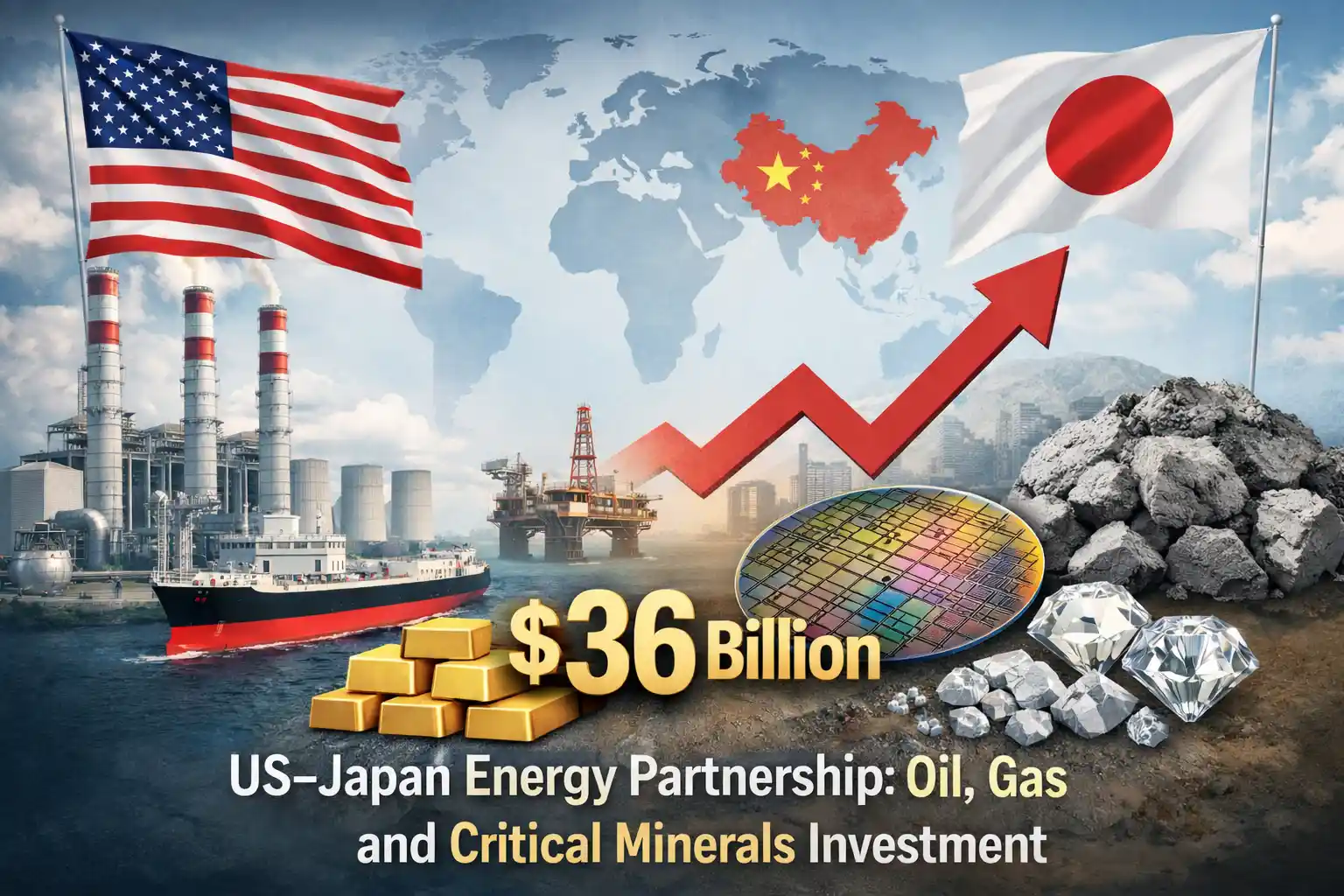
The comprehensive economic and strategic agreement signed between the United States and Japan in 2025 is now moving into implementation. Under the first phase of that mega deal, both countries have announced a joint investment package of $36 billion.
This investment will focus on natural gas–based power generation, crude oil export infrastructure, and high-tech manufacturing linked to critical minerals. Analysts believe this is not merely an economic investment, but a strategic move aimed at counterbalancing China’s dominance in global supply chains.
Detailed Investment Breakdown
| Project | Location | Estimated Investment | Potential Capacity |
| Gas Power Plant | Ohio (US) | $20–22 billion | 9.2 gigawatts |
| Deepwater Oil Export Terminal | Texas (US) | $10–12 billion | 2–3 million barrels/day |
| Synthetic Diamond Plant | Georgia (US) | $600 million | High-tech industry supply |
The remaining investment will support logistics, supply chain infrastructure, and related facilities.
9.2 GW Gas Power Project in Ohio
- With a capacity of 9.2 gigawatts, this facility will be among the largest gas-based power plants in the United States.
- It could supply electricity to approximately 7–8 million households.
- The total installed electricity capacity of the U.S. is around 1,200 GW, meaning this project alone could add nearly 1% to national capacity.
Natural gas currently accounts for roughly 40% of U.S. electricity generation.
This project is expected to strengthen energy stability and support industrial growth.
Texas Deepwater Crude Oil Export Terminal
The United States:
- Produces around 13 million barrels per day (mbpd) of crude oil.
- Exports approximately 4–5 mbpd.
The new terminal:
- Could add 2–3 mbpd of additional export capacity.
- Will allow large VLCC tankers to load directly.
Potential impact:
- Easier supply of U.S. crude to Asian markets
- Competitive pressure on OPEC+ producers
- Possible volatility in global oil prices
Synthetic Diamonds and Critical Minerals
Critical minerals are essential for:
- Semiconductors
- Electric vehicles
- AI chips
- Defense equipment
China’s position:
- Controls 60–70% of global rare earth processing capacity
- Strong dominance in battery and technology material supply chains
The Georgia plant:
- Will produce industrial-grade diamond grit
- Used in semiconductor wafer cutting and advanced manufacturing
Objective: Reduce technological supply dependence on China.
Geopolitical Analysis
This investment comes at a time when:
- U.S.–China trade tensions remain ongoing
- Strategic competition in the Indo-Pacific region is intensifying
- Control over energy and mineral resources has become central to global politics
Japan:
- Imports nearly 90% of its energy needs
- Seeks diversified and secure supply chains
United States:
- Emerging as a global energy superpower
- Strengthening self-reliance in technology and defense sectors
Market and Investor Implications
✔ Positive outlook for energy infrastructure companies
✔ Increased dollar inflows from higher oil exports
✔ New opportunities in high-tech manufacturing
Risks:
- Oil price volatility
- Possible trade retaliation from China
- Project delays or cost overruns
Potential Impact on Global Energy Markets
| Factor | Possible Impact |
| Increased U.S. exports | Stronger supply in Asia |
| OPEC+ response | Potential production adjustments |
| China | Development of alternative supply strategies |
Outcome
This $36 billion initiative marks the first phase of the 2025 U.S.–Japan mega agreement and represents a significant step in reshaping global energy and technology supply chains.
If completed between 2028 and 2030:
- U.S. oil export capacity could increase by 30–40%.
- Japan’s energy security would strengthen significantly.
- China’s dominance in supply chains could face challenges.
- Competition in global energy and technology markets would intensify.
This partnership may play a defining role in shaping the economic balance of power in the Indo-Pacific region over the coming decade.
Source: White House, U.S. Department of Energy, METI Japan and international media reports.