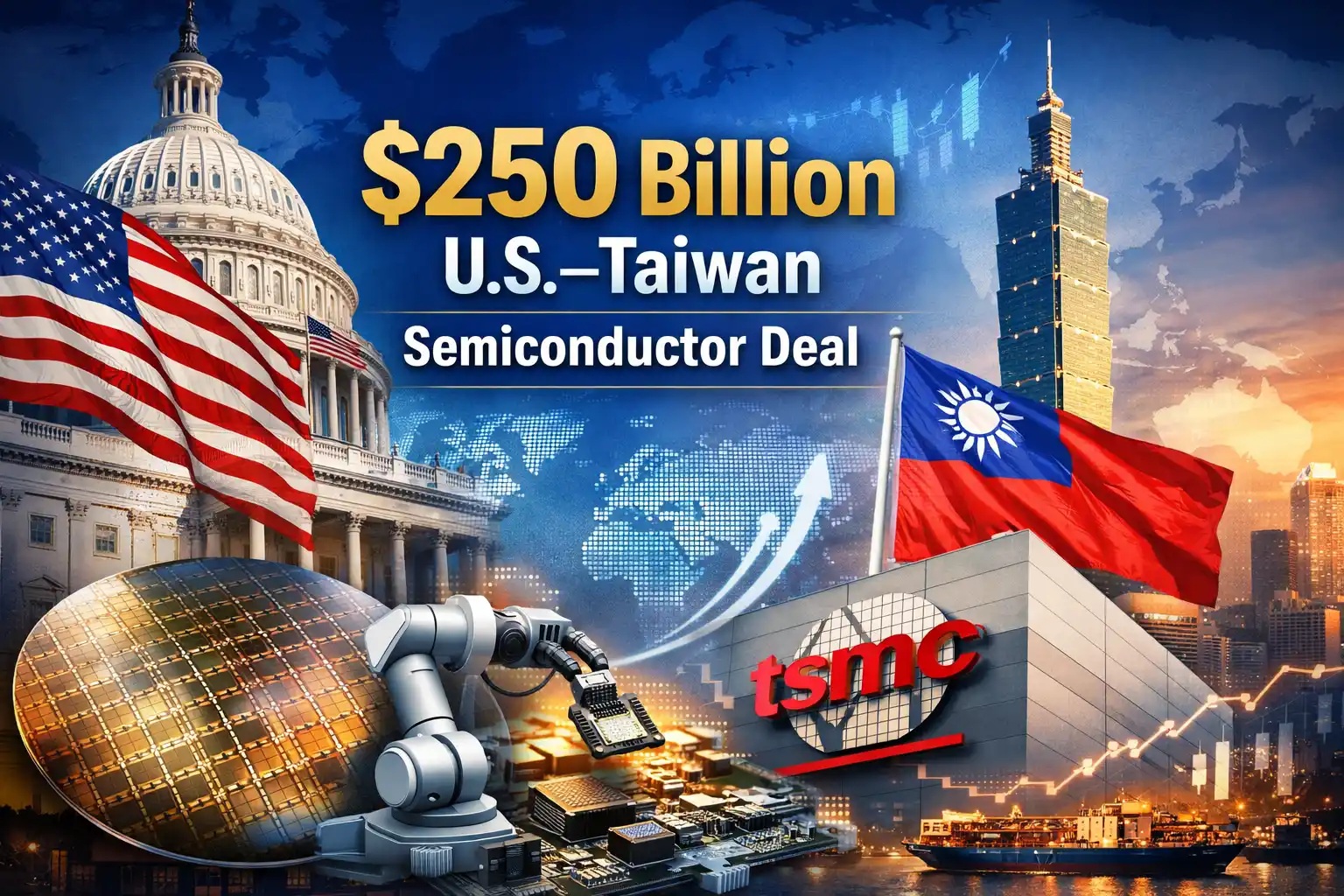
The United States and Taiwan have reached a historic trade and investment agreement under which Taiwanese companies will invest nearly $250 billion in the United States over the coming years. The deal is heavily focused on semiconductors, artificial intelligence (AI), advanced manufacturing, and energy, and is being seen as a strategic turning point in the global technology and supply-chain landscape.
Analysts believe the agreement could reshape the global semiconductor industry and significantly influence the ongoing U.S.–China technology rivalry.
Why This Deal Was Needed
Over the past few years, the global economy has faced:
- Severe chip shortages after the pandemic
- Rising geopolitical tensions, especially between the U.S. and China
- Explosive growth in AI, electric vehicles, cloud computing, and defense technologies
The U.S. has been pushing to bring advanced chip manufacturing back home to reduce dependence on overseas supply chains. Taiwan, while being the world’s largest semiconductor hub, faces geopolitical risks due to its strained relationship with China.
This deal addresses concerns on both sides.
Key Highlights of the Agreement
Under the agreement:
- Taiwanese firms will invest $250 billion in the U.S. in phases
- Most investments will go into semiconductor fabs, AI chips, R&D centers, and energy projects
- The U.S. will reduce import tariffs on several Taiwanese products
- Some high-tech goods may receive zero-tariff access
- The deal will be implemented gradually over multiple years
The U.S. Department of Commerce described the agreement as a long-term strategic economic partnership.
Semiconductors at the Center of the Deal
Semiconductors are now the backbone of modern economies, powering:
- Smartphones and computers
- Artificial intelligence systems
- Automobiles and electric vehicles
- Defense equipment
- Data centers and cloud infrastructure
The Role of TSMC
The deal strongly features Taiwan Semiconductor Manufacturing Company (TSMC), the world’s largest chipmaker.
- TSMC is already building major facilities in Arizona
- The new agreement is expected to accelerate and expand these investments
- Advanced AI and high-performance chips will increasingly be produced in the U.S.
Experts say this move will help the U.S. secure access to cutting-edge chip technology.
Why the Deal Matters to the United States
For the U.S., the agreement brings multiple strategic benefits:
- Reduced reliance on China for critical technology
- Greater control over semiconductor supply chains
- Creation of thousands of high-skill manufacturing jobs
- Stable chip supplies for AI and defense industries
- Stronger global leadership in advanced technology
The White House has linked the deal directly to national security and economic resilience.
What Taiwan Gains from the Agreement
Taiwanese officials have called it one of the most significant trade agreements the country has ever signed with the U.S.
Benefits for Taiwan include:
- Improved access to the large U.S. market
- Lower tariffs boosting Taiwanese exports
- Deeper cooperation with the U.S. in AI and advanced technology
- Long-term economic and strategic stability
Taiwan says the deal positions it as a key strategic technology partner of the United States.
China’s Strong Reaction
China has sharply criticized the agreement.
- Beijing argues the deal violates the One-China policy
- Chinese officials accuse the U.S. of strengthening Taiwan economically and strategically
- China has urged Washington to reconsider the agreement
Analysts warn the deal could further intensify U.S.–China tensions, particularly in technology and trade.
Potential Risks and Concerns
Despite its scale, the agreement has raised some concerns:
- Large overseas investments could weaken domestic manufacturing in Taiwan
- Rising geopolitical tensions may affect long-term stability
- Some elements of the deal still require approval from Taiwan’s legislature
Both governments, however, insist that safeguards are in place to manage these risks.
Impact on the Global Technology Industry
Experts expect the deal to have far-reaching global effects:
- Semiconductor manufacturing will become more geographically diversified
- Global supply chains will be less vulnerable to disruption
- New investment opportunities will emerge in AI and advanced manufacturing
The agreement is widely seen as a game-changer for the global tech ecosystem.
Outcome
The $250 billion U.S.–Taiwan trade and semiconductor agreement is more than a business deal—it is a strategic move that could redefine global technology power dynamics. While the U.S. strengthens its technological independence and security, Taiwan gains economic stability and a deeper strategic alliance.
In the coming years, the deal’s impact will be clearly felt across semiconductors, AI, global trade, and geopolitics.
Source: US department of commerce