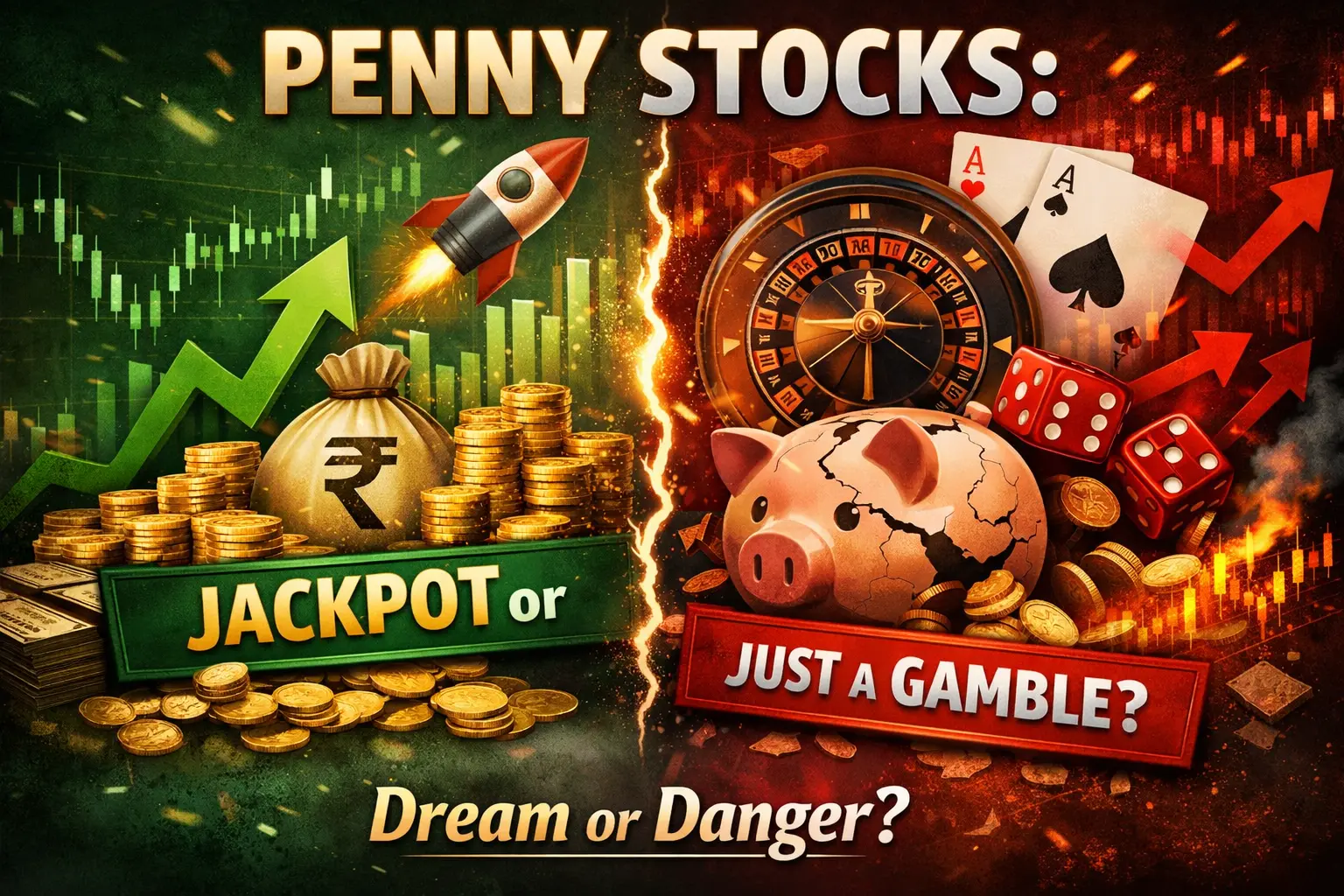
Cheap Shares, Big Dreams, and the Biggest Market Illusion
Whenever people talk about making quick money in the stock market, penny stocks immediately steal the spotlight.
A share priced at ₹2, ₹5, or ₹10 triggers instant imagination:
“If this becomes ₹100, my life is sorted.”
Social media, WhatsApp tips, Telegram channels, and flashy YouTube thumbnails strengthen this belief. Phrases like “operator entry confirmed”, “next multibagger”, or “hidden gem” sound extremely convincing.
But the stock market follows one brutal truth:
The more attractive the dream, the higher the risk behind it.
This article cuts through the hype to answer one honest question:
👉 Are penny stocks real wealth creators, or are they simply a high-risk gamble disguised as opportunity?
What Exactly Is a Penny Stock? More Than Just a Low Price
Penny stocks are not just “cheap shares”
A penny stock usually refers to a company that:
- Trades at a very low price (generally below ₹50)
- Has small market capitalization
- Suffers from low visibility and weak investor trust
- Often lacks stable business performance
Example:
- Company A trades at ₹6
- Company B trades at ₹600
The difference is not the price —
the difference lies in business strength, financial stability, and long-term visibility.
A low price does not mean low risk.
In fact, it often means higher uncertainty.
Why Do Investors Get Attracted to Penny Stocks So Easily?
1️⃣ The “Low Investment, Low Risk” Illusion
Many investors think:
- “I can’t invest ₹50,000”
- “₹5,000 is fine, even if I lose it”
But low capital does not reduce risk —
it only reduces emotional resistance to bad decisions. Risk depends on business quality, not ticket size.
2️⃣ Multibagger Stories That Hijack the Mind
Media highlights only success stories:
- ₹3 stock becoming ₹300
- 100x return in a few years
What never gets highlighted:
- Hundreds of stocks that went from ₹10 to ₹1
- Thousands of investors stuck with permanent losses
The human brain remembers miracles, not statistics.
3️⃣ The Quantity Trap: “I Own Thousands of Shares”
Buying 1,000 shares feels powerful.
It creates false confidence:
“Even a small rise will make me rich.”
But the market rewards quality of earnings, not quantity of shares.
The Hidden Risks of Penny Stocks (That Most People Ignore)
⚠️ 1️⃣ Weak Fundamentals and Fragile Businesses
Most penny companies suffer from:
- Continuous losses
- Unstable revenue
- Poor cash flow
- High debt
Example:
- Revenue declining
- Debt increasing
- Yet the stock rises only due to rumors
That is not investing — that is pure speculation.
2️⃣ Operator-Driven Price Manipulation
Penny stocks are playgrounds for operators:
- Artificial volume is created
- Prices are pushed upward
- Retail investors enter due to fear of missing out
- Operators quietly exit
After that:
- Circuits hit
- Liquidity disappears
- Retail investors are trapped
The script is old, but the victims are always new.
3️⃣ Liquidity Risk: Profit on Screen, Loss in Reality
- Stock looks green in the portfolio
- But when you want to sell, there are no buyers
- Upper or lower circuits block exits
In penny stocks:
Entering is easy, exiting is painful.
4️⃣ Poor Corporate Governance and Transparency
Many penny companies:
- Delay financial results
- Provide unclear disclosures
- Have questionable promoter credibility
Without trust, valuation becomes meaningless.
Can Penny Stocks Ever Become a Jackpot?
The honest answer:
✔️ Yes — but only in extremely rare cases
A real jackpot happens when:
- A genuine business turnaround occurs
- Debt is reduced significantly
- Revenue growth becomes consistent
- Management quality improves
Key truth:
Jackpots are created by business transformation, not by cheap prices.
Price follows performance — not hope.
How Smart Investors Approach Penny Stocks
✔️ 1️⃣ They Treat It as Speculation, Not Investment
- Exposure limited to 5–10% of portfolio
- Never risk core capital or long-term goals
✔️ 2️⃣ They Study the Balance Sheet Carefully
They track:
- Debt trend
- Cash flow quality
- Promoter shareholding
A good story without numbers is a warning sign.
✔️ 3️⃣ Exit Strategy Is Defined Before Entry
- Target profit decided
- Maximum acceptable loss fixed
- Emotions kept out of decisions
Hope is not a strategy.
🚫 Who Should Completely Avoid Penny Stocks?
- Beginners with limited market understanding
- Tip-dependent investors
- Emotion-driven traders
- Investors saving for retirement or critical goals
Penny stocks are not wealth-protection tools —
they are high-risk bets.
The Dream of Jackpot vs the Power of Discipline
Penny stocks sell a beautiful dream:
- Small money
- Big returns
- Fast success
But the market rewards something else:
Slow, disciplined, and boring investing creates lasting wealth.
If penny stocks were guaranteed jackpots,
market regret wouldn’t be so common.
The real question is not:
“How high can this stock go?”
The real question is:
👉 If this stock collapses, can I survive the damage?
If the answer is unclear,
penny stocks are nothing but a gamble.
And even if the answer is yes, remember:
Discipline can make you wealthy — even without a jackpot.