What Looks Free Often Costs the Most
When a new investor enters the stock market, one sentence sounds sweeter than anything else:
“I have a sure-shot stock tip.”
WhatsApp groups, Telegram channels, Twitter (X), YouTube comments — everywhere you hear:
- “This stock will explode tomorrow”
- “Upper circuit guaranteed”
- “Insider information”
- “Free tip, just try once”
At first glance, it feels harmless.
No fees. No subscription. No course to buy.
But slowly, these “free tips” start doing real damage:
- They destroy capital
- They break confidence
- They turn excitement into fear
- And many investors quit the market forever
The truth is simple but harsh:
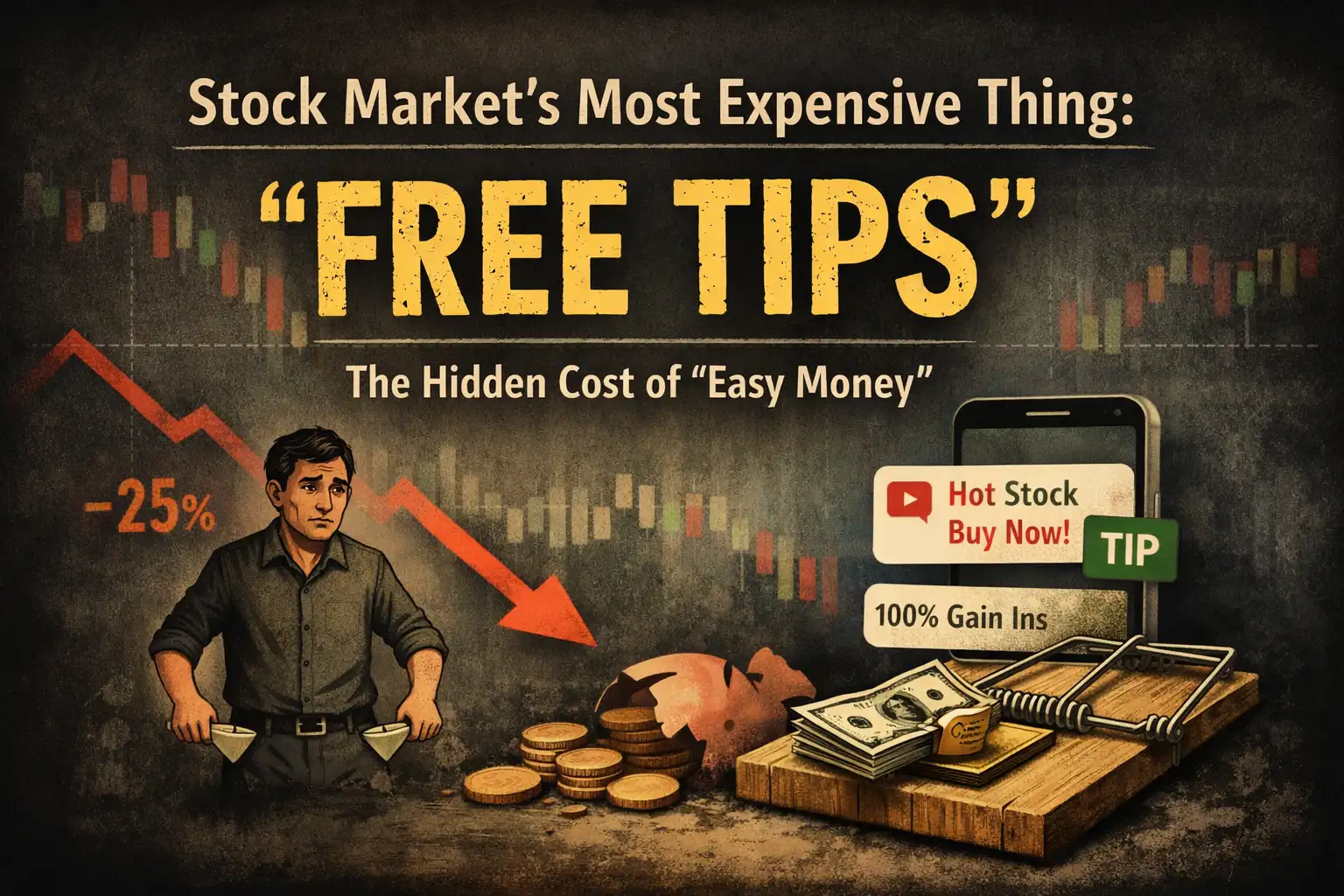
The most expensive thing in the stock market is “Free Tips.”
Because their cost is not paid in money upfront,
it is paid later — through losses, mistakes, stress, and regret.
How Free Tips Trap the Investor’s Mind
The human brain loves shortcuts.
When someone says:
- “No need to analyze”
- “I’ve already done the research”
- “Just buy and relax”
our brain immediately feels relief.
The Psychological Trap
Free tips attack three powerful emotions:
- Greed – “What if this really works?”
- FOMO (Fear of Missing Out) – “Everyone will make money except me”
- Overconfidence – “This time I’ll recover all losses”
And the moment emotions take control, logic leaves the room.
That’s where the real loss begins.
📲 Where Do These Free Tips Come From?
Many investors think free tips are random or innocent.
In reality, they follow a very predictable pattern.
Common Sources of Free Tips:
- WhatsApp & Telegram groups
- Twitter (X) “market experts”
- YouTube live chat recommendations
- Facebook stock market communities
- “A friend who knows someone in the market”
Now ask yourself one honest question:
If someone is consistently making money from the stock market,
why would they share it for free with strangers?
🎭 The Real Agenda Behind Free Tips
In most cases, free tips are not about helping investors.
They are about personal benefit.
1️⃣ Building Followers & Influence
- A few tips work initially
- People start trusting
- Followers increase
Trust is the currency here.
2️⃣ Selling Paid Services Later
Once trust is built:
- “Join our premium group”
- “Exclusive paid calls”
- “Serious traders only”
The free tips were just marketing.
3️⃣ Dumping Their Own Position
This is the most dangerous one.
Often:
- The tip-giver already owns the stock
- Retail investors buy after the tip
- Price rises slightly due to demand
- Tip-giver quietly exits
Retail investors are left holding the stock — and the loss.
Real-Life Example: The Hidden Cost of a Free Tip
Example: The WhatsApp Tip Disaster
Ramesh receives a message:
“XYZ Ltd – Target 30% in 5 days”
No analysis. No risk explanation. Just excitement.
He invests ₹1,00,000.
- Day 1: Stock up 3%
- Day 2: Flat
- Day 3: Market weak
- Day 7: Negative company news
- Day 15: Stock down 25%
What happens next?
- The tip-giver changes the group name
- Deletes messages
- Or disappears completely
Ramesh is left with:
- Loss
- Stress
- Self-doubt
And one painful question:
“Where did I go wrong?”
🧪 The Biggest Damage of Free Tips: Zero Learning
The most dangerous part of free tips is not loss of money.
It is loss of learning.
What Free Tips Never Teach You:
- How a company actually makes money
- How to read balance sheets
- How to manage risk
- When to exit a bad trade
- How to think independently
The investor becomes a button-clicker:
👉 BUY when someone says so
👉 SELL when panic hits
No process. No understanding.
📊 Tip-Based Investing vs Knowledge-Based Investing
| Tip-Based Investor | Knowledge-Based Investor |
| Depends on others | Takes own decisions |
| Emotion-driven | Logic-driven |
| Short-term focus | Long-term vision |
| Frequent losses | Controlled risk |
| Afraid of markets | Understands markets |
Free tips create followers.
Knowledge creates investors.
🔍 “Free” Tips Are Never Really Free
Free tips come with hidden costs:
- Wrong entry price
- No exit strategy
- Overtrading
- Capital erosion
- Loss of confidence
You may not pay money upfront,
but you pay with:
- Time
- Mental peace
- Hard-earned savings
That is why free tips are the most expensive product in the stock market.
Why Experienced Investors Ignore Free Tips
Experienced investors know one truth:
There is no certainty in the stock market.
They understand:
- Every stock has risk
- Context matters more than headlines
- Discipline matters more than predictions
So they:
- Filter noise
- Ignore tips
- Follow a process
They don’t chase quick money.
They build sustainable wealth.
⚠️ Free Tips + News Trading: A Deadly Combination
Many free tips are sold under the label of “news”:
- “Big order coming”
- “Results will be strong”
- “Merger announcement soon”
But by the time news reaches the public:
👉 Smart money has already acted.
Retail investors always enter late — and exit in panic.
🛑 Who Suffers the Most From Free Tips?
- New investors
- Small capital traders
- Emotion-driven participants
- People dreaming of quick riches
The stock market is unforgiving to shortcuts.
💡 What Should Investors Do Instead?
✔️ 1. Ask “WHY” Before Buying
- Why this stock?
- What is the risk?
- What is the exit plan?
If there is no answer — don’t invest.
✔️ 2. Trust the Process, Not Predictions
Slow growth with discipline beats fast money with stress.
✔️ 3. Focus on Learning
- Company results
- Business models
- Basic valuation
Knowledge compounds just like money.
✔️ 4. Trade Less, Think More
In the stock market:
More action does not mean more profit.
🎤A Message to Serious Investors
The stock market is not a lottery system.
Money here is made through understanding, patience, and discipline — not shortcuts.
Anything that promises:
- Quick profit
- No effort
- No responsibility
is usually the most dangerous.
The next time someone says:
“It’s a free tip, just try once”
Ask yourself one honest question:
“Am I ready to trust my hard-earned money to someone else’s shortcut?”
If the answer is no —
you are already ahead of most investors.
📌 Remember:
In the stock market, the biggest investment is not money —
it is mindset, discipline, and independent thinking.