Imagine the stock market as a huge marketplace where different stalls (sectors) sell different products (companies). Sometimes the clothing stall attracts the biggest crowd, sometimes the food stall is the busiest, and sometimes the tech gadgets stall becomes everyone’s favorite.
If you can understand which stall is about to become popular and why, you can invest there early and potentially earn higher returns.
This is exactly what professional investors call the Sector Rotation Strategy — moving money from one sector to another based on the stage of the market cycle to maximize returns and reduce risk.
In simple words:
👉 Understand the market trend and invest in the sectors that are likely to perform best in that phase.
What Is Sector Rotation Strategy?
Sector Rotation Strategy is an investment approach where investors shift their money from one sector to another depending on the stage of the economic and market cycle.
The Logic:
The market never moves in one straight direction. There are bull phases, corrections, slowdowns, and recoveries. Different sectors perform well in different phases.
The Goal of Sector Rotation:
➡️ Invest where growth potential is high
➡️ Exit sectors where risk is increasing
This strategy is generally more suitable for medium- to long-term investors (weeks, months, or years) rather than daily traders.
Market Cycle and Sector Rotation (Easy Understanding)
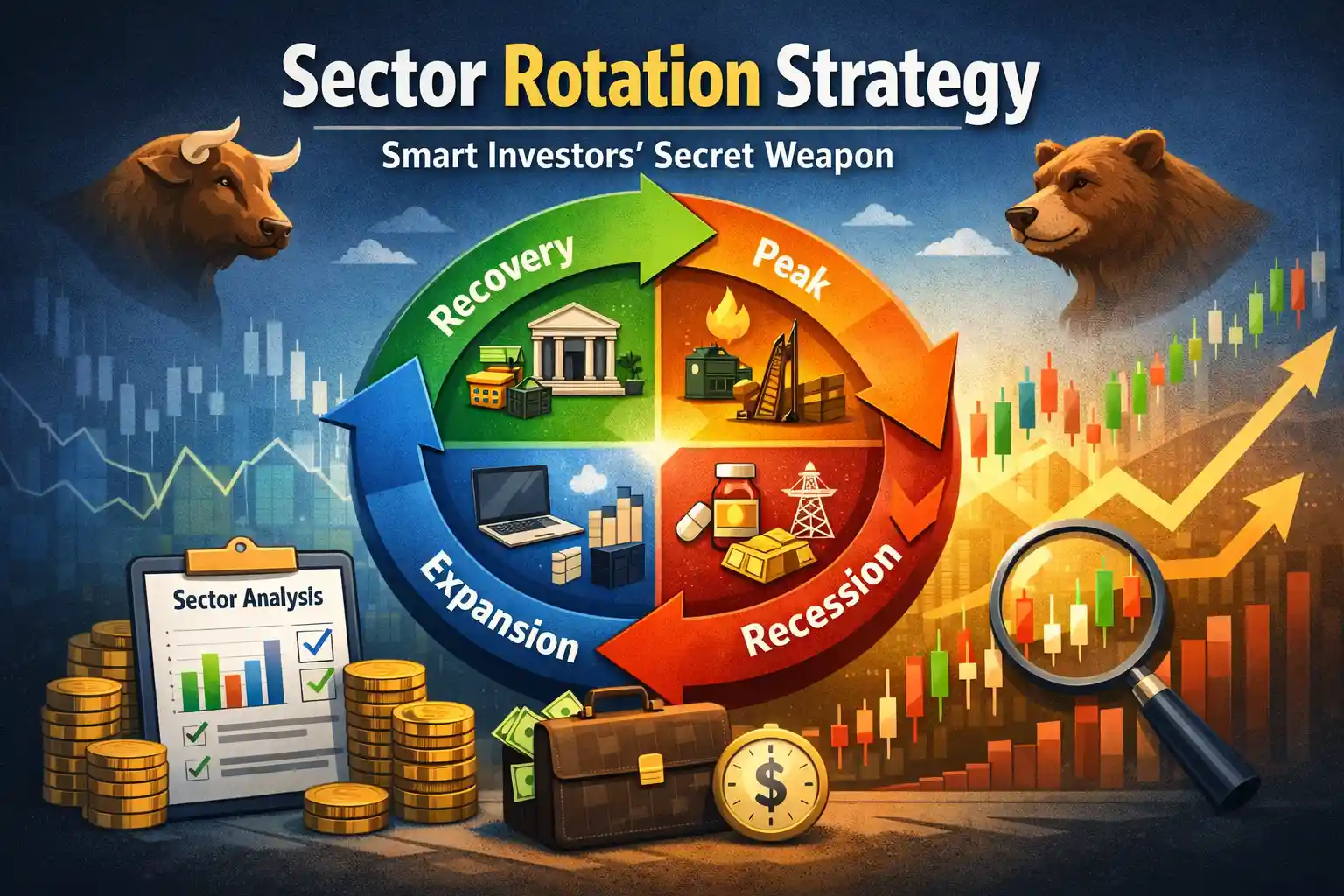
The stock market broadly moves in four major stages:
1️⃣ Recovery
2️⃣ Expansion
3️⃣ Overheating / Peak
4️⃣ Contraction / Recession
Each stage tends to favor specific sectors:
| Market Stage | Better Performing Sectors |
| 🔄 Recovery | Consumer Discretionary, Financials |
| 📈 Expansion | Technology, Industrials |
| 🔥 Peak | Energy, Materials |
| 📉 Contraction | Utilities, Healthcare, Consumer Staples |
Understanding with a Practical Example
Let’s understand this with a recent real-world scenario:
2020–2021: Post-COVID Recovery Phase
After the market crash and economic slowdown:
- Financials and Consumer Discretionary sectors started performing strongly.
- Banks, credit companies, and retail stocks rallied.
- Reason: Demand started returning and interest rate policies were supportive.
2021–2022: Expansion Phase
As the economy and corporate profits improved:
- Technology and Industrials gained strong momentum.
- Digital transformation, automation, and manufacturing revival drove growth.
2022–2023: Inflation / Peak Phase
Energy prices surged:
- Energy and Commodity-related sectors outperformed.
- Rising oil and raw material prices supported profits in these sectors.
2023–2024: Slowdown Phase
As consumer demand slowed:
- Healthcare and Consumer Staples showed stable performance.
- Reason: People continue spending on essential goods and healthcare even during uncertainty.
Investors who shifted their investments across sectors in line with these phases were able to potentially outperform the broader market.
The Logic Explained in Simple Words
Think of it like seasonal demand:
🌧️ During the rainy season, raincoat and umbrella companies see higher demand.
☀️ In summer, AC and refrigerator companies perform better.
❄️ In winter, heater and woolen clothing companies gain traction.
Demand changes with seasons — and smart investors adjust accordingly.
Similarly, in the stock market, sector performance changes with economic conditions. Sector rotation simply means adjusting your investments accordingly.
How to Apply Sector Rotation Strategy (Step-by-Step)
1. Identify the Market Phase
- Look at indicators like GDP growth, inflation, interest rates.
- Understand whether the market sentiment is bullish or cautious.
2. Identify Strong Sectors
- Track sector performance trends.
- Compare which sectors are outperforming the broader index.
3. Don’t Ignore Diversification
- Avoid putting all your money into one sector.
- Allocate across 2–3 promising sectors to manage risk.
4. Review and Rebalance Regularly
- Review your portfolio every quarter or six months.
- If trends change, gradually rotate capital.
Advantages of Sector Rotation
✅ Helps align investments with market trends
✅ Potentially higher returns than passive investing (if executed well)
✅ Reduces dependency on a single sector
✅ Encourages macro-driven, disciplined investing
Risks and Limitations
❌ Incorrect timing can lead to losses
❌ Frequent shifting may increase taxes and transaction costs
❌ Requires time, research, and understanding of macroeconomic signals
Final Summary
Sector Rotation Strategy is a disciplined investment method where you shift your money between sectors based on the stage of the economic cycle.
For example:
- Recovery → Financials & Consumer sectors
- Expansion → Technology & Industrials
- Peak → Energy & Materials
- Slowdown → Healthcare & Consumer Staples
It is not about luck. It requires research, trend analysis, and patience.
Smart investors use this strategy to potentially enhance returns while managing risk in changing market conditions.