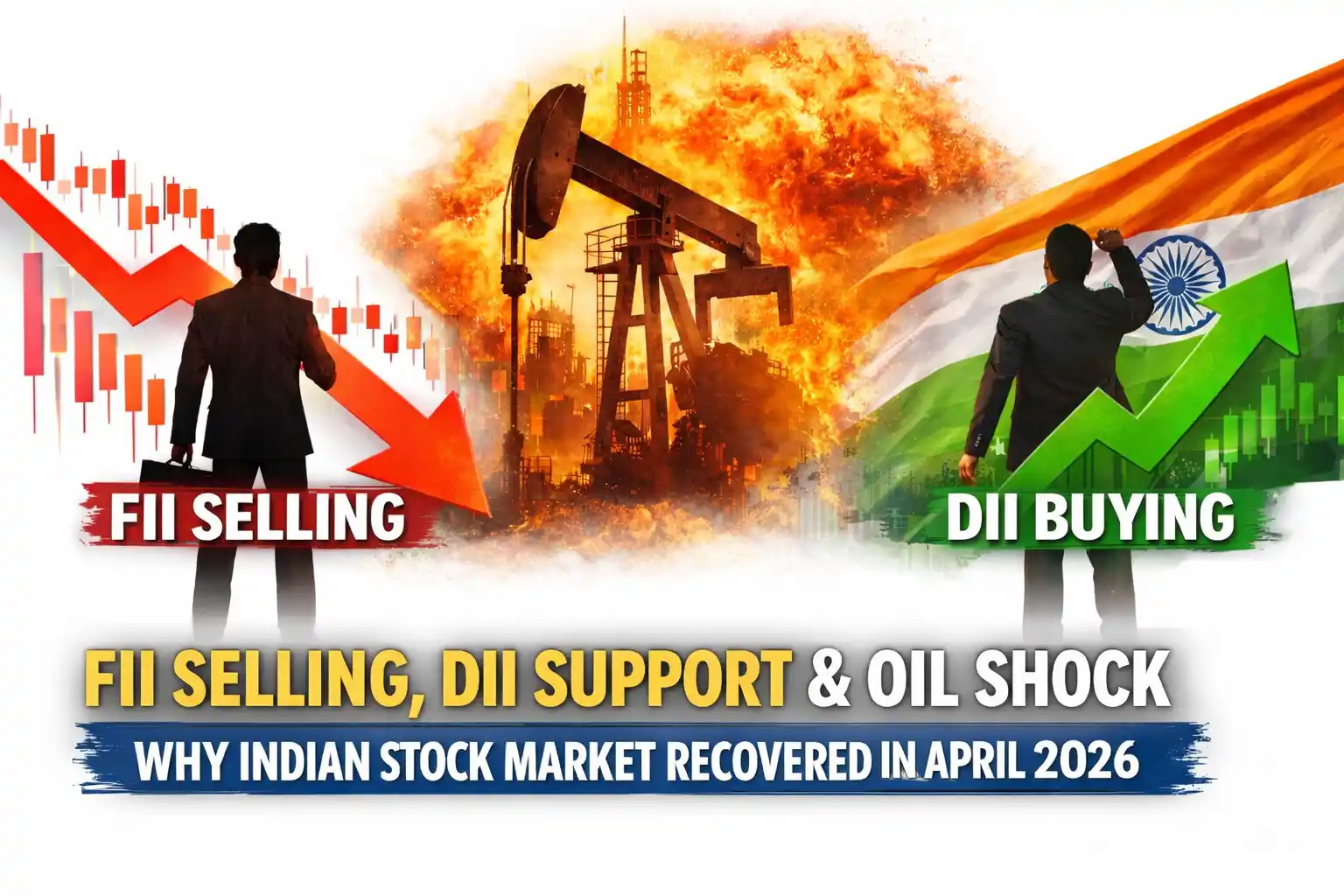
April 2026 has been a highly volatile month for the Indian stock market. On one side, Foreign Institutional Investors (FII) continued heavy selling, while on the other side, Domestic Institutional Investors (DII) provided strong buying support and prevented a major fall.
The interesting part is:
In the last 2–3 trading sessions, the market has shown signs of recovery
This indicates that after a panic phase, the market is now trying to stabilize.
We will clearly understand:
- Latest FII, DII, and oil data
- Real impact on the market
- Reasons behind the recent recovery
- What can happen next
April 2026 FII Data – Strong Selling Pressure
In April 2026, FIIs showed aggressive selling behavior:
- Total net outflow: ₹50,000+ crore (approx.)
- Continuous selling across multiple sessions
- FY26 total outflow: ₹1.5–1.6 lakh crore (record level)
Clear trend:
FIIs are pulling money out of India due to global risk factors
DII Data – Strong Support for the Market
While FIIs were selling, DIIs supported the market strongly:
- Buying trend remains strong in April
- March buying: ₹30,000+ crore
- FY26 total inflow: ₹8 lakh crore+ (record level)
Sources of inflow:
- SIP investments
- Mutual funds
- Insurance companies
Simple takeaway:
Domestic investors have become the backbone of the Indian market
Oil Price – The Biggest Trigger
Brent Crude Oil played a major role in April:
- Prices touched near $100 per barrel
- Spike driven by Middle East tensions
Impact on India:
- Higher import bill
- Rising inflation risk
- Pressure on rupee
Result:
FIIs become cautious and increase selling
Key Reasons Behind Market Decline
1. Global Geopolitical Tensions
- Rising Middle East conflict weakened global sentiment
- Investors shifted towards safer assets
2. US Bond Yield & Dollar Strength
- US yields remain high
- Dollar is strong
For FIIs:
The US looks safer and more attractive compared to emerging markets
3. Federal Reserve Policy Uncertainty
- Delay in expected rate cuts
- Tight global liquidity
4. High Valuation in Indian Markets
- Nifty was near highs
- Midcap and smallcap stocks were expensive
Profit booking was natural
Market Impact (Till Mid-April)
- Nifty corrected around 4–5%
- Midcap & smallcap saw deeper corrections
- Banking and IT sectors faced pressure
However, there was no crash — thanks to strong DII support
Market Recovery in Last 2–3 Days – What Changed?
In recent trading sessions, the market has shown a bounce. Here are the key reasons:
1. Short Covering
- Traders closed their short positions
- This triggered a quick upward move
2. Continued DII Buying
- DIIs are still consistently buying
- Providing a strong base to the market
3. Stability in Oil Prices
- After the spike, oil prices showed some stability
- Panic sentiment eased slightly
4. Oversold Market Condition
- Market became oversold in the short term
- A technical bounce was expected
5. Selective FII Activity
- Selling pressure from FIIs reduced in some sessions
- Selective buying seen in certain stocks
Sector-wise Movement
Weak Sectors
- IT (global slowdown concerns)
- Banking (high FII exposure)
- Metals
Strong / Recovering Sectors
- Pharma
- Defence
- PSU stocks
- Telecom
Clear sector rotation is visible
FII vs DII – The Real Market Battle
| Factor | FII | DII |
| Action | Selling | Buying |
| View | Short-term cautious | Long-term bullish |
| Impact | Volatility | Stability |
Conclusion:
The Indian market is no longer fully dependent on FIIs
What Can Happen Next?
Short Term
- Market may remain volatile
- Consolidation possible after the bounce
Positive Triggers
- Oil prices stabilize
- Geopolitical tensions ease
- Rate cut signals from the Fed
Risk Factors
- Another spike in oil prices
- Escalation of global conflicts
- Continued FII selling
Outcome
April 2026 clearly shows how global factors drive short-term market movements, while domestic investors provide long-term stability.
The recent recovery is a positive sign, but caution is still necessary.
Investor Strategy:
- Avoid panic selling
- Continue SIP investments
- Focus on fundamentally strong stocks
- Ignore short-term volatility