
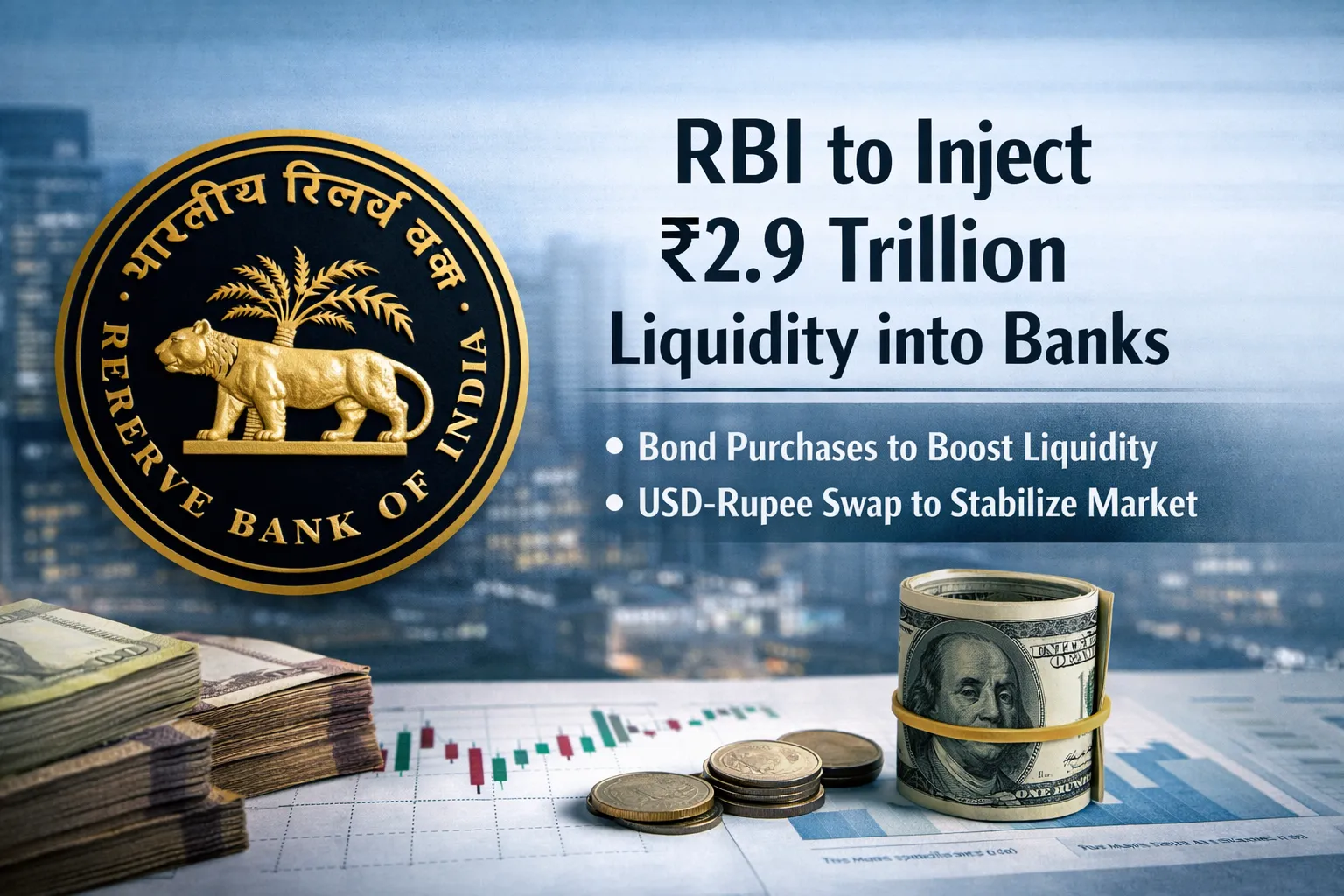
The Reserve Bank of India (RBI) on Tuesday announced a significant liquidity support measure for the banking system, stating that it will inject nearly ₹2.9 trillion into the financial system. The move comes at a time when liquidity conditions have tightened due to tax outflows and foreign exchange interventions.
The central bank said the liquidity infusion will be carried out through a combination of government bond purchases and a USD-INR swap auction, aimed at stabilizing money market rates and ensuring smooth credit flow across the economy.
Market participants see this as a strong signal that the RBI is committed to maintaining financial stability amid rising short-term funding pressures.
What Has the RBI Announced?
The RBI plans to inject liquidity using two key instruments:
1. Open Market Operations (OMO) – Government Bond Purchases
The central bank will purchase government securities from banks in the open market. In return, banks will receive cash, directly increasing rupee liquidity in the system.
2. USD-INR Swap Auction
Under this mechanism, RBI will purchase US dollars from banks and provide rupees, with an agreement to reverse the transaction at a later date. This also adds durable liquidity to the banking system.
Together, these measures amount to nearly $32 billion (approximately ₹2.9 trillion).
Liquidity Injection Schedule
OMO Bond Purchases
RBI will conduct bond purchases in four tranches:
- December 29, 2025
- January 5, 2026
- January 12, 2026
- January 22, 2026
Each operation will involve purchases worth around ₹50,000 crore.
USD-INR Swap Auction
- A $10 billion dollar-rupee swap auction is scheduled for January 13, 2026.
Why Did the RBI Take This Step?
Liquidity in the banking system has come under pressure in recent weeks due to several factors:
- Large advance tax and GST payments, which drained cash from banks
- RBI’s foreign exchange market interventions, which absorbed rupee liquidity
- Increased year-end demand for cash
As a result, overnight money market rates began moving higher, prompting the central bank to act proactively.
Impact on the Banking System
According to market experts, the RBI’s move is expected to:
- Provide immediate relief to banks facing funding constraints
- Help stabilize short-term interest rates
- Support credit growth by ensuring adequate availability of funds
- Improve overall liquidity confidence in the financial system
Effect on Government Bonds and Yields
The RBI’s bond purchases are expected to:
- Increase demand for government securities
- Lead to softening of bond yields
- Reduce borrowing pressure for the government in the near term
Bond market participants have welcomed the announcement, viewing it as supportive for debt markets.
Stock Market Reaction and Outlook
Following the announcement, investors are closely watching banking and financial stocks. Improved liquidity conditions generally support:
- Better market sentiment
- Lower funding costs for corporates
- Stability in equity markets, especially banking stocks
However, overall market direction will also depend on global cues and macroeconomic developments.
Not the First Liquidity Support in 2025
This is not the first time the RBI has stepped in to support liquidity this year. In 2025 so far, the central bank has injected over ₹6.5 trillion into the banking system through various tools, highlighting its active liquidity management approach.
What Economists Are Saying
Economists believe the timing of the RBI’s move is appropriate. Without intervention, funding stress could have intensified and pushed short-term rates sharply higher.
Experts also note that the RBI is trying to strike a balance between supporting economic growth and maintaining monetary discipline, especially amid global uncertainties.
Outcome
The RBI’s decision to inject ₹2.9 trillion into the banking system sends a clear message that the central bank is determined to prevent liquidity stress and ensure financial stability. The move is expected to ease pressure on banks, stabilize interest rates, and support economic activity in the coming weeks.
Market participants will now closely monitor how liquidity conditions evolve and whether further measures are needed as the financial year-end approaches.
Source: RBI docs