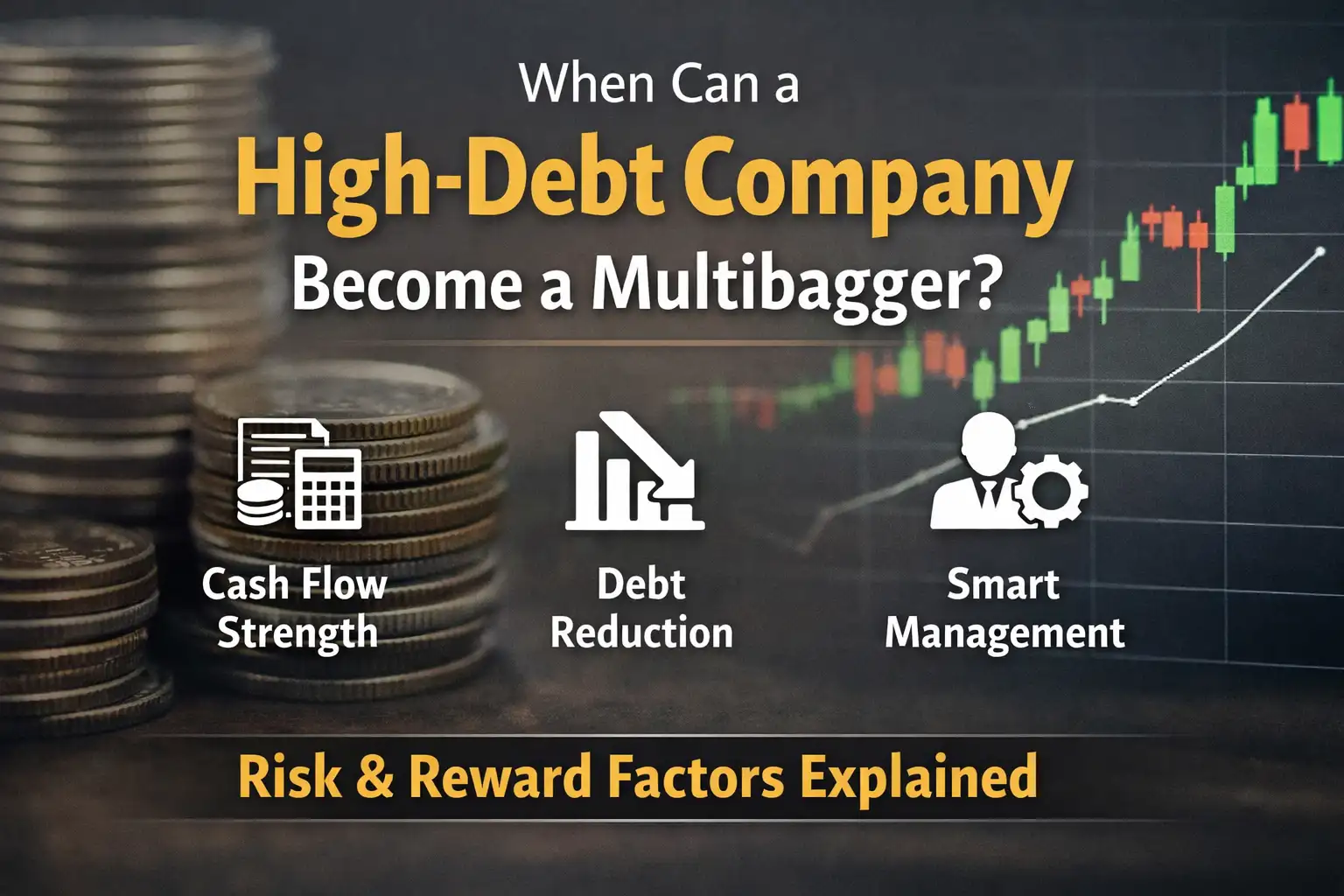
Why Does the Word “Debt” Scare Investors?
In the stock market, the moment investors hear “high-debt company”, the reaction is almost automatic:
👉 Stay away. Too risky. It will collapse.
And honestly, in many cases, this fear is justified.
History is full of companies that collapsed under the weight of debt.
But here’s the lesser-known truth 👇
📌 Some of the biggest multibaggers in market history once carried heavy debt.
The real question is not:
Does the company have debt?
The real question is:
Is the debt destroying the company, or is it helping build the future?
That thin line decides whether a stock becomes a wealth creator or a value trap.
Let’s break it down logically.
First, Understand This: Debt Is Not the Enemy
Debt by itself is neither good nor bad.
What truly matters is:
- Why the debt was taken
- How it is being used
- Whether the business can comfortably service it
A company doesn’t fail because it has debt —
it fails because it cannot manage that debt.
When Debt Is Used for Expansion, Not Survival
✔ Positive Signal:
A high-debt company can become a multibagger when the borrowing is used for:
- Capacity expansion
- New plants or factories
- Infrastructure creation
- Long-term revenue-generating assets
This type of debt is productive debt.
📌 Example:
Imagine a company that:
- Borrows heavily to set up new manufacturing units
- Increases production capacity over 2–3 years
- Operates in a sector where demand is stable or growing
If revenues and margins improve after expansion,
👉 the same debt that looked dangerous earlier becomes a growth engine.
When Operating Cash Flow Turns Strong
Debt becomes deadly only when:
- A company takes new loans just to repay old ones
✔ Multibagger Sign:
A high-debt company starts transforming when:
- Operating cash flow turns positive
- The core business generates enough cash to:
- Pay interest
- Repay principal
- Fund daily operations
In simple terms:
“The business engine is running on its own fuel, not borrowed oxygen.”
Markets reward this transition very quickly.
When Debt Peaks and Then Starts Declining
Markets don’t wait for perfection —
they react to direction.
✔ Powerful Indicator:
- Debt-to-equity was very high earlier
- Now debt has stopped increasing
- Gradually, it starts declining
This shows:
- Management discipline
- Improved cash generation
- Focus on balance sheet repair
At this stage:
- Valuations are usually still low
- But sentiment quietly starts improving
- This is often where multibagger journeys begin
Management Quality Decides Everything
In high-debt companies, management quality is non-negotiable.
✔ Strong Management Signs:
- Promoter stake is stable or increasing
- Clear communication about debt reduction
- Capital allocation is sensible
- No unnecessary acquisitions
❌ Red Flags:
- Frequent equity dilution
- Promoters pledging large shareholdings
- Aggressive expansion without profits
A multibagger emerges when:
👉 Management solves problems instead of just explaining them.
High Debt Works Best in Cyclical Businesses
Sectors like:
- Steel
- Cement
- Infrastructure
- Capital goods
are cyclical by nature.
During downturns:
- Profits fall
- Debt looks scary
- Stock prices crash
But when the cycle turns:
- Prices improve
- Capacity utilisation rises
- Operating leverage kicks in
📌 Result:
Even a small increase in revenue leads to a sharp jump in profits,
and the stock price follows aggressively.
This is how many high-debt cyclical companies turn into unexpected multibaggers.
When a High-Debt Company Can NEVER Become a Multibagger
Let’s be honest — not every high-debt stock is an opportunity.
❌ Avoid companies where:
- The business model itself is weak
- Demand is permanently shrinking
- Cash flows remain negative
- Debt keeps rising every year
Such companies are not undervalued —
they are value traps.
Quick Checklist Before You Bet on a High-Debt Stock
Ask yourself these questions:
- ✅ Is the debt taken for growth, not survival?
- ✅ Is operating cash flow positive?
- ✅ Is total debt stabilising or declining?
- ✅ Is management credible and disciplined?
- ✅ Can the industry cycle support earnings recovery?
If most answers are “Yes”, the stock deserves deeper research.
Final Thoughts: Debt Is a Tool, Not a Verdict
One of the biggest mistakes investors make is using simple labels:
- High debt = bad company
- Low debt = good company
Reality is far more nuanced.
📌 Debt is like a sharp tool —
in the wrong hands, it destroys,
in the right hands, it builds empires.
A smart investor doesn’t fear debt blindly —
they understand it deeply.
Because today’s high-debt company,
handled well,
can quietly become tomorrow’s multibagger.