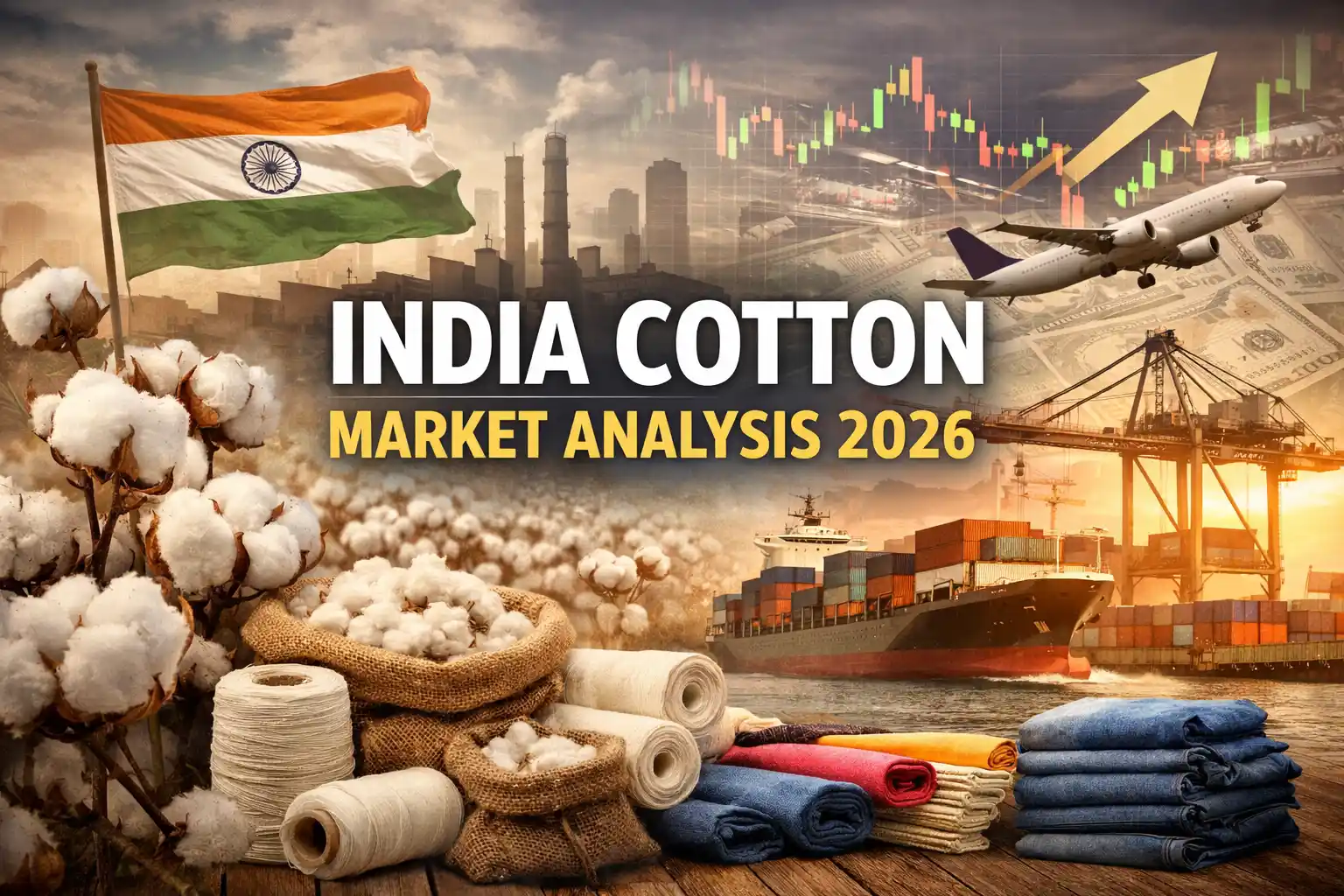
Cotton is the most important raw material for India’s textile industry. Millions of farmers, factory workers, and businesses in India depend directly or indirectly on cotton and textiles for their livelihood.
In recent years, cotton prices and availability have seen major fluctuations due to weather issues, pest attacks, global price movements, and changes in government policy. These changes directly affect textile companies because cotton is their main input cost.
In this report, we will understand in simple language:
- How much cotton India produces
- How much cotton is consumed in the country
- At what price textile companies are buying cotton
- How much cotton India needs to import
- Import duty and tax situation
- Impact of recent trade deals
- Advantages and disadvantages for the industry
- Final outlook for the sector
Cotton Production in India
India is one of the largest cotton-producing countries in the world. Major cotton-producing states include Gujarat, Maharashtra, Telangana, Punjab, and Haryana.
According to industry estimates:
- India’s cotton production in the 2024–25 season is expected to be around 30–32 million bales.
- One bale equals roughly 170 kilograms of cotton.
- This means India produces approximately 5 to 5.4 million tonnes of cotton annually.
However, production has faced pressure in recent years because of:
- Irregular rainfall,
- Pest attacks,
- Reduced cultivation area,
- Rising farming costs.
Production estimates and trade data are regularly monitored by Cotton Association of India, which has also noted lower output compared to peak production years.
How Much Cotton Does India Consume?
India is one of the world’s biggest textile manufacturing countries, so domestic demand for cotton is very high.
Industry estimates show:
- Indian textile mills consume around 30–31.5 million bales per year.
- More than 90% of cotton produced in India is used domestically.
So production and consumption are nearly equal. However, mills still import cotton because:
- Some high-quality varieties are not available locally,
- Domestic prices sometimes become higher,
- Mills need consistent supply.
Current Cotton Prices for Textile Companies
Cotton prices fluctuate based on supply, demand, exports, and policy decisions.
In the current market situation:
- Cotton prices in India are around ₹50,000–₹55,000 per candy.
- One candy equals approximately 356 kilograms.
So textile mills are paying around:
- ₹140–155 per kg for cotton.
A major issue is that Indian cotton sometimes becomes more expensive than global cotton, increasing raw material costs for textile manufacturers and reducing their profit margins.
How Much Cotton Does India Import?
In recent years, India has imported record levels of cotton.
Estimated figures:
- In 2024–25, India imported around 4–4.5 million bales.
- In 2025–26, imports may rise to about 5 million bales.
Cotton imports mainly come from:
- United States
- Brazil
- Australia
- African countries
Imports are required because mills need:
- Better quality cotton,
- Specific cotton varieties,
- Lower-cost cotton when domestic prices rise.
Import Duty and Tax on Cotton
Normally, India imposes an 11% import duty on cotton.
However:
- In 2025, the government temporarily removed duty for a few months to help mills get cheaper cotton.
- Duty has since been restored.
Policy decisions related to cotton imports are taken by Government of India and implemented through bodies such as Ministry of Textiles.
When duty is high:
- Imported cotton becomes expensive,
- Domestic farmers benefit,
- But textile mills face higher raw material costs.
Impact of Recent Trade Deals on Cotton and Textiles
Trade agreements between India and major economies are influencing cotton and textile markets.
Possible impacts include:
- India may get access to cheaper high-quality cotton from the US and other suppliers.
- However, if competing countries get better export benefits in global markets, Indian textile exporters may face tougher competition.
So:
- Raw material may become cheaper,
- But finished textile exports may face higher competition globally.
Impact on Textile Industry
Advantages
- Mills get access to better quality cotton through imports.
- Production stability improves when supply shortages are reduced.
- Export orders become easier to fulfill.
- Raw material shortages decrease.
Disadvantages
- Higher domestic cotton prices reduce profit margins.
- Farmers may suffer if prices fall too much due to imports.
- Dependence on imports increases.
- Industry becomes sensitive to global price changes.
Final Conclusion
India remains strong in cotton production, but output growth is not keeping pace with textile industry demand. Textile manufacturing is crucial for employment and exports, so stable and affordable cotton supply is essential.
Going forward, three key improvements are needed:
- Higher cotton farm productivity,
- Better cotton quality,
- Stronger global competitiveness for textile exporters.
If production improves and prices remain stable, India’s textile sector can further strengthen its position in the global market.
Note: This analysis is based on currently available market data and industry estimates, and actual market conditions may change over time.