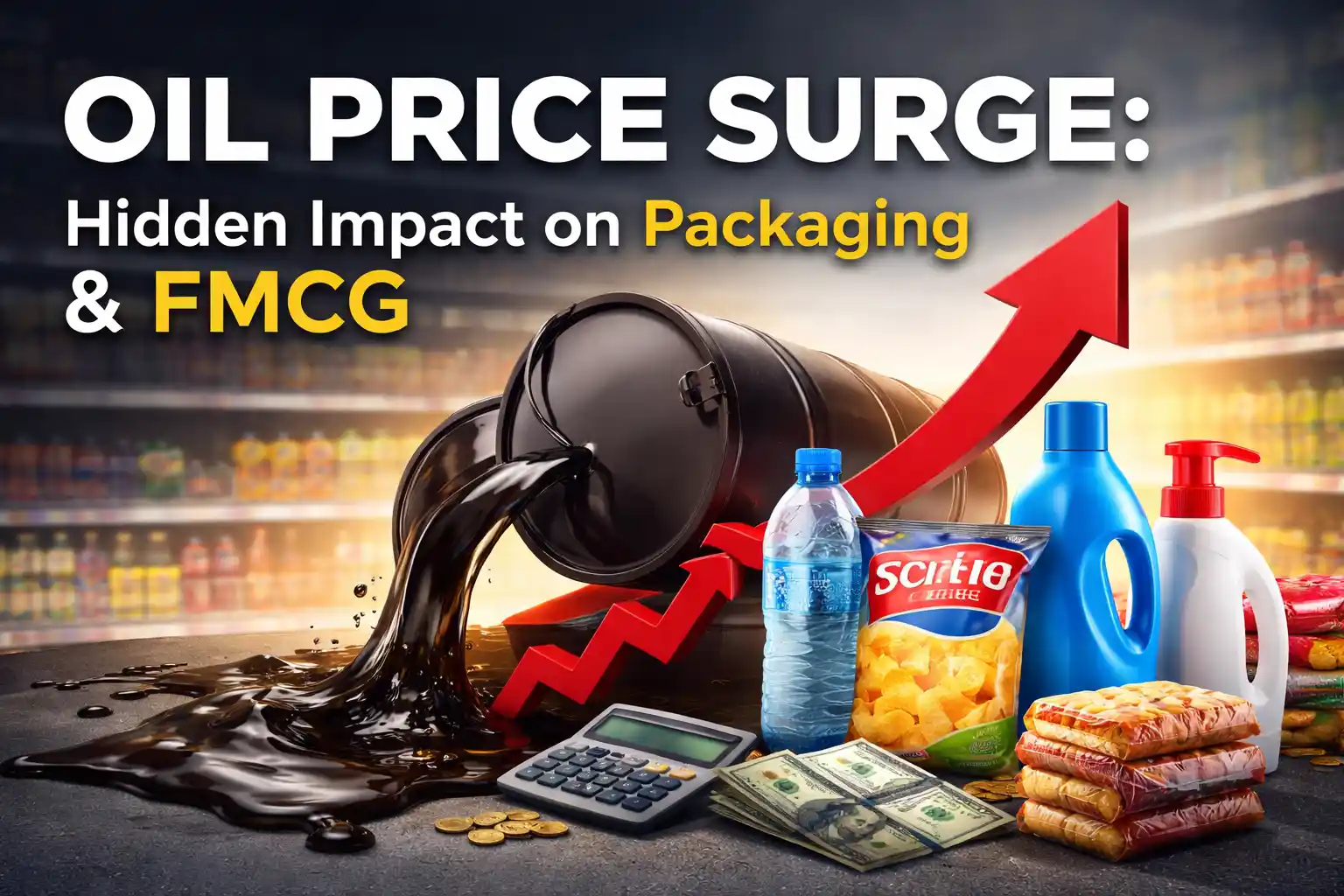
Whenever oil prices rise, most people only notice petrol and diesel becoming expensive. But the real impact goes much deeper. Oil is not just a fuel — it is the backbone of the global economy, supporting packaging, manufacturing, transportation, and daily-use products.
This means when oil becomes expensive, its effect gradually spreads to almost everything we use in our daily life — from a biscuit packet to a shampoo bottle to an online delivery box.
In this article, we will clearly understand step-by-step how an oil price surge creates a chain reaction and impacts packaging, FMCG, and everyday products.
Packaging Industry: Fully Dependent on Oil
The packaging industry heavily depends on oil-based raw materials.
How is it connected to oil?
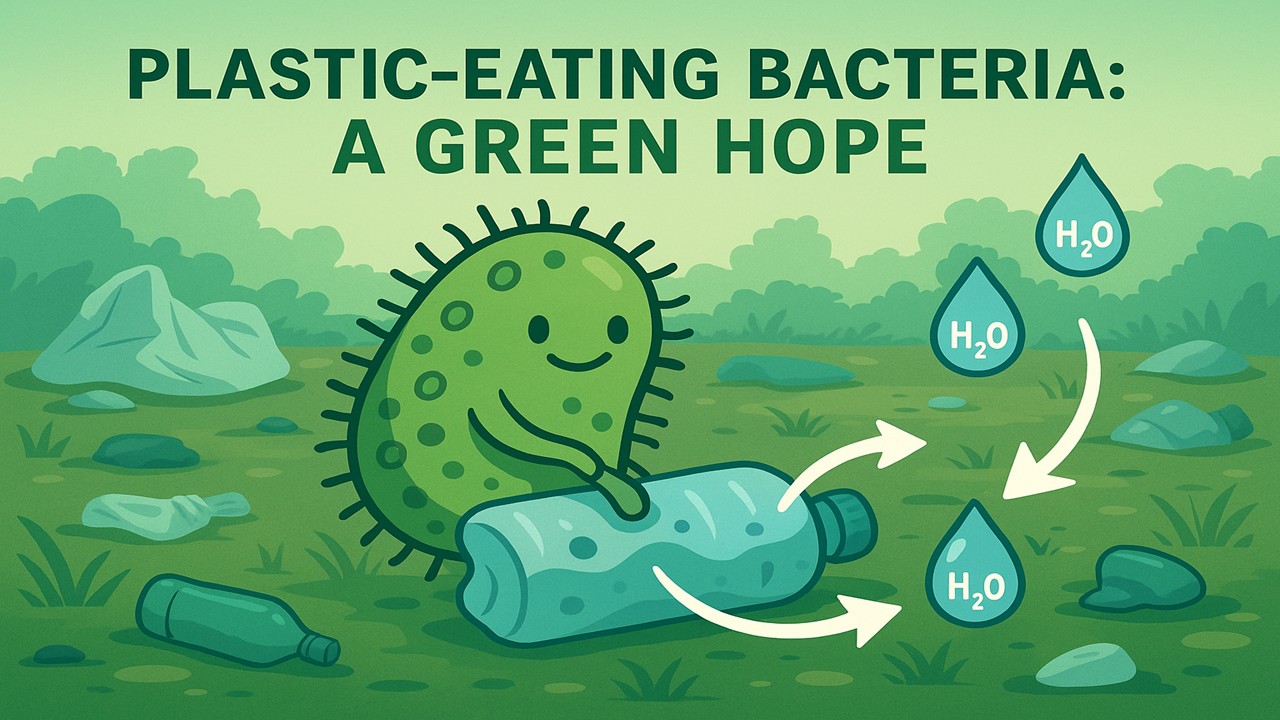
- Plastic (Polyethylene, Polypropylene) is made from crude oil
- Flexible packaging (chips packets, wrappers) uses petrochemicals
- Bottles, containers, and caps are derived from oil
What happens when oil prices rise?
- Crude oil becomes expensive → petrochemicals become expensive
- Petrochemicals become expensive → plastic cost increases
- Plastic cost increases → packaging cost rises
Example:
- Cost of water bottles increases
- Biscuit wrappers become expensive
- Shampoo bottle production cost rises
Result: Overall production cost for companies increases
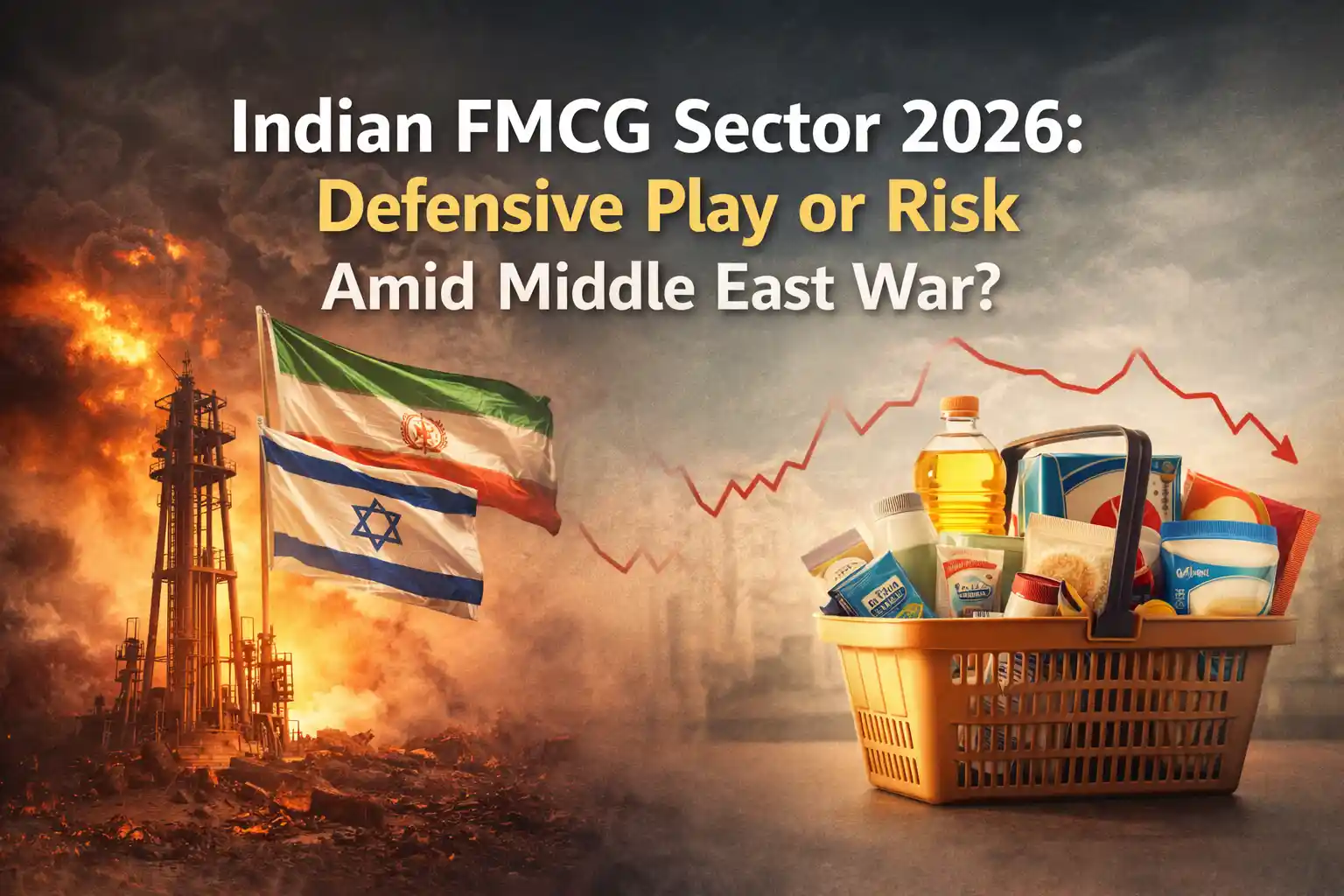
Also read : Indian FMCG Sector 2026: Defensive Play or Risk Amid Middle East War?
FMCG Sector Faces Double Impact
The FMCG (Fast Moving Consumer Goods) sector is highly affected because it operates on high volume and low margins.
Two major reasons:
(1) Packaging Cost Increase
As discussed, packaging is oil-dependent — so FMCG product costs directly rise.
(2) Transportation Cost Increase
- Raw materials are transported to factories
- Finished goods are distributed to markets
Both depend on fuel → cost increases
Final Impact:
- Total product cost rises significantly
- Companies either increase prices or reduce quantity
Example:
- A ₹10 snack becomes ₹12
- Or remains ₹10 but quantity is reduced
This is called Shrinkflation (same price, less quantity)
Transportation: The Biggest Hidden Factor
One of the most powerful impacts of rising oil prices is on logistics.
How the supply chain works:
- Supplier → Factory
- Factory → Warehouse
- Warehouse → Retailer
- Retailer → Customer
Fuel is used at every stage
When fuel becomes expensive:
- Truck freight charges increase
- Shipping costs rise
- Air cargo becomes even more expensive
Domino Effect:
- Raw material becomes expensive
- Production becomes expensive
- Distribution becomes expensive
- Final product becomes expensive
A small increase in oil price affects the entire chain
Also read: Indian FMCG Sector 2026: Defensive Play or Risk Amid Middle East War?
Daily Use Products: Real-Life Impact
Now let’s see how this affects everyday consumers.
Products affected:
- Packaged food (biscuits, chips, noodles)
- Personal care (soap, shampoo, creams)
- Household items (detergents, cleaners)
- Bottled beverages (water, soft drinks)
What changes in the market:
- MRP increases gradually
- Discounts and offers reduce
- Pack sizes shrink
- Slight quality adjustments may happen
These changes happen slowly, not suddenly
How Companies Manage Rising Costs
Companies face a big challenge — rising costs but price-sensitive customers.
Strategies used by companies:
1. Shrinkflation
- Reduce quantity
- Keep price same
2. Gradual Price Hike
- Increase prices slowly, not suddenly
3. Cost Cutting
- Slightly reduce packaging quality
- Use cheaper materials
4. Efficiency Improvement
- Increase bulk production
- Improve supply chain efficiency
The goal is to protect profit margins
Impact on Global Supply Chain
Oil price surge also affects the global economy.
Effects:
- Import/export costs increase
- Shipping routes become expensive
- Delivery delays rise
Example:
- Raw materials imported from other countries become costly
- Export businesses face higher costs
This impacts global trade and economic growth
Hidden Inflation: The Biggest Risk
The most dangerous impact of rising oil prices is Hidden Inflation
What is Hidden Inflation?
- Prices increase gradually
- Consumers don’t notice immediately
How it appears:
- A ₹20 product becomes ₹22
- A ₹50 pack becomes smaller
But overall monthly expenses increase
Final Conclusion
Oil price surge works like a chain reaction that spreads across the entire economy.
Key Takeaways:
- Packaging industry is affected first
- FMCG sector faces double pressure
- Transportation costs impact the entire supply chain
- Daily use products become expensive
- Hidden inflation reduces purchasing power
So, oil prices are not just about fuel — they directly impact your monthly budget and lifestyle.