
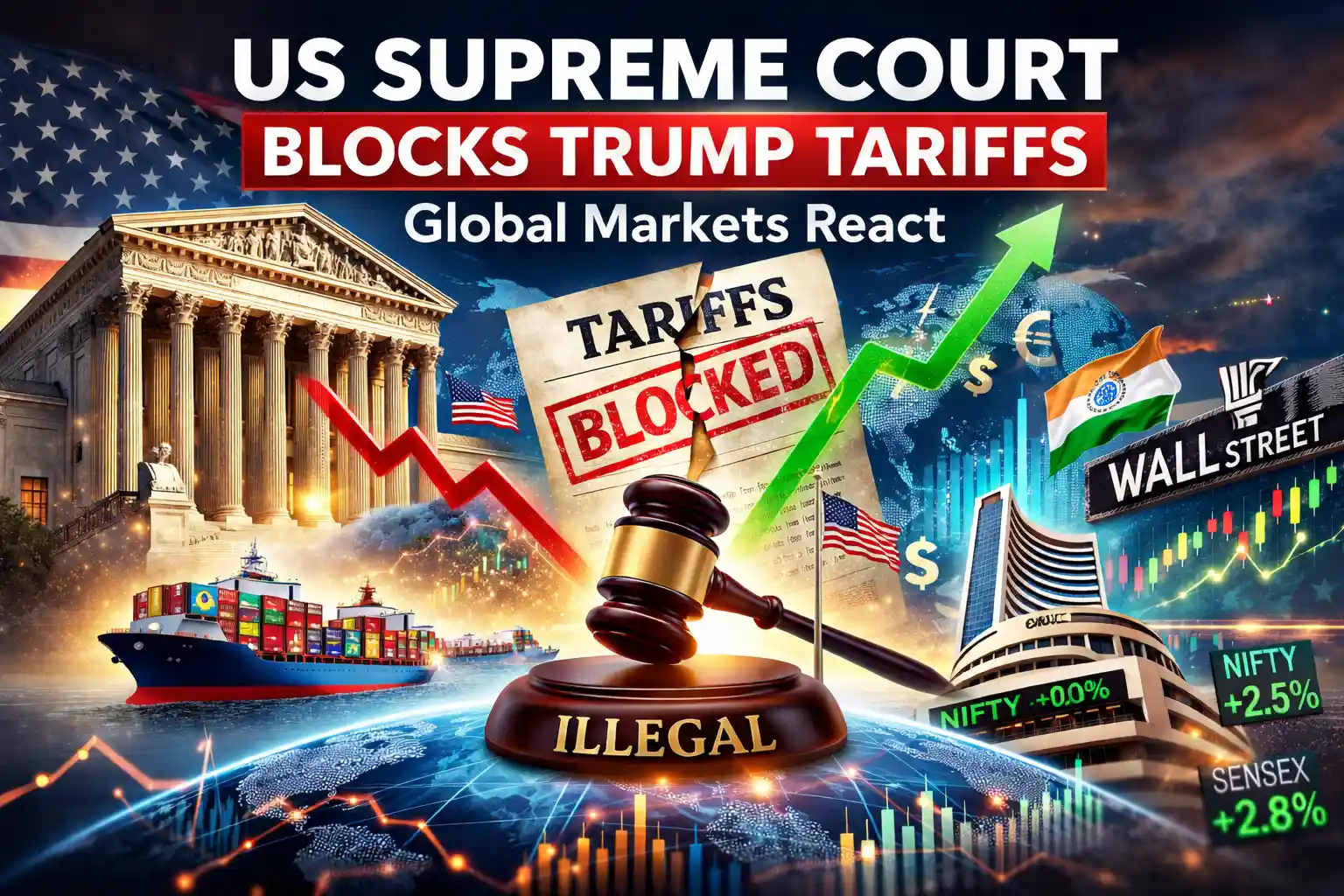
On February 20, 2026, the U.S. Supreme Court delivered a landmark judgment that reshaped the global trade narrative. In a 6–3 majority decision, the Court ruled that several broad tariffs imposed by former President Donald Trump were unconstitutional.
This ruling is not just a legal development—it has major implications for global markets, international trade, and investor sentiment worldwide. In this article, we break down the legal reasoning, political reaction, market impact (both US and India), future outlook, and the overall outcome of the decision.
A Historic Ruling: Trump Tariffs Declared Illegal
The Supreme Court ruled that the President does not have unilateral authority to impose sweeping global tariffs without clear authorization from Congress.
The majority opinion emphasized:
- Tariffs are a form of taxation.
- Under the US Constitution, the power to levy taxes rests with Congress—not the President.
- Executive authority cannot override legislative powers in trade policy.
This decision reinforces the constitutional principle of separation of powers.
What Is IEEPA and Why Did the Court Reject It?
Trump had imposed these tariffs under the International Emergency Economic Powers Act (IEEPA), a 1977 law that grants the President authority to regulate economic transactions during a national emergency.
However, the Court found:
- The term “tariff” is not explicitly mentioned in IEEPA.
- The law was designed for emergency financial controls—not broad trade taxation.
- Using emergency powers to reshape trade policy exceeds constitutional limits.
Therefore, the Court concluded that IEEPA could not be used as a legal basis for imposing wide-ranging import duties.
The 6–3 Decision and Judicial Divide
Majority (6 Justices):
- The Executive Branch overstepped its authority.
- Trade taxation powers belong exclusively to Congress.
Dissenting Justices (3 Justices):
- Argued that the emergency powers language in IEEPA is broad.
- Suggested the President needs flexibility to respond to economic threats.
Despite the disagreement, the ruling sends a strong message about maintaining institutional balance between the Executive and Legislative branches.
Which Tariffs Are Affected?
Following the ruling:
❌ Global tariffs imposed under IEEPA were immediately invalidated.
✔️ Sector-specific tariffs (such as those on steel or automobiles imposed under different legal provisions) may remain in place.
This distinction is important because it limits the ruling to tariffs enacted under emergency authority, not all trade restrictions.
Trump’s Reaction and the New 10% Tariff Move
After the decision, Donald Trump criticized the ruling, arguing that it weakens America’s ability to defend its trade interests.
He subsequently invoked Trade Act of 1974 (Section 122) to impose a temporary 10% global tariff for up to 150 days.
This indicates that while the Court blocked one legal pathway, trade tensions and policy debates are far from over.
Global Economic Impact
The ruling triggered immediate reactions across global financial markets:
- Improved stability in currency markets
- Easing concerns among exporters
- Positive movement in global equity indices
There are also discussions about potential tariff refunds, which could cost the US Treasury an estimated $130–$175 billion, adding fiscal pressure.
Impact on US Markets
The decision initially boosted investor sentiment on Wall Street.
Short-Term Effects:
- Relief rally in major indices
- Gains in import-dependent and retail stocks
- Reduced uncertainty around trade costs
Medium-Term Risks:
- Political uncertainty remains
- Possibility of new tariff frameworks
- Ongoing trade tensions with key global partners
Overall, markets responded positively, but long-term clarity depends on future policy actions.
Impact on Indian Markets
For India, the ruling carries significant implications:
Export Boost Potential
If US import duties are reduced:
- Textile exporters
- Pharmaceutical companies
- Engineering goods manufacturers
may benefit from improved pricing competitiveness.
Metals & Chemicals
Lower trade barriers could reduce cost pressures for Indian exporters in steel and specialty chemicals.
Stock Market Sentiment
Export-oriented sectors in India could witness renewed buying interest, especially if US trade policy stabilizes.
However, if new tariffs are introduced under different legal provisions, volatility may return.
Future Outlook
Looking ahead:
1️⃣ Congress may clarify or tighten trade authority laws.
2️⃣ Future administrations could adopt alternative legal routes for tariffs.
3️⃣ US-China and broader global trade relations may reset.
4️⃣ Markets may experience short-term stability but long-term policy uncertainty.
For investors, monitoring policy developments will be crucial.
Outcome
The Supreme Court’s ruling is more than a trade decision—it is a constitutional milestone.
✔️ It reinforces that tariff and taxation powers lie with Congress.
✔️ It limits executive overreach in trade matters.
✔️ It provides short-term relief to global markets.
✔️ Yet, it does not eliminate political and policy risks.
In conclusion, while markets welcomed the decision, the future of US trade policy remains a dynamic and evolving story. Investors and businesses worldwide will now watch closely to see whether America moves toward trade stability—or enters a new phase of tariff debates.
Source: law cornell supreme justia