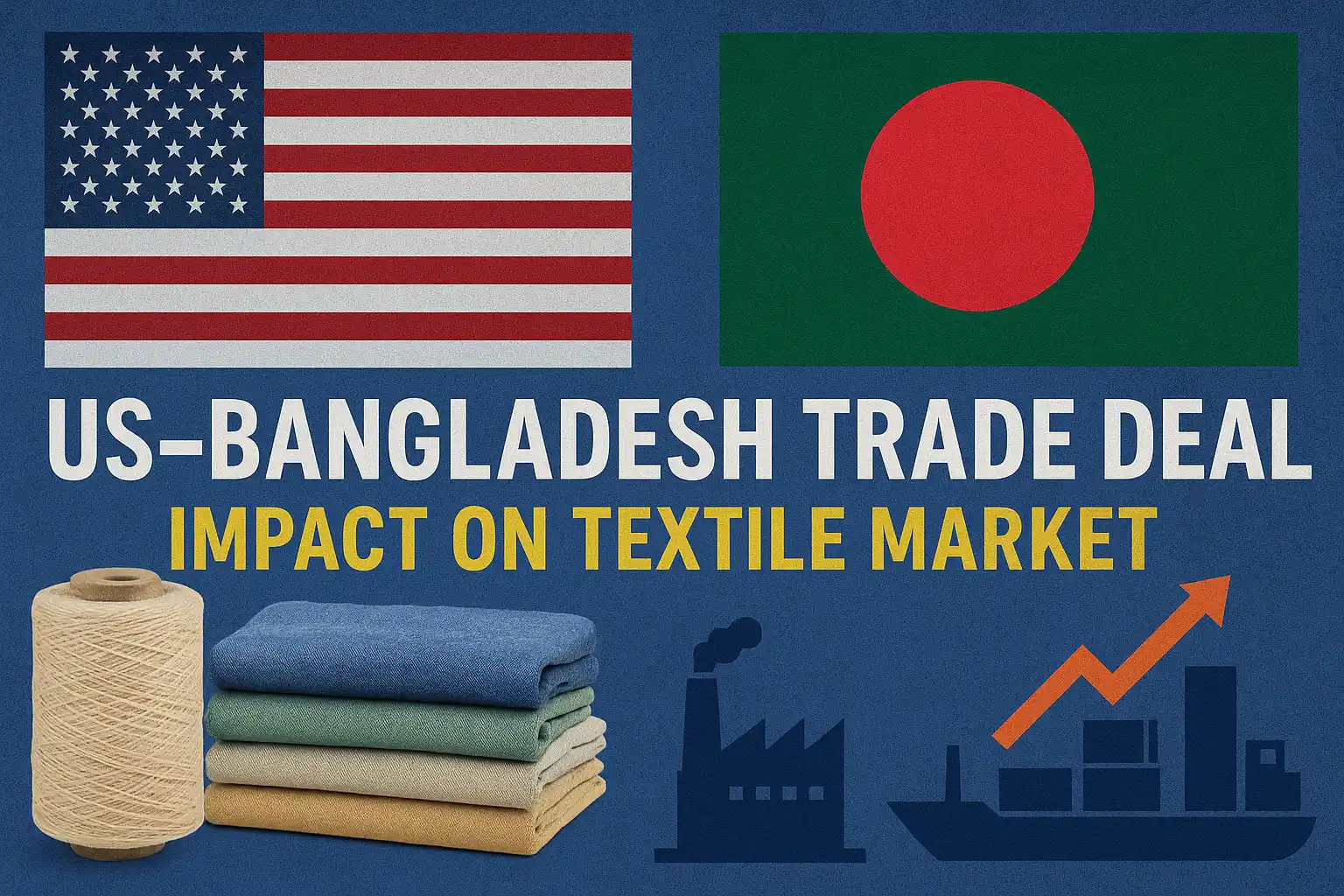
A major shift has emerged in the global textile and garment industry after the United States and Bangladesh signed a new trade agreement on 9 February 2026. This deal is not only important for the two countries involved but also has implications for other export-driven economies in South Asia, particularly nations like India and Vietnam that compete in the same markets.
The United States remains the world’s largest consumer market, and easier access to it can significantly boost exports. Changes in tariff structures often influence sourcing decisions, pricing competitiveness, and order allocation among exporting countries. That is why this agreement has attracted attention across global trade and business circles.
Trade Agreement Overview
The United States and Bangladesh signed a bilateral trade agreement called the Agreement on Reciprocal Trade on 9 February 2026, aimed at strengthening economic cooperation and improving market access between the two countries.
Under this agreement:
- The U.S. reduced tariffs on most Bangladeshi exports to 19%, down from around 20% earlier.
- A special provision allows certain textile and garment products to enter the U.S. market at zero tariff, but only when those products are made using U.S.-origin cotton or synthetic fibers.
- The agreement is seen as a step toward deeper economic and trade cooperation between the two nations.
However, it is important to note that India already enjoys roughly an 18% tariff level on many exports to the U.S., which remains slightly better than Bangladesh’s general tariff rate.
What Is a Tariff and Why It Matters
A tariff is a tax imposed by a country on imported goods. Higher tariffs make imported goods more expensive, while lower tariffs make them more competitive in the importing country.
Under this deal:
- Tariffs on Bangladeshi goods entering the U.S. have been reduced to 19%, making exports more competitive.
- Certain garments can enter duty-free if U.S. raw materials are used.
This especially benefits Bangladesh’s garment industry, which is the backbone of its export economy.
However, since India’s general tariff rate is already slightly lower, the competitive advantage for Bangladesh mainly exists in selected garment categories where zero tariff applies.
Impact on Bangladesh’s Textile and Garment Industry
Bangladesh is one of the world’s largest garment exporters, and the U.S. is among its biggest markets.
Tariff reduction improves competitiveness through:
✔ Lower landed cost for U.S. buyers
✔ Potential increase in export orders
✔ Possible factory expansion and job creation
Additionally, garments produced using U.S. cotton and fibers can now enter the U.S. without tariff, making those products cheaper and more attractive to American buyers.
What Bangladesh Gives in Return
Trade agreements are mutual. In return for tariff concessions, Bangladesh agreed to offer better market access to U.S. goods, including:
- Machinery and automobiles
- Chemicals and medical equipment
- Dairy products, meat, poultry, fruits, nuts, soy products
- Other agricultural and industrial goods
This makes American products more competitive in Bangladesh’s domestic market.
Expected Economic Impact
📌 For Bangladesh
- Higher export potential, especially in garments.
- Possible increase in employment in export industries.
- Improved investor confidence due to better U.S. market access.
📌 For the United States
- Expanded export opportunities in Bangladesh.
- Growth opportunities for U.S. agriculture and industrial sectors.
Overall, trade relations between both nations are expected to deepen.
How This Affects Other Countries, Including India
The agreement also affects regional exporters:
- India currently faces around 18% tariff levels, slightly lower than Bangladesh’s general tariff rate.
- However, Bangladesh gains an advantage in specific garment categories that qualify for zero tariff, potentially increasing competition in low-cost apparel segments.
Thus, countries competing in textile exports to the U.S., including India and Vietnam, may see greater competition, particularly in price-sensitive apparel segments.
Trade deals like this can gradually shift global sourcing patterns.
✅ Outcome: What Could Happen Next?
In the coming months, it will become clearer how global apparel brands and retailers adjust their sourcing strategies. If Bangladesh successfully expands production in zero-tariff categories, competition in low-cost garment exports could intensify.
However, countries like India, which have stronger supply-chain integration and diversified textile production, may continue to maintain strength in higher-value and premium segments.
Overall, this agreement marks the beginning of a new competitive phase in global textile trade, with clearer impacts likely to emerge over the next 6–12 months.
Source: The whitehouse