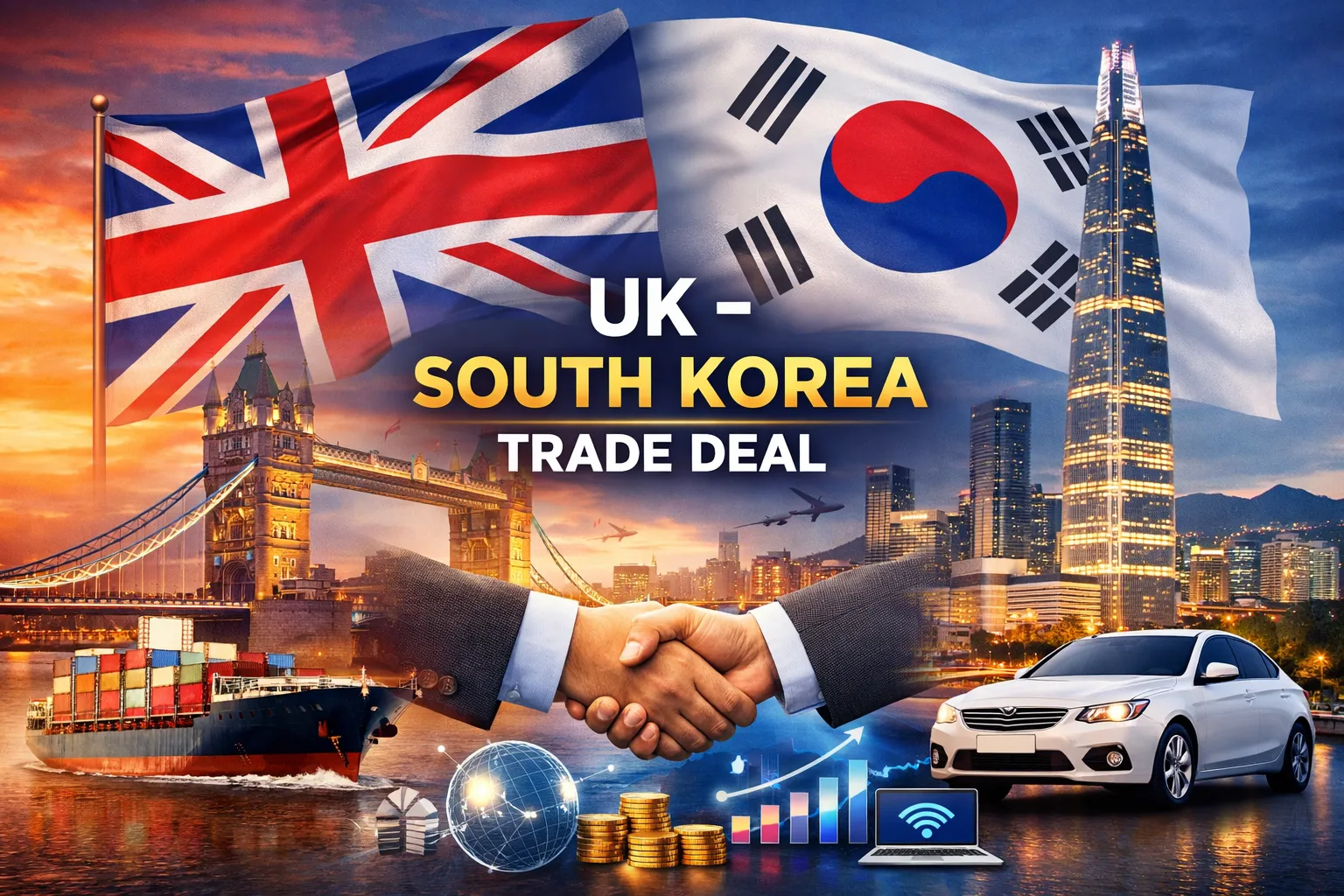
The United Kingdom and South Korea on 15 December 2025 signed an upgraded Free Trade Agreement (FTA) aimed at strengthening bilateral trade, expanding market access for businesses, and modernising rules around digital trade and services. The deal replaces the existing post-Brexit continuity agreement and is being seen as a key part of the UK’s global trade strategy.
What Is the UK–South Korea Trade Deal?
The new agreement updates and modernises the trade deal that both countries had been operating under since 2019. That earlier arrangement was temporary and due to expire in 2025. The newly signed deal creates a long-term and stable framework for trade between the two economies.
Nearly All Goods to Be Traded Without Tariffs
Under the upgraded agreement, around 98% of goods traded between the UK and South Korea will be tariff-free.
This means most products will move across borders without import duties, reducing costs for exporters and making goods more competitive in both markets.
Government estimates suggest the deal could benefit more than £2 billion worth of UK exports.
Major Relief for the Automotive Sector
One of the most important changes relates to rules of origin, especially for cars and auto parts.
- Earlier, vehicles needed 55% local content to qualify for tariff-free access
- Under the new deal, this requirement has been reduced to 25%
This change allows UK car manufacturers to source components globally while still enjoying duty-free access to the South Korean market, making supply chains more flexible and efficient.
Strong Focus on Digital Trade and Services
The agreement goes beyond goods and places strong emphasis on digital trade and the services sector.
Key highlights include:
- Legal recognition of electronic contracts
- Improved market access for financial, legal, and professional services
- Clearer rules for digital business and cross-border services
These provisions are expected to support UK companies operating in finance, technology, consulting, and digital services in South Korea.
Food, Drink and Pharma Sectors Set to Gain
Several industries are expected to benefit from the deal, including:
- Food and beverages such as Guinness and Scottish salmon
- Pharmaceuticals
- Manufacturing and engineering goods
- Digital and technology services
Lower trade barriers are expected to reduce costs and improve competitiveness for companies in these sectors.
Why the Deal Matters
South Korea is among the world’s top ten economies, making it a strategically important trading partner for the UK.
Analysts say the deal:
- Strengthens the UK’s post-Brexit trade presence in Asia
- Reduces uncertainty for businesses
- Supports investment and job creation
- Improves supply-chain resilience
For South Korea, the agreement offers better access to UK goods, services, and expertise, particularly in finance and advanced manufacturing.
Challenges to Watch
Despite the positive outlook, experts note some challenges:
- Full implementation will take time
- Certain non-tariff barriers, such as regulatory standards, may remain
- Global economic uncertainty could still affect trade volumes
Outcome
The UK–South Korea upgraded trade deal marks an important step in strengthening economic ties between the two nations. With tariff-free trade on most goods, simplified rules for manufacturers, and strong support for digital and service-based industries, the agreement is expected to provide long-term benefits for businesses on both sides.
For the UK, the deal reinforces its strategy of expanding trade partnerships beyond Europe, while South Korea gains a more open and predictable framework for cooperation with one of the world’s major service economies.
Source: UK Gov news
Join our chatroom Bizchat for professional talks and more!