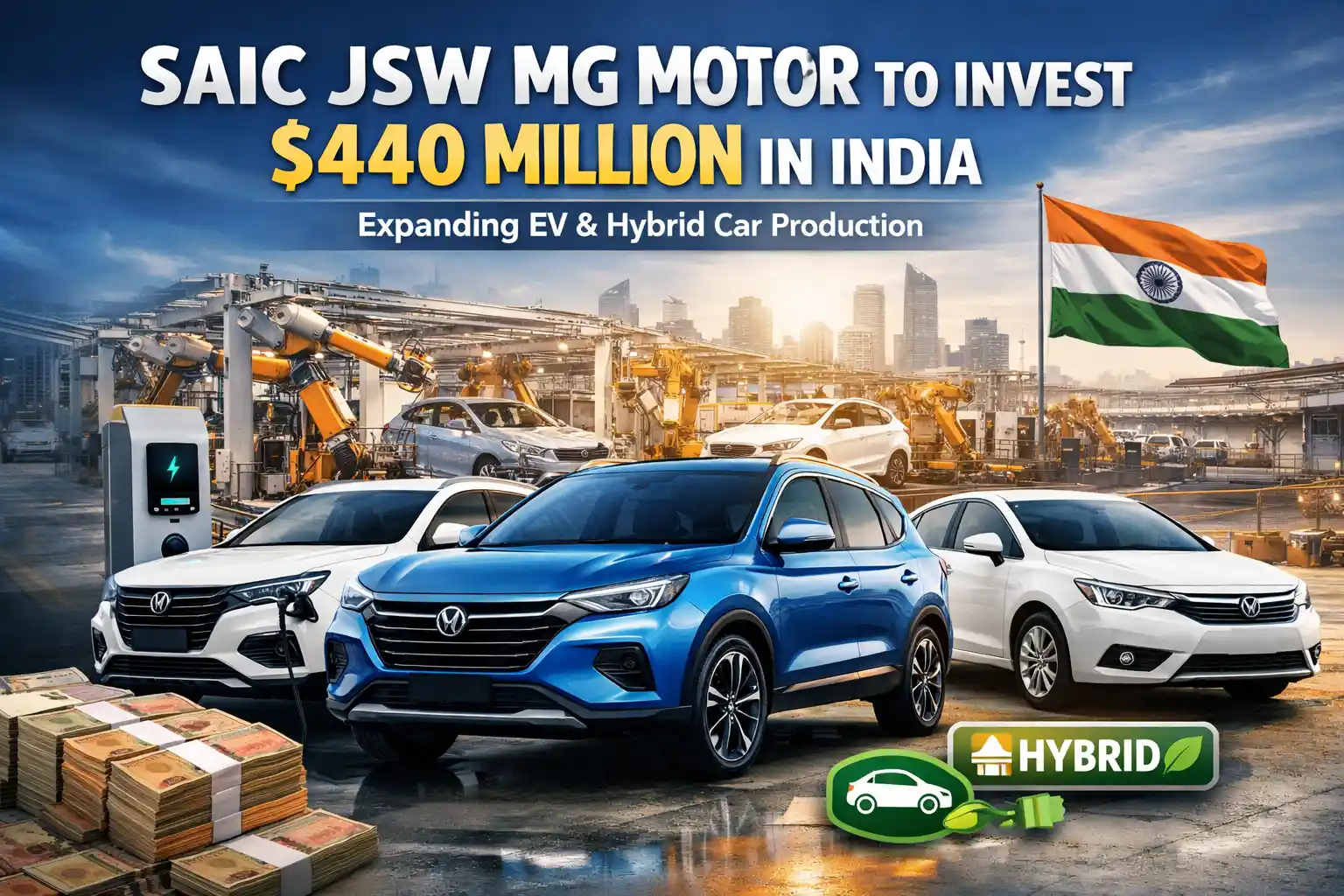
In a major development for India’s automobile industry, JSW MG Motor — a joint venture between China’s SAIC Motor and India’s JSW Group — has announced plans to invest up to $440 million (around ₹3,000–₹4,000 crore) to expand its manufacturing capacity and launch new vehicles focused on hybrid and electric technology.
This investment comes as part of the company’s strategy to strengthen its presence in India’s fast‑growing new energy vehicle (NEV) market and compete more effectively with other major carmakers.
➤ What Is JSW MG Motor and the SAIC Partnership?
JSW MG Motor is a joint venture (JV) formed by:
- SAIC Motor – One of China’s largest automakers with global technology and manufacturing experience.
- JSW Group – A major Indian business conglomerate with strong financial backing and market reach in India.
The JV operates out of a manufacturing plant in Halol, Gujarat, where it currently produces several MG brand cars for the Indian market. These include both conventional petrol models and electric vehicles like the MG Windsor EV, which has been contributing significantly to its sales growth.
➤ Details of the Investment Plan
Under the new expansion plan announced on 15 February 2026, the company will:
🔹 Invest between $330 million and $440 million (₹3,000–₹4,000 crore) over the next few years.
🔹 Increase annual production capacity from around 120,000 cars per year to 300,000 cars per year.
🔹 Launch 3–4 new car models in 2026, including hybrid and electric vehicles, and one plug‑in hybrid.
This upgrade will involve extensive changes to the plant, such as improvements in the paint shop, body shop and overall assembly line, making it capable of handling larger volumes and advanced EV technologies.
➤ Focus on Hybrids and EVs (NEVs)
The company calls its electric and hybrid vehicles New Energy Vehicles (NEVs). As part of its future strategy:
✅ At least 75 % of all vehicles it sells will be NEVs — significantly higher than the current share.
✅ The company expects NEVs to capture about 30 % of total annual car sales in India by 2030 (compared to roughly 5 % today).
This focus shows that JSW MG Motor is aiming not just to sell more cars, but to lead the shift toward cleaner electric and hybrid mobility in India, where demand for such vehicles continues to rise.
➤ Current Business Performance and Challenges
Despite rising sales, JSW MG Motor has not yet turned profitable:
📌 In the financial year ending March 2025, the company reported a loss of $121 million.
📌 It had approximately $60 million in cash and $344 million in borrowings at that time.
📌 Car sales increased to 70,500 units in 2025 from 61,000 in 2024, mainly due to strong demand for the Windsor EV.
To reduce costs and improve profit margins, the company plans to source more components locally within India rather than importing them, which will cut overseas freight costs and reduce reliance on foreign currency.
➤ Why This Investment Matters
This announcement is a significant moment for India’s EV and hybrid market:
🔸 India is now one of the world’s fastest‑growing car markets. Automakers are intensifying efforts to shift toward greener technologies as customer demand rises.
🔸 Tripling production capacity signals JSW MG Motor’s intent to be among the major players in the NEV space, competing with companies like Tata Motors, Hyundai, Maruti Suzuki and BYD.
🔸 The move also reflects slowly improving political and trade ties between India and China, easing some restrictions on foreign investments.
➤ What Comes Next?
The next phase for JSW MG Motor will involve:
🚘 Launching new hybrid and electric models in the Indian market throughout 2026.
🏭 Completing the factory expansion over the next 2–3 years.
💡 Strengthening local supplier partnerships to further cut costs and reduce dependency on parts imports.
If successful, this expansion could help JSW MG Motor not only increase sales but also move closer to profitability while shaping the future of cleaner mobility in India.
Summary – Key Points at a Glance
| Aspect | Details |
| Investment Amount | $330–$440 million (₹3,000–₹4,000 crore) |
| Production Increase | 120,000 → 300,000 vehicles/year |
| New Models | 3–4 hybrid & EV launches in 2026 |
| NEV Focus | 75% of product lineup by NEVs |
| Profit Status | Still loss‑making, but sales rising |
| Strategy | Local sourcing to cut cost |
Source: JSW group & Media reports (Reuters, Business Standard, Outlook Business, Economic Times)