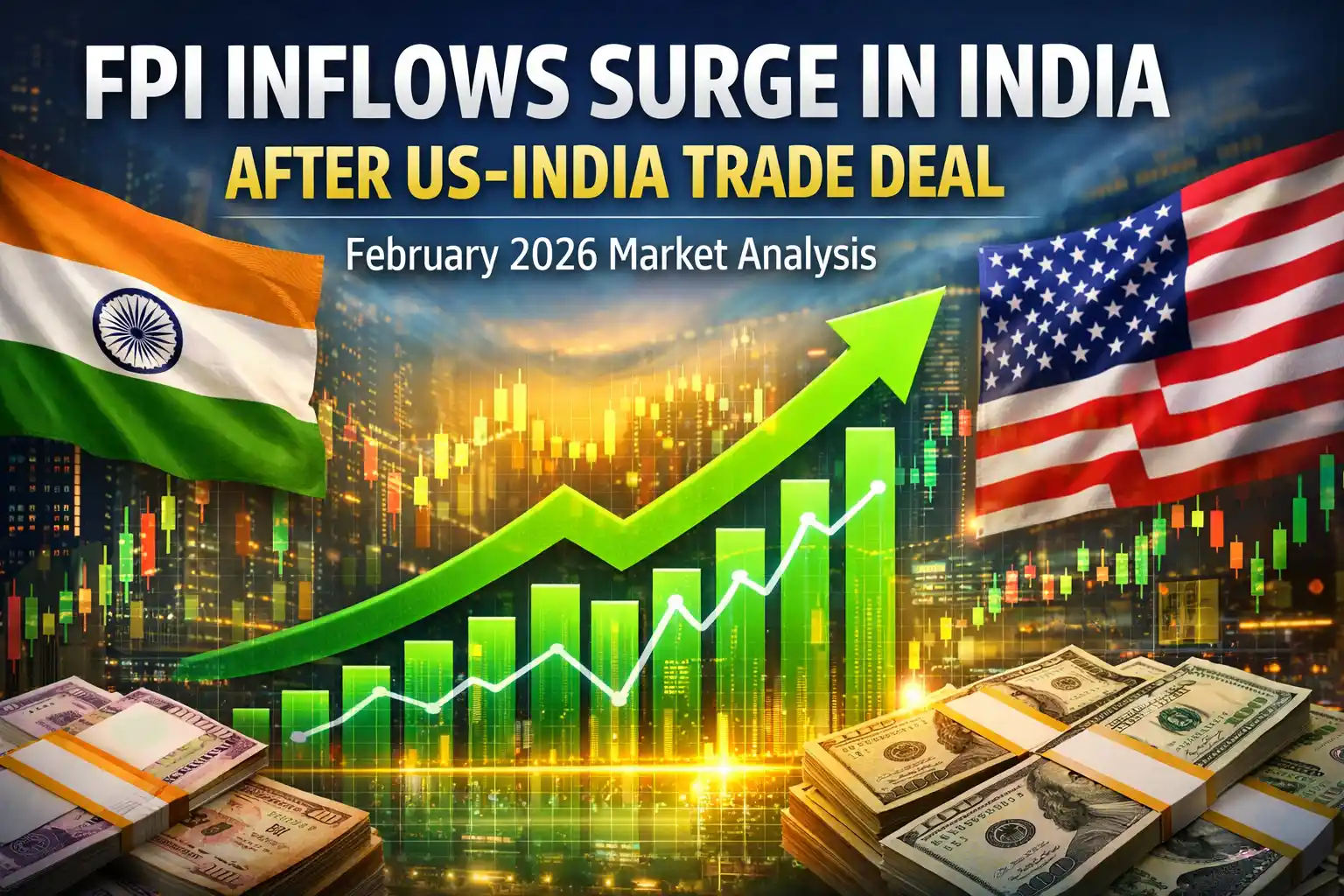
Foreign Portfolio Investors (FPIs) made a notable return into Indian equity markets, reversing a prolonged cycle of outflows that had weighed on investor sentiment. In the first half of February, FPIs invested ₹19,675 crore in Indian stocks — a significant rebound after months of heavy selling. This shift has been closely linked to optimism surrounding the India‑US trade deal and improving global macroeconomic cues.
This article explains what led to this turnaround, the details of the data, how markets have responded, and what this could mean going forward.
Understanding FPIs and Why They Matter
Foreign Portfolio Investors (FPIs) are international investors such as foreign mutual funds, pension funds, and investment firms. They invest in shares listed on Indian exchanges but do not take direct management control of Indian companies.
Their investment flows are closely watched because they reflect global investor confidence, influence market liquidity, and can drive short‑ to medium‑term price movements in stock markets.
A shift from sustained outflows to robust inflows is therefore a meaningful signal for markets.
What Happened in Early February 2026
Here are the major figures shaping the narrative:
FPI Inflows in Early February
- FPIs pumped ₹19,675 crore into Indian equities in the first fortnight of February 2026.
- This surge followed three straight months of heavy selling:
- ₹35,962 crore outflow in January
- ₹22,611 crore outflow in December
- ₹3,765 crore outflow in November
- The data shows a sudden reversal in sentiment as FPIs turned net buyers after months of exits.
FPI Outflows in 2025
Despite the February rebound, FPIs still recorded net outflows of ₹1.66 lakh crore from Indian equities over 2025 — one of the most significant withdrawal phases in recent years.
What Triggered the FPI Turnaround?
1. 🇮🇳🇺🇸 India‑US Trade Deal Boosts Confidence
The announcement of the interim trade framework between India and the United States is widely seen as a major catalyst for renewed foreign interest. FPIs may be anticipating reduced trade barriers, improved bilateral commerce, and a more favourable export‑import outlook between two of the world’s largest economies.
2. Easing Global Macro Environment
Market analysts noted that softer US inflation data improved expectations around the global interest rate cycle. This, coupled with a stabilisation in bond yields and the US dollar, boosted risk appetite for emerging markets like India.
3. Strong Domestic Fundamentals
Domestic economic indicators — including stable inflation, steady corporate earnings, and supportive fiscal policy signals from the 2026 Union Budget — helped reinforce confidence in India’s growth trajectory.
Market Reaction and Sector Dynamics
Although the overall inflow figure looks strong, market behaviour shows nuances:
- FPIs were net buyers in 7 out of 11 trading sessions in early February.
- However, on 13 February, there was a sharp sell‑off of ₹7,395 crore, triggered by an 8.2% drop in the IT index — often referred to in media as the “Anthropic shock.”
- This contributed to a minor net selling position in parts of the month, even amid positive overall trends.
This indicates that while FPIs resumed buying, risk remains in specific sectors, especially tech and IT.
Expert Insights and Sentiment
Market analysts and researchers offered the following perspectives:
✔️ Improved risk appetite towards emerging markets, helped by stabilising global macro factors and USD performance, encouraged FPIs to re‑enter Indian markets.
✔️ Supportive fiscal policy and macro stability at home further reinforced this shift.
✔️ Despite the rebound, recent market dips show continued volatility and selective selling, especially in sectors like IT that have seen sharp corrections.
These views suggest that FPIs are cautiously optimistic — not fully confident enough to end selling entirely but comfortable enough to start rebuilding positions.
⚠️ Challenges and Remaining Risks
Even with the inflows, several risks remain that investors should watch:
🔹 1. Lingering Outflows from 2025
The heavy net outflows last year mean FPIs are still recovering from a defensive stance and have not fully embraced a long‑term risk‑on posture.
🔹 2. Sector‑Specific Volatility
The sharp IT index drop highlights that sectoral headwinds can still trigger profit‑taking and short‑term selling.
🔹 3. Partial Impact of the Trade Deal
Market experts caution that while the trade deal has improved sentiment, its long‑term economic benefits and implementation details remain uncertain. Analysts have noted that many specifics are yet to be fully negotiated or made transparent to the public.
These factors mean that while the trend is positive, it’s too early to call this a complete structural shift in FPI behaviour.
What This Means for Investors
✔️ Short‑Term Market Sentiment Improves: FPIs returning to Indian markets is a positive sign after months of heavy selling.
✔️ Macro Confidence Is Building: Both global and domestic narratives are contributing to improved risk appetite.
✔️ Cautious Optimism Is Key: While the trend is encouraging, volatility and selective selling show that investors are not yet fully confident.
For long‑term investors, this could signal the start of a gradual re‑entry phase, while short‑term traders should monitor sectoral performance and global economic cues closely.
Outcome
The surge in FPI inflows to ₹19,675 crore in early February 2026 marks a notable reversal for foreign investors in Indian markets, largely driven by optimism surrounding the India‑US trade deal and easing macro concerns.
However, structural caution persists given the significant outflows of 2025 and ongoing sell‑offs in certain sectors. What we are witnessing appears to be the beginning of renewed confidence rather than a complete turnaround.
Market participants should view this data as a positive sentiment shift, while still paying attention to volatility triggers and unfolding macro narratives in the weeks ahead.
(Analysis based on available market data and FPI trends in India after the US‑India trade deal)