
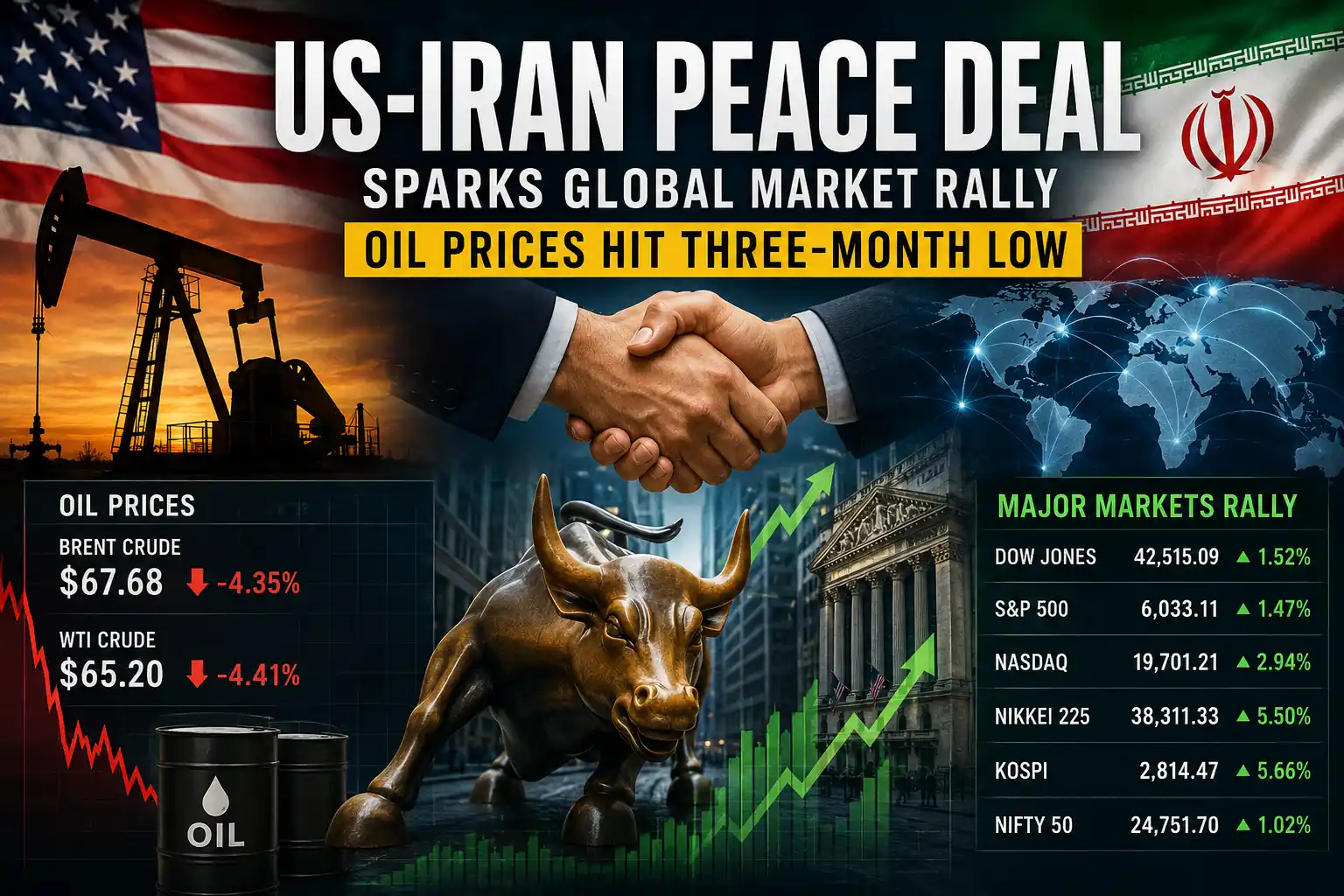
Global financial markets witnessed a strong rally on June 15, 2026, after the United States and Iran announced a preliminary peace agreement aimed at ending hostilities and reopening the Strait of Hormuz. The development significantly eased investor concerns, leading to a surge in global equities and a sharp decline in crude oil prices.
The agreement is being viewed as one of the most important geopolitical developments of 2026, as it has the potential to reduce risks to global energy supplies and support economic growth at a time when investors are closely monitoring inflation, interest rates, and trade activity.
What Is the US-Iran Peace Agreement?
According to reports, the United States and Iran have agreed on a framework aimed at ending the conflict and reducing tensions in the Middle East. The agreement includes efforts to reopen the Strait of Hormuz, improve maritime security, and continue diplomatic negotiations to prevent further escalation.
While several issues still require negotiation, the breakthrough has significantly reduced fears of a broader regional conflict that could disrupt global trade and energy supplies.
For financial markets, the most important outcome is the reduced risk of disruptions in the Persian Gulf, one of the world’s most critical energy-producing regions.
Oil Market Sees the Biggest Reaction
The most immediate impact of the agreement was seen in the crude oil market.
Key Oil Market Data
- Brent Crude fell by approximately 4% to 5%, reaching its lowest level in nearly three months.
- WTI Crude also recorded a sharp decline.
- Investors expect oil supplies from the Middle East to normalize as tensions ease.
During the conflict, markets feared that shipping disruptions in the Strait of Hormuz could significantly impact global oil supplies. The peace agreement has greatly reduced those concerns, resulting in a broad sell-off in crude oil prices.
Energy analysts believe that oil prices could remain under pressure in the coming weeks if regional stability continues to improve.
Wall Street Responds with Strong Gains
US stock markets welcomed the peace breakthrough with a wave of buying activity.
Major US Market Performance
- The Nasdaq surged by nearly 3%.
- The Dow Jones Industrial Average closed at a record level.
- The S&P 500 also posted strong gains.
Investors believe that lower oil prices could help ease inflationary pressures while supporting economic growth and corporate profitability.
Technology, industrial, and consumer-focused stocks were among the biggest beneficiaries of the rally.
European Markets Join the Rally
European markets also reacted positively to the agreement.
- The STOXX Europe Index moved higher.
- Major markets in Germany, France, and the United Kingdom recorded gains.
- Lower energy costs improved sentiment across industrial and consumer sectors.
Analysts noted that reduced geopolitical risks could provide additional support to Europe’s economic recovery efforts.
Asian Markets Surge on Improved Sentiment
Asian equity markets recorded some of the strongest gains following the announcement.
Key Asian Market Moves
- Japan’s Nikkei 225 jumped approximately 5.5% during trading.
- South Korea’s Kospi advanced around 5.7%.
- Taiwan’s Taiex gained roughly 2.7%.
- Australia’s ASX 200 rose about 1.5%.
Investors viewed the agreement as a major step toward stabilizing global energy supplies and reducing economic uncertainty.
Why the Strait of Hormuz Matters
The Strait of Hormuz is one of the most strategically important shipping routes in the world.
Key Facts
- Nearly 20% of global seaborne oil trade passes through the strait.
- Major oil exporters such as Saudi Arabia, the UAE, Kuwait, and Iraq rely heavily on this route.
- Large energy-importing nations including India, China, Japan, and many European countries depend on oil shipments moving through the waterway.
Any disruption in the Strait of Hormuz can immediately impact global energy prices and supply chains, which explains why markets reacted so strongly to the news of its potential reopening.
India Could Be Among the Biggest Beneficiaries
India imports nearly 85% of its crude oil requirements, making lower oil prices particularly beneficial for the country’s economy.
Potential Benefits for India
Lower Import Bill
A decline in crude oil prices can significantly reduce India’s energy import costs.
Reduced Inflation Pressure
Lower fuel prices can help reduce transportation and production costs, easing inflation across multiple sectors.
Support for the Indian Rupee
Lower oil imports reduce demand for foreign currency, which can provide support to the rupee.
Improved Corporate Profitability
Industries such as airlines, logistics, automobiles, chemicals, and manufacturing could benefit from lower operating costs.
Indian equity markets extended gains as investors welcomed the positive impact of lower energy prices on the country’s economic outlook.
Indian Rupee Strengthens
The Indian rupee also gained support following the decline in oil prices.
Currency traders expect lower crude prices to improve India’s current account position and reduce external pressures on the economy. As a result, the rupee strengthened for a third consecutive trading session.
Impact on Gold Prices
Gold, traditionally considered a safe-haven asset during times of uncertainty, faced pressure after the peace announcement.
As geopolitical risks eased, investors shifted funds toward equities and other risk assets. However, gold remained relatively supported as markets continued to monitor upcoming Federal Reserve policy decisions and interest-rate expectations.
Which Sectors Could Benefit the Most?
Airlines
Lower aviation fuel costs can significantly improve profit margins.
Logistics and Shipping
Reduced fuel expenses and smoother trade routes can boost operational efficiency.
Chemicals and Manufacturing
Lower energy and raw material costs can enhance profitability.
Banking and Financial Services
Improved investor confidence often leads to stronger market activity and business expansion.
Risks Still Remain
Despite the positive market reaction, analysts caution that challenges remain.
Key Risks
- The agreement is still in its preliminary stage.
- Discussions regarding Iran’s nuclear program remain unresolved.
- Regional security concerns have not completely disappeared.
- Full normalization of oil supplies may take time.
Any setback in negotiations could quickly reverse market sentiment and increase volatility.
Outcome
The US-Iran peace agreement has emerged as one of the most significant economic and geopolitical developments of 2026. The announcement pushed oil prices to their lowest levels in three months, fueled a strong rally on Wall Street, and lifted markets across Asia and Europe.
For major oil-importing countries such as India, the development could provide substantial economic benefits through lower energy costs, reduced inflationary pressure, and improved corporate earnings. However, investors will continue to closely monitor future negotiations to determine whether this preliminary agreement can evolve into long-term regional stability and sustained economic gains.