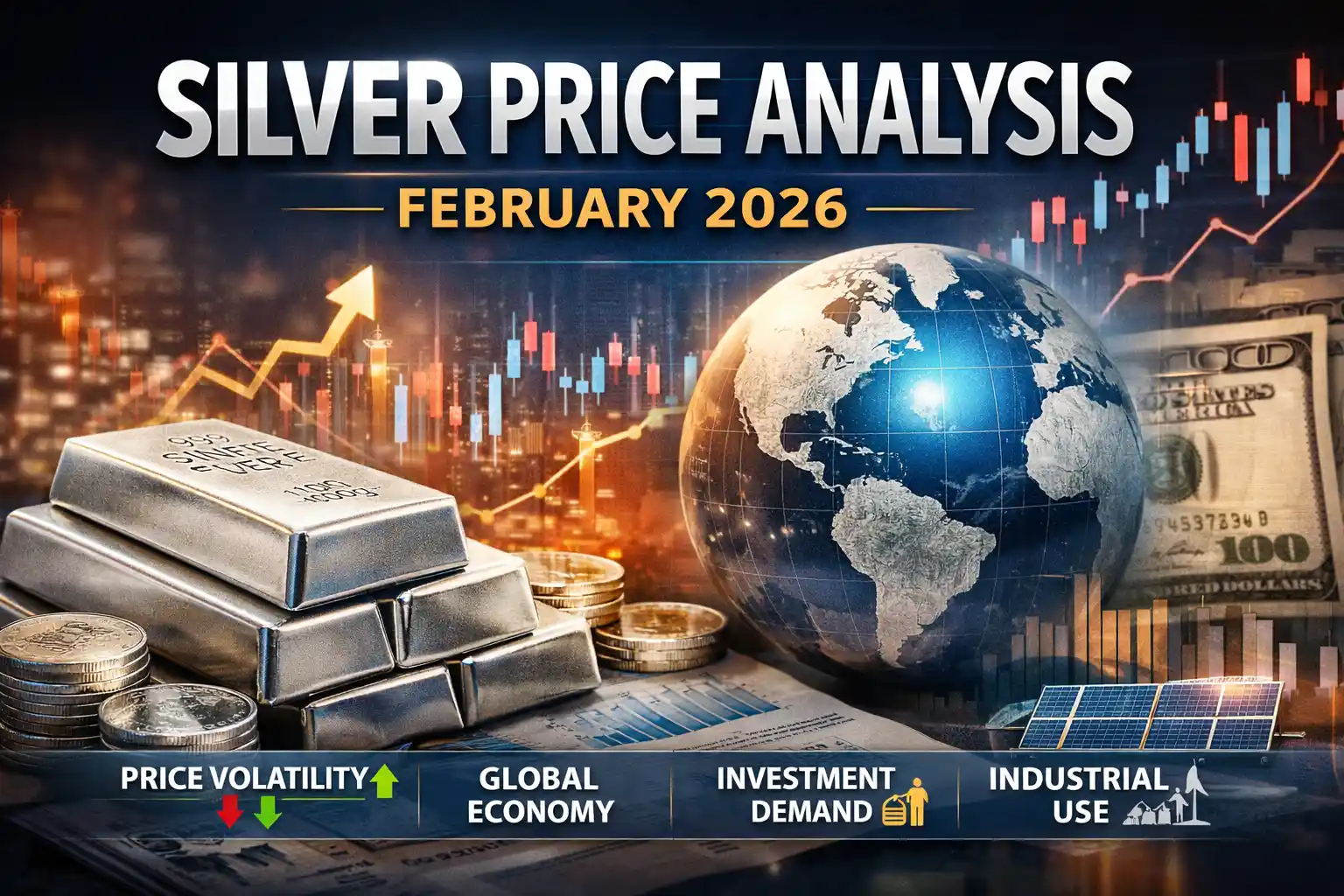
Silver markets around the world experienced significant volatility during the first half of February 2026. After a strong rally in January, prices started the month near multi-month highs but quickly reversed as profit-taking intensified and macroeconomic forces shifted. Unlike gold, silver serves both as a precious metal for investment and as an industrial metal used in electronics, solar panels, automotive components, and various industrial applications. This dual role made silver especially sensitive to shifts in investor sentiment, industrial demand projections, and broader economic signals.
At the global level, prices are benchmarked in U.S. dollars per ounce on major exchanges such as the COMEX in New York and spot pricing from the London Bullion Market Association (LBMA). As February unfolded, early optimism gave way to rapid price swings, driven by profit-booking, a strengthening U.S. dollar, evolving interest rate expectations, and shifting risk appetite among global investors.
During this period, silver’s performance highlighted how quickly market dynamics can change — especially in markets linked to both investment demand and real economy fundamentals. For traders, investors, and industrial stakeholders worldwide, this period served as a reminder that silver prices can be significantly influenced by global macro trends, not just local or regional demand.
Silver’s Global Price at the Beginning of February
At the start of the month, global benchmark prices for silver were trading around $34 to $35 per ounce. This level reflected the momentum built in January, as investors moved into precious metals amid inflation concerns and geopolitical risk.
This pricing is based on futures contracts on the COMEX and LBMA spot rates, which are widely recognized as the international pricing standards.
Early Downturn – Why Silver Prices Fell in Early February
Almost immediately after the month began, silver prices experienced downward pressure. Several key factors contributed:
- Profit-taking by large institutional investors who booked gains after January’s strong rally
- U.S. Dollar strength, making dollar-priced commodities relatively more expensive for holders of other currencies
- Shifts in global risk sentiment, where investors reduced exposure to commodities
- Commodity fund position adjustments reducing long exposure in futures markets
As a result, prices slid sharply into the $31–$32 per ounce range, signaling a rapid shift from bullish momentum to bearish pressure.
Technical Recovery Phase – Was There a Bounce Back?
After this initial drop, markets saw some technical buying — largely driven by short-covering and bargain hunting. Traders who had short positions covering losses contributed to a temporary rebound.
During this period, silver prices recovered modestly back toward the $33–$34 per ounce range. However, this improvement did not represent a full market reversal, but rather a short-term technical correction within a broader downtrend.
Mid-February Performance Snapshot
By mid-February, the upward correction faded and prices were once again under pressure. Silver settled around $31–$32 per ounce, down roughly 8–12% from the start of the month.
This pattern — fall, partial rebound, and renewed selling — is a classic sign of market uncertainty, where bullish and bearish forces balance each other out as traders reassess macroeconomic drivers.
Current Trading Levels (Mid-February)
During the middle of the month, global silver pricing remained in a $31–$33 per ounce range. This reflected ongoing uncertainty, with key economic data and currency movements continuing to influence market direction.
Because silver is priced in USD internationally, fluctuations in the U.S. dollar index have a significant impact on daily trading levels.
Why Was Silver So Volatile?
Silver’s volatility in early 2026 was driven by the interaction of several forces:
- Profit-booking after a strong rally
- U.S. dollar strength exerting downward pricing pressure
- Higher interest rate expectations in major economies
- Futures market leverage creating exaggerated price moves
- Shifting risk sentiment among global investors
Because silver is thinner (less liquid) than gold, these factors can create larger swings in silver prices relative to other commodities.
Global Factors Affecting Silver Prices
Several broad global influences shaped silver’s performance:
- Economic data from the United States and Europe
- Industrial output forecasts in major economies
- Changes in monetary policy expectations
- Investor risk appetite tied to global growth projections
When economic uncertainty rises, markets often rotate away from commodities — especially those with significant industrial demand like silver.
Relationship Between Dollar, Interest Rates & Silver
A strong U.S. dollar typically makes commodities priced in USD more expensive for holders of other currencies. As the dollar strengthened in early February, silver prices faced additional downward pressure.
Interest rate expectations also play a role — higher rates tend to boost the dollar and reduce the attractiveness of non-yielding assets like silver.
Industrial Demand vs Investment Demand
Silver demand is shaped by two major components:
Industrial Demand
- Solar photovoltaic installations
- Electronics manufacturing
- Automotive & EV components
- Batteries and electrical contacts
Investment Demand
- ETF holdings and flows
- Futures & options trading
- Safe-haven buying in times of uncertainty
Although investment demand can fluctuate rapidly, long-term industrial demand provides structural support to prices.
Global Futures Market Impact
COMEX futures trading significantly influences global silver pricing. Large asset managers, hedge funds, and commodity traders adjust positions that amplify price moves — both up and down.
Sudden large position changes can lead to sharp price swings, especially when triggered by macroeconomic events or risk sentiment shifts.
Price Comparison: Start of February vs Mid-Month
| Date | Approx. Silver Price (USD/oz) |
| Feb 1 | 34–35 |
| Feb 5 | ~33 |
| Feb 8 | 31–32 |
| Feb 10 | ~33 |
| Feb 15 | ~31–32 |
| Mid Feb | ~31 |
This table highlights the net downward shift through the first half of the month.
Key Technical Levels – Support & Resistance
Traders often watch these technical price zones:
- Support Levels: ~$30–31 per oz
- Major Support: ~$29 per oz
- Resistance Levels: ~$34–35 per oz
Price reactions around these technical zones often signal potential market direction shifts.
Market Sentiment – Traders & Investors
The sentiment among global investors remains mixed. Some market participants view the drop as continuation of a bearish correction, while others see value accumulation opportunities at lower price bands.
This split sentiment reflects uncertainty about future monetary policy, macroeconomic data, and industrial demand forecasts.
Was There Buying in the Decline?
Yes — in the mid-$31 per ounce region, some technical buying occurred. Short-covering and value buying temporarily lifted prices, but it did not reach a sustained bullish breakout.
Silver vs Gold – Relative Performance
Compared to gold, silver typically exhibits greater volatility due to its smaller market size and heavier industrial demand linkage. While gold often acts as a stable safe-haven, silver can show amplified moves in both directions.
During February 2026, silver’s relative weakness compared to gold highlighted its sensitivity to economic growth concerns and risk rotation.
What Could Happen in the Rest of February?
Looking ahead, silver could remain in a consolidation range if current macro trends persist:
- A sustained strong dollar could continue to cap prices
- Renewed industrial demand data could provide support
- Any shift in interest rate outlook could trigger renewed volatility
Unexpected economic data releases or monetary policy shifts remain key catalysts to watch.
Short-Term Outlook for Silver
In the near term, silver may consolidate between $30 and $34 per ounce, as global markets absorb the combined impact of currency movements, inflation data, and industrial demand signals.
What Lessons Can Investors Take Away?
- Silver is more volatile than many other commodities
- Profit-taking after strong rallies is common
- Structural industrial demand lends long-term support
- Risk management and diversification remain essential
Key Takeaways from February 2026
The first half of February 2026 showed that silver markets are deeply influenced by global macroeconomic dynamics, currency movements, and investor behavior. Although initial gains from January gave hope of further upside, the market shifted quickly due to profit-booking, dollar strength, and shifting risk sentiment.
As industrial demand continues to grow in the long term, short-term price swings will remain tied to macro factors — especially the direction of the U.S. dollar, interest rates, and global growth expectations.
For now, silver is trading lower than it began the month — but still within a range suggesting balance between buyers and sellers. Traders and investors watching macroeconomic cues and technical levels will likely shape the next significant move in global silver pricing.
Disclaimer: This analysis is based on available market data and is for informational purposes only, not financial advice.