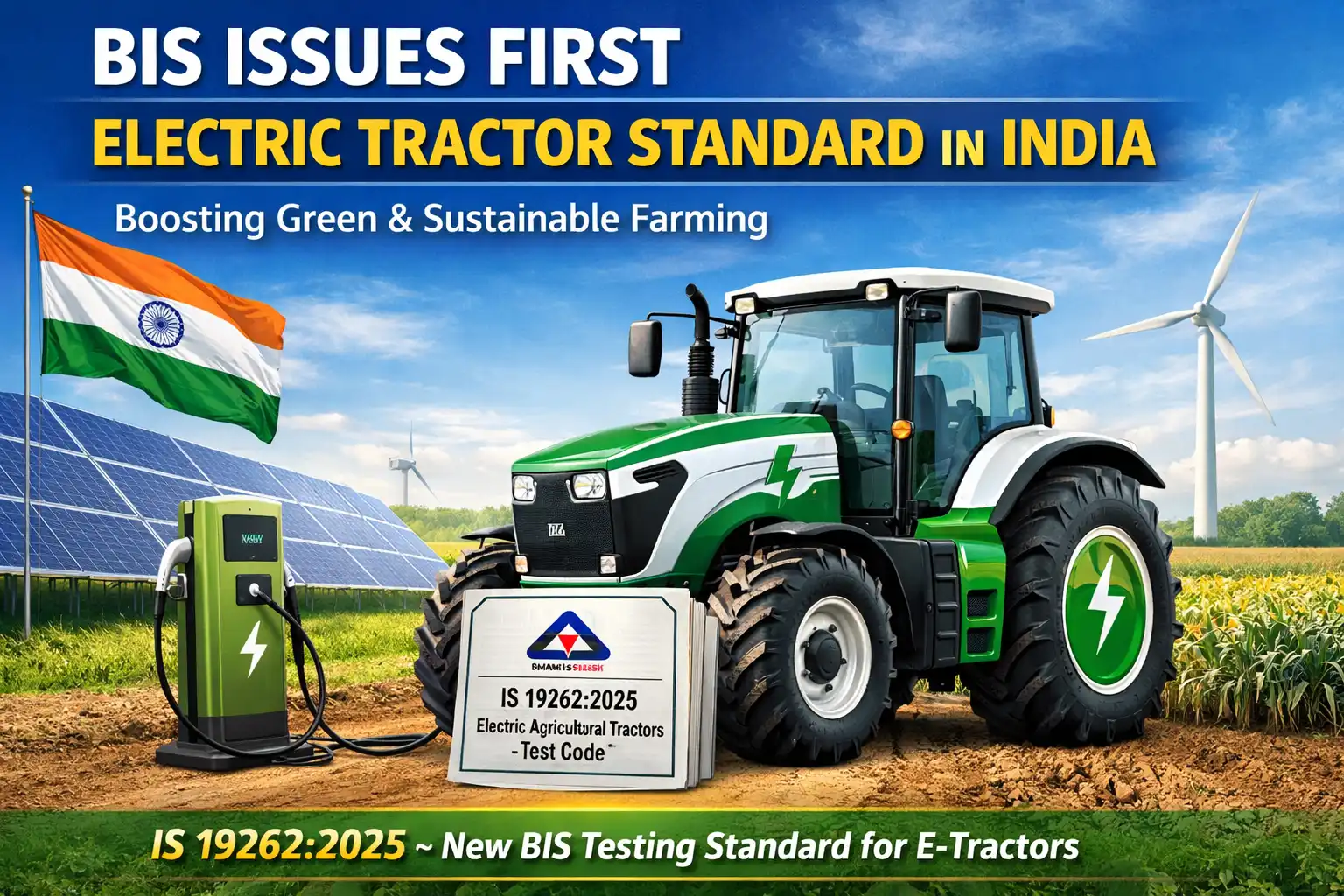
India has taken a significant step toward promoting green and sustainable agriculture with the Bureau of Indian Standards (BIS) issuing the country’s first testing standard for electric agricultural tractors. The newly notified standard, IS 19262:2025, aims to ensure safety, reliability, and consistent performance of electric tractors across the country.
The move is being seen as a major boost to clean energy adoption in agriculture and aligns with the government’s broader push toward eco-friendly farming solutions.
Why This Standard Was Needed
Over the past few years, electric tractors have started gaining attention in India as an alternative to diesel-powered machines. Several manufacturers and startups have introduced prototypes and early-stage models. However, the absence of a uniform national testing framework created uncertainty.
- Farmers had limited clarity on real-world performance
- Manufacturers followed different testing methods
- There was no common benchmark for quality and safety
The BIS standard addresses these gaps by introducing a uniform and transparent testing mechanism.
What Is IS 19262:2025
IS 19262:2025 is a dedicated test code for electric agricultural tractors. It clearly defines how and on what parameters electric tractors should be tested before being marketed.
At present, the standard is voluntary, but industry experts believe it could later become mandatory, especially for certification, subsidies, or large-scale adoption.
Key Areas Covered Under the Standard
The new BIS standard outlines multiple performance and safety tests, including:
- PTO Power Test – measuring the tractor’s ability to run farm implements
- Drawbar Power Test – assessing pulling capability
- Belt and Pulley Performance – checking mechanical efficiency
- Vibration Measurement – ensuring operator comfort and machine stability
- Safety Inspections – evaluation of battery, motor, and major components
These tests ensure that electric tractors perform reliably under real farming conditions.
Benefits for Farmers
The introduction of a national testing standard is expected to significantly benefit farmers:
- Greater confidence while purchasing electric tractors
- Clear verification of manufacturers’ performance claims
- Lower operating and maintenance costs over time
- Reduced noise and zero tailpipe emissions
Compared to diesel tractors, electric tractors offer cleaner, quieter, and more cost-efficient operations.
What It Means for Manufacturers
For electric tractor manufacturers, IS 19262:2025 provides a clear development and testing roadmap.
- Product design and R&D can now align with defined benchmarks
- Certification and comparison across models become easier
- Better access to government incentives and policy support
Industry analysts believe the standard will help create a more organised and credible electric farm machinery market in India.
Part of a Larger Government Strategy
The BIS initiative fits into the government’s broader vision to:
- Reduce diesel dependency in agriculture
- Cut carbon emissions
- Promote modern and sustainable farming practices
By standardising electric tractor testing, India is laying the foundation for a clean and future-ready agricultural ecosystem.
Challenges Still Remain
Despite the positive step, certain challenges persist:
- Limited charging infrastructure in rural areas
- High battery costs and lifecycle concerns
- Need for greater farmer awareness and training
Experts say the introduction of standards will accelerate solutions to these challenges.
Outcome
The release of India’s first testing standard for electric agricultural tractors marks a turning point in the country’s agricultural mechanisation journey. By ensuring safety, performance, and reliability, the BIS standard is expected to build trust among farmers and manufacturers alike.
In the long run, IS 19262:2025 could become the backbone of India’s shift toward clean, efficient, and sustainable farming technologies.
Source: Bis