Imagine you are driving at high speed… and the moment you press the brake, your car doesn’t just slow down by turning energy into heat — it captures that energy and sends it back to the battery. That’s the magic of regenerative braking.
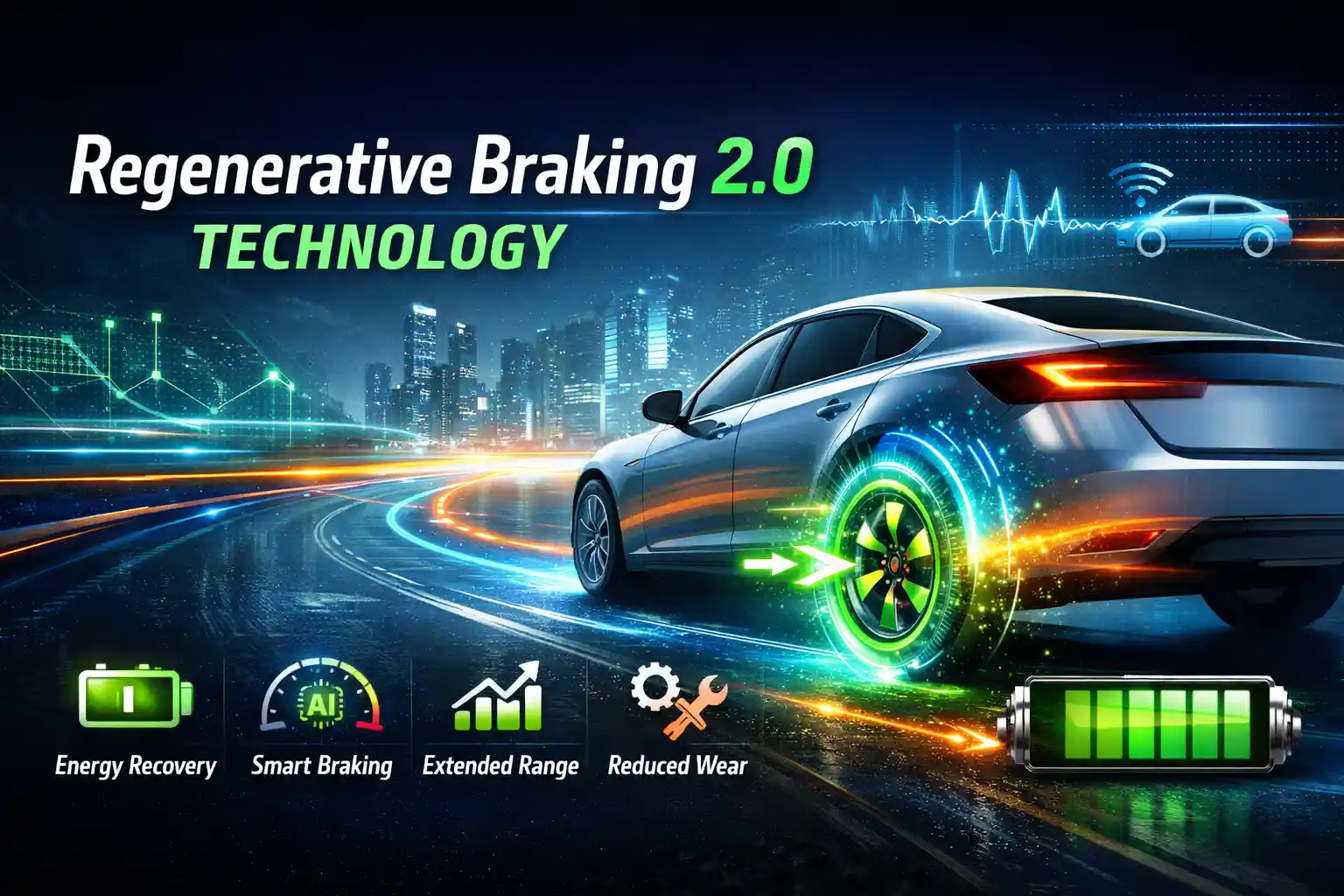
Now, the next evolution — Regenerative Braking 2.0 — is taking this concept even further. It’s not just about recovering energy anymore; it’s about doing it intelligently, efficiently, and seamlessly with advanced software and predictive systems. This technology is shaping the future of EVs and hybrid vehicles.
What is Regenerative Braking 2.0?
Traditional regenerative braking systems in electric and hybrid vehicles convert kinetic energy (energy of motion) into electricity instead of wasting it as heat like conventional braking systems.
In conventional braking:
- Brake pads create friction
- Kinetic energy turns into heat
- Energy is completely lost
In regenerative braking:
- The electric motor works as a generator
- Kinetic energy is converted into electrical energy
- That energy is stored back in the battery
Regenerative Braking 2.0 is the advanced version of this system. It integrates:
- Smart sensors
- Real-time data processing
- AI-based control algorithms
- Predictive energy management
Instead of applying a fixed level of regeneration, the system dynamically adjusts braking force and energy recovery based on traffic, road slope, navigation data, and battery condition.
In simple words — it makes braking smarter.
How Does Regenerative Braking 2.0 Work?
The basic principle remains the same:
When the driver slows down or presses the brake:
- The wheels rotate the electric motor
- The motor switches to generator mode
- Electricity is generated
- Energy flows back to the battery
But Regenerative Braking 2.0 adds advanced layers:
✔ Adaptive Control System
The system analyzes:
- Road gradient (uphill/downhill)
- Distance to the vehicle ahead
- Speed patterns
- Battery charge level
It then automatically adjusts regenerative force.
✔ Multi-Stage Regeneration
Drivers can choose:
- Light regeneration
- Medium regeneration
- Strong regeneration
Some vehicles even offer one-pedal driving, where releasing the accelerator slows the vehicle significantly without pressing the brake.
✔ Brake-by-Wire Integration
Electronic control ensures seamless coordination between:
- Regenerative braking
- Traditional friction braking
This makes braking smoother and more efficient.
Which Companies Are Working on This Technology?
Many global automotive leaders are already implementing advanced regenerative systems:
Hyundai Motor Company
Developed Smart Regenerative Braking systems that adjust automatically based on traffic and road conditions.
Kia Corporation
Offers advanced regenerative braking with adaptive levels in its EV lineup.
Robert Bosch GmbH
Developing intelligent braking control units and energy recovery modules.
Continental AG
Working on electronic brake-by-wire systems and integrated regen control.
ZF Friedrichshafen AG
Designing dynamic regenerative braking systems optimized for load and traction.
In addition, companies like Tesla and Ford Motor Company are continuously improving software-based regenerative systems in their EV platforms.
Benefits of Regenerative Braking 2.0
✔ Increased Energy Efficiency
More braking energy is recovered and stored, which improves overall driving range in EVs.
✔ Extended Brake Component Life
Less use of friction brakes means:
- Lower wear and tear
- Reduced maintenance cost
✔ Smooth Driving Experience
One-pedal driving and adaptive braking provide:
- Better comfort
- Reduced driver fatigue
✔ Reduced Energy Waste
By converting motion into usable electricity, energy loss is minimized.
✔ Smart Predictive Driving
The system anticipates:
- Traffic slowdowns
- Slopes
- Driving patterns
This enhances efficiency automatically.
When Will This Technology Become Common?
Advanced regenerative braking systems are already available in many EVs and hybrids.
2024–2026
More automakers are expected to make smart regenerative braking standard in EV models.
2027–2030
Integration with AI, connected systems, and autonomous driving platforms will significantly enhance performance.
Post-2030
Regenerative braking may become part of fully AI-enabled mobility ecosystems integrated with:
- V2X communication
- Autonomous driving
- Smart infrastructure
Final Thought
Regenerative Braking 2.0 is not just a braking upgrade — it represents a major evolution in how vehicles manage energy.
Where energy was once wasted, it is now recovered.
Where braking once meant heat loss, it now means power generation.
As this technology continues to evolve, driving will become more efficient, more intelligent, and more sustainable.
The cars of the future will not only move forward — they will learn how to save energy with every stop.