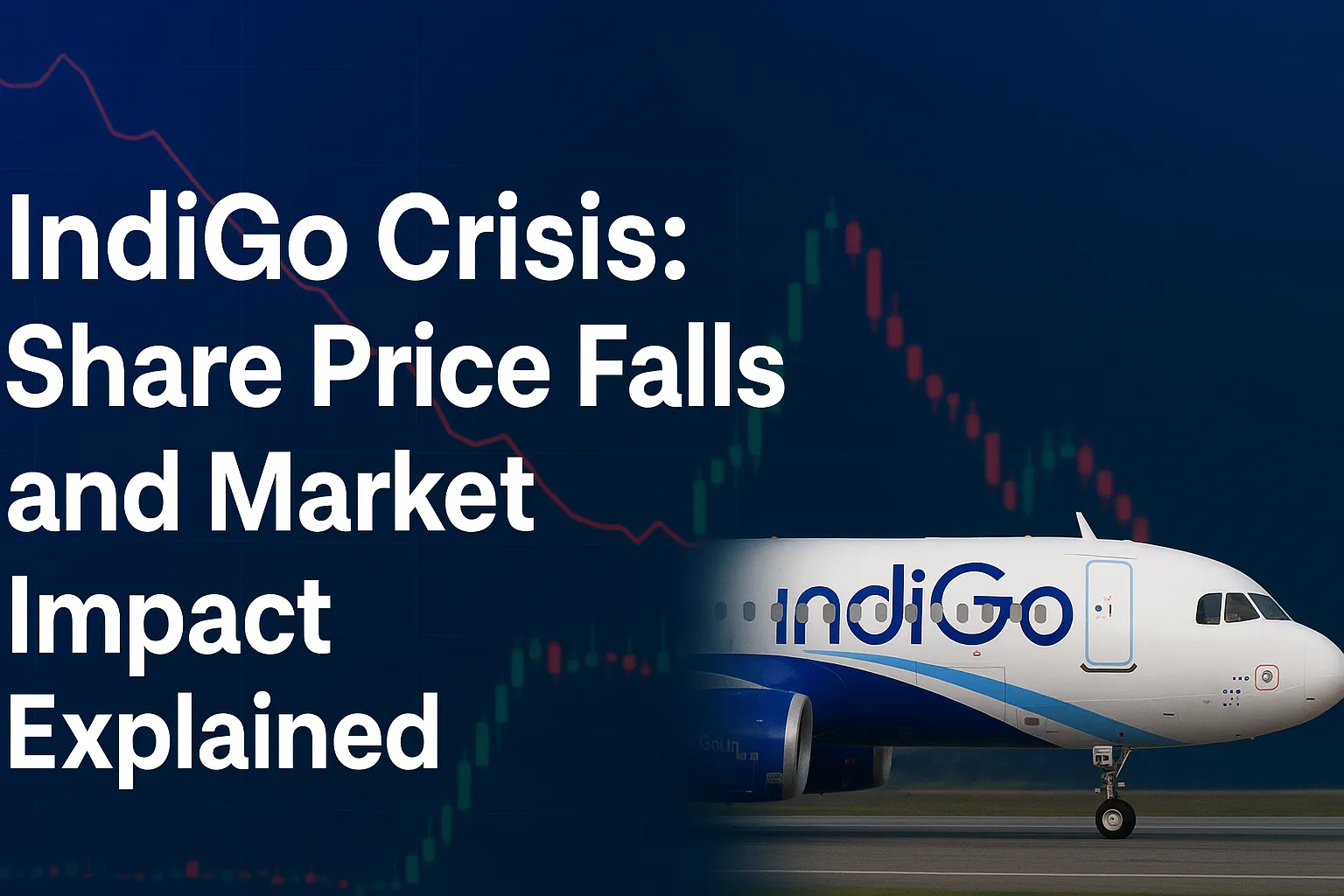
India’s largest airline, IndiGo — operated by InterGlobe Aviation — is facing a severe market shock after a wave of flight cancellations triggered by a crew-rostering failure. The operational turmoil, regulatory action and investor panic have combined to inflict heavy losses on the company’s stock and market valuation.
Shares Collapse as Flight Disruptions Mount
On 9 December 2025, aviation regulator DGCA (Directorate General of Civil Aviation) ordered IndiGo to cut its scheduled flights by 5% — after the airline had cancelled at least 2,000 flights in the preceding week due to lack of pilot planning under new rest-and-duty rules.
The stock of InterGlobe Aviation tumbled sharply. From levels near ₹5,900 at the end of November, the share price fell to around ₹4,912 on 9 December — a drop of about 17.1%.
Estimated market-cap erosion has been massive: reports suggest that roughly ₹37,000 crore in shareholder value was wiped out in just a few days as investor confidence shattered and sell-offs intensified.
Regulatory Action: DGCA Cuts Flights, Issues Show-Cause Notice
The root of the crisis lies in the implementation of tougher crew duty-time limitations introduced by DGCA. Under the revised rules, pilots are required longer rest periods, with a cap on night flying and stricter constraints on duty hours. IndiGo reportedly failed to realign its crew rosters in time, leading to a severe shortage of captains.
Because of the disruptions, DGCA issued a show-cause notice to IndiGo’s top management (CEO/COO) and directed the airline to reduce daily flight operations by 5%, especially on high-frequency and high-demand routes. The airline was asked to submit a revised flight schedule by 10 December.
With about 2,200–2,300 flights scheduled daily, this cut translates to approximately 110–115 flights cancelled each day — a significant operational setback.
There are even suggestions that DGCA may extend the cut to 10% if compliance does not improve, which would mean 220–230 fewer flights per day.
Financial Fallout: Revenue, Profits, and Credit Risk Hit Hard
The consequences of sweeping cancellations are being felt on multiple financial fronts:
- According to analysis by brokerage Emkay Global, the airline stands to lose about 3% of its FY26 revenue, while EBITDA could shrink by around 8% and pre-tax profits may drop as much as 17%, if flight disruptions and refund/compensation costs continue.
- Cancellation refunds — among other compensation and re-accommodation costs — have already been initiated. Government and media reports indicate that crores of rupees are being processed in refunds.
- Operational fixed costs (fuel, crew salaries, airport charges) remain largely unchanged even as revenue shrinks, because flights that contribute income have been cancelled. This means much poorer yield per operating aircraft, further weakening profitability.
Global credit-rating agency Moody’s Ratings has flagged the disruptions as “credit negative,” indicating a potential downgrade in IndiGo’s credit profile because of elevated risk on debt servicing, cost pressures and unpredictable cash flows.
Institutional & Market Sentiment — Funds, Brokers, and Competitors React
The sell-off hasn’t been limited to retail investors alone. Several large mutual funds and institutional holdings with significant exposure to IndiGo have reportedly reduced positions to limit downside risk. This widespread de-risking amplified downward pressure on the stock.
Some brokerages, notably Investec, have issued “Sell” calls — projecting further downside toward ₹4,040 per share, citing weakening demand for third-quarter recovery and rising costs under the new regulatory regime.
On the other hand, certain long-term investors and a few optimistic brokerages such as Jefferies and UBS continue to maintain bullish long-term outlooks — pointing to IndiGo’s dominant market share, strong balance sheet, and growth potential in both domestic and international routes.
Meanwhile, competitor airlines have started seeing some benefit. Shares of rival carriers have surged as investors speculate that travellers abandoned by IndiGo might shift to other airlines, giving them near-term gains.
Outlook: Recovery Possible, But Risk Lingers
IndiGo’s management has publicly committed to restoring operations gradually. The airline has reportedly formed a crisis-management task force and submitted plans to DGCA to align its roster and duty-time compliance. It aims to normalise operations by 10–15 December, with full stability expected by February 2026.
However, analysts and credit-watchers warn that the stock remains volatile. Key triggers to watch in coming weeks: the revised schedule submission, actual flight performance, refund/compensation burden, crew-rehiring and cost control, regulatory actions or penalties, and overall demand trends in the aviation market.
If IndiGo succeeds in stabilising operations quickly and avoids further regulatory penalties, it could recover some lost ground — especially given its scale, fleet order book and market dominance. But if disruptions persist or costs balloon, the financial stress may deepen and confidence could erode further.
Market’s Message: Confidence Must Be Earned
What began as an operational misstep — failure to rework pilot rosters in time for new duty rules — snowballed rapidly into one of the worst crises in Indian aviation in recent memory. For investors and markets, the message was loud and clear: shortcuts on compliance carry steep price tags.
In a business as capital-intensive and regulation-sensitive as airlines, predictable operations and regulatory discipline are as important as passenger demand. IndiGo’s historic advantage of scale and low-cost efficiency has taken a hit, and it will now need transparent corrective action, consistent performance and patience from stakeholders.
Whether the airline recovers to its former glory or remains haunted by this episode depends on execution over the next few months — and investors should watch closely before deciding whether to treat current prices as a “buy-the-dip” opportunity or a sign of deeper structural risk.