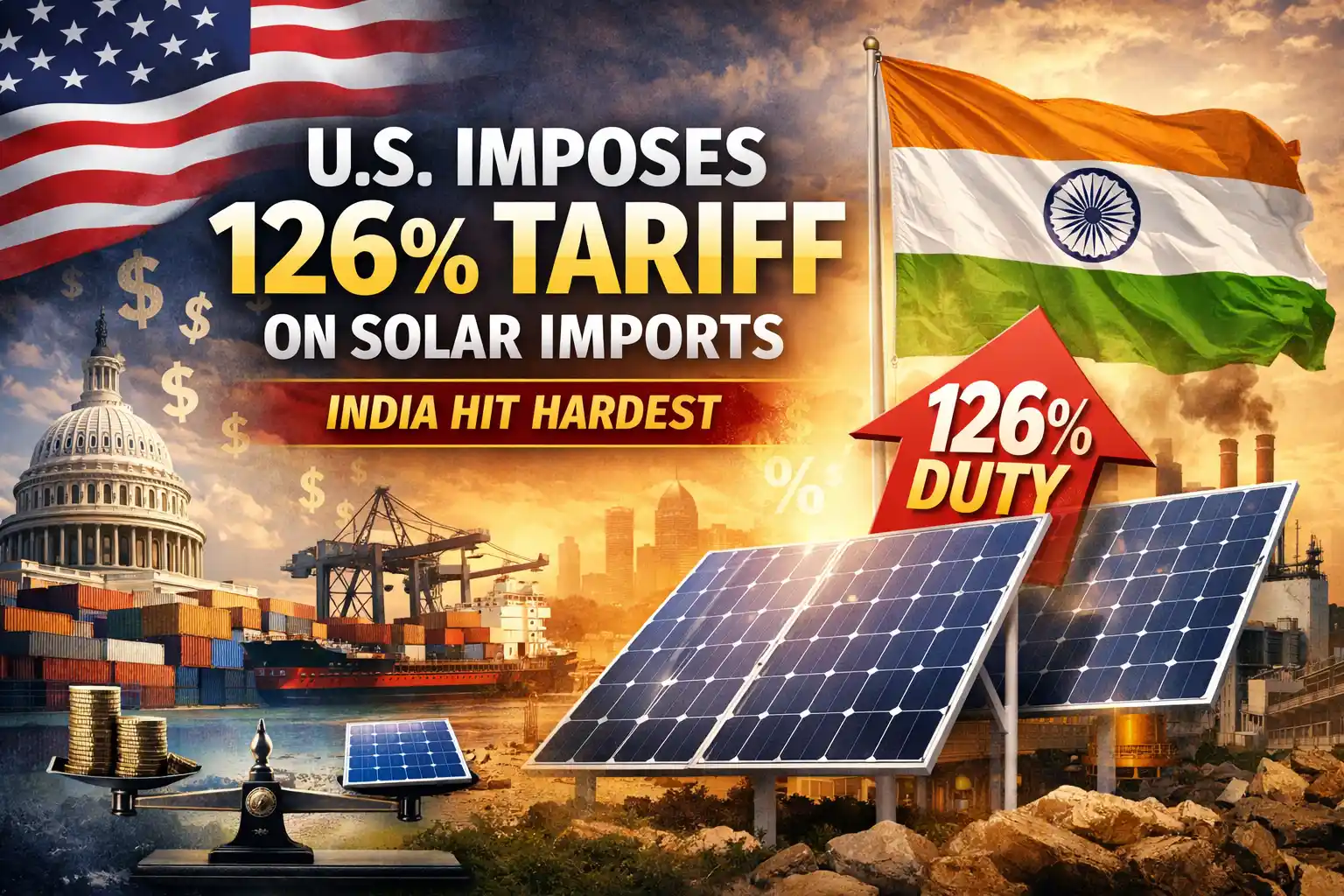
In a major trade action that could reshape the global solar supply chain, the U.S. Department of Commerce has announced preliminary countervailing duties (CVD) on imported solar cells and solar panels from India, Indonesia, and Laos.
India faces the steepest proposed duty of up to 126%, followed by Indonesia at around 104% and Laos at approximately 80%.
US officials stated that the decision follows an investigation which found that solar manufacturers in these countries allegedly benefited from significant government subsidies, enabling them to sell products in the US market at prices considered unfairly low.
The tariff decision is preliminary, meaning the rates could be revised after further review and final determination.
What the US Investigation Found
According to the Commerce Department, investigators determined that certain foreign solar manufacturers received measurable financial assistance from their governments. These benefits allegedly include:
- Direct financial incentives
- Tax concessions
- Subsidized electricity
- Preferential land allocation
- Production-linked incentive programs
Under US trade law, when such subsidies are found to distort competition, countervailing duties are imposed to “neutralize” the financial advantage.
Because India’s assessed subsidy margin was calculated to be higher than that of Indonesia and Laos, it now faces the highest proposed tariff rate.
Why India Is Particularly Affected
India has rapidly expanded its solar manufacturing capacity in recent years and emerged as a key exporter to the United States.
With strong policy support aimed at building domestic renewable manufacturing, Indian producers became increasingly competitive in the US market. However, that competitiveness has now come under scrutiny.
Trade analysts note that higher export volumes often lead to deeper investigations and stricter calculations. India’s growing presence in the American solar market likely contributed to the intensity of the probe.
A Continuation of US Solar Trade Actions
This is not the first time the US has acted against imported solar products.
In 2018, during the administration of Donald Trump, the US imposed safeguard tariffs under Section 201 to protect domestic manufacturers from surging imports.
However, the current move differs in structure. While Section 201 tariffs were global safeguards, the latest action specifically targets alleged government subsidies through countervailing duty mechanisms.
This reflects a broader shift in US industrial policy toward actively strengthening domestic manufacturing in strategic sectors, particularly clean energy.
Why the US Did Not Ban Imports Completely
Despite the high tariff rates, Washington stopped short of imposing a complete import ban.
Experts highlight three key reasons:
1️⃣ WTO Constraints
As a member of the World Trade Organization (WTO), the United States must adhere to international trade rules. Blanket bans without strong justification could trigger formal disputes and retaliation.
2️⃣ Domestic Supply Limitations
US solar installation demand is growing rapidly. Domestic production capacity is still insufficient to meet total demand. A complete ban could disrupt project pipelines and delay renewable energy expansion.
3️⃣ Cost Concerns
A full prohibition could significantly increase panel prices, raising costs for developers and potentially slowing America’s clean energy transition.
Tariffs, therefore, serve as a middle-ground approach — protecting domestic manufacturers while maintaining some level of supply continuity.
Impact on the US Solar Market
The immediate consequences could include:
- Increased pricing power for US-based solar manufacturers
- Higher procurement costs for developers and installers
- Possible delays or renegotiations of large solar projects
At the same time, the policy may encourage fresh investment into US-based cell and module manufacturing facilities.
Impact on India and Other Exporters
For Indian manufacturers, the tariffs could create short-term challenges:
- Reduced competitiveness in the US market
- Pressure on export margins
- Potential slowdown in new contracts
However, industry observers suggest that companies may respond by:
- Diversifying exports toward Europe, the Middle East, and Africa
- Expanding domestic sales
- Investing further into vertical integration to improve cost efficiency
The move could also trigger diplomatic discussions between Washington and New Delhi, as both countries maintain strong strategic and economic ties.
Broader Global Implications
The decision signals rising protectionism in clean energy industries worldwide.
Governments are increasingly treating renewable manufacturing as a strategic sector, combining climate goals with industrial policy.
This action may accelerate:
- Supply chain realignment
- “Friend-shoring” strategies
- Increased trade litigation at the WTO
It also raises concerns about the cost of the global energy transition if protectionist measures become widespread.
What Happens Next?
Because the duties are preliminary, final rates may change following additional review and input from affected parties.
Possible next steps include:
- Legal challenges under WTO mechanisms
- Bilateral negotiations
- Further trade measures by affected countries
Outlook and Conclusion
The US decision to impose tariffs of up to 126% on solar imports marks a significant development in global clean energy trade.
India, as the hardest-hit exporter, faces near-term uncertainty in the US market. However, the move underscores a broader trend: major economies are prioritizing domestic manufacturing strength even within the renewable energy sector.
The coming months will determine whether this evolves into a larger trade confrontation or results in negotiated adjustments that balance industrial protection with global climate ambitions.
Source: International Trade Administration