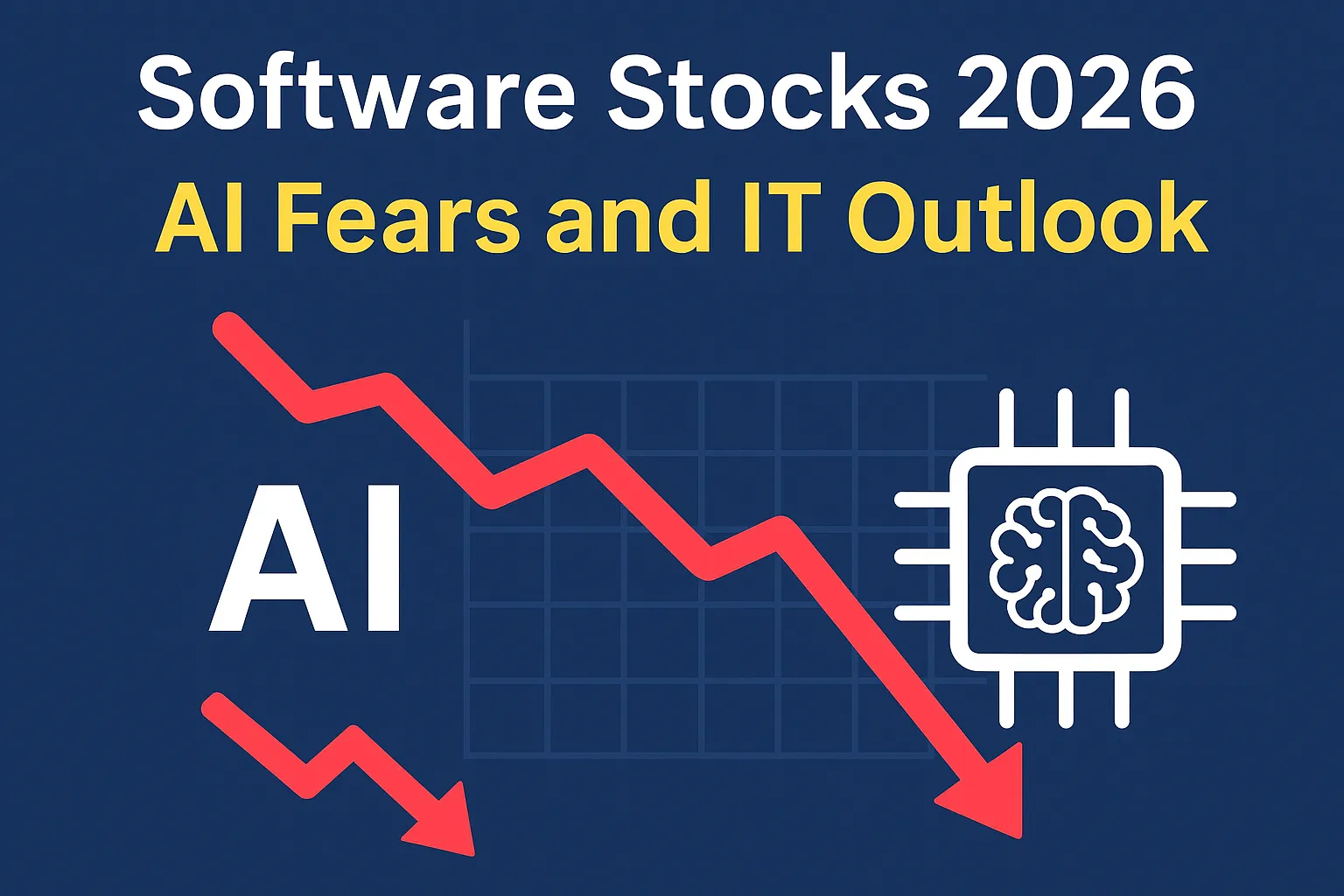
In early February 2026, global software and IT stocks have been falling sharply — in both the U.S. and Indian markets. Even top companies like Microsoft, Adobe, Salesforce, and Indian IT leaders (Infosys, TCS, HCL Tech etc.) saw deep declines in their share prices. This sudden weakness surprised many investors because software stocks were historically strong growth performers.
This article explains why this is happening, what investors are worried about, and what long‑term possibilities exist in the software and IT sector.
Main Reason: AI Disruption Fears
AI Is No Longer Just a Tool — It’s Seen as a Threat
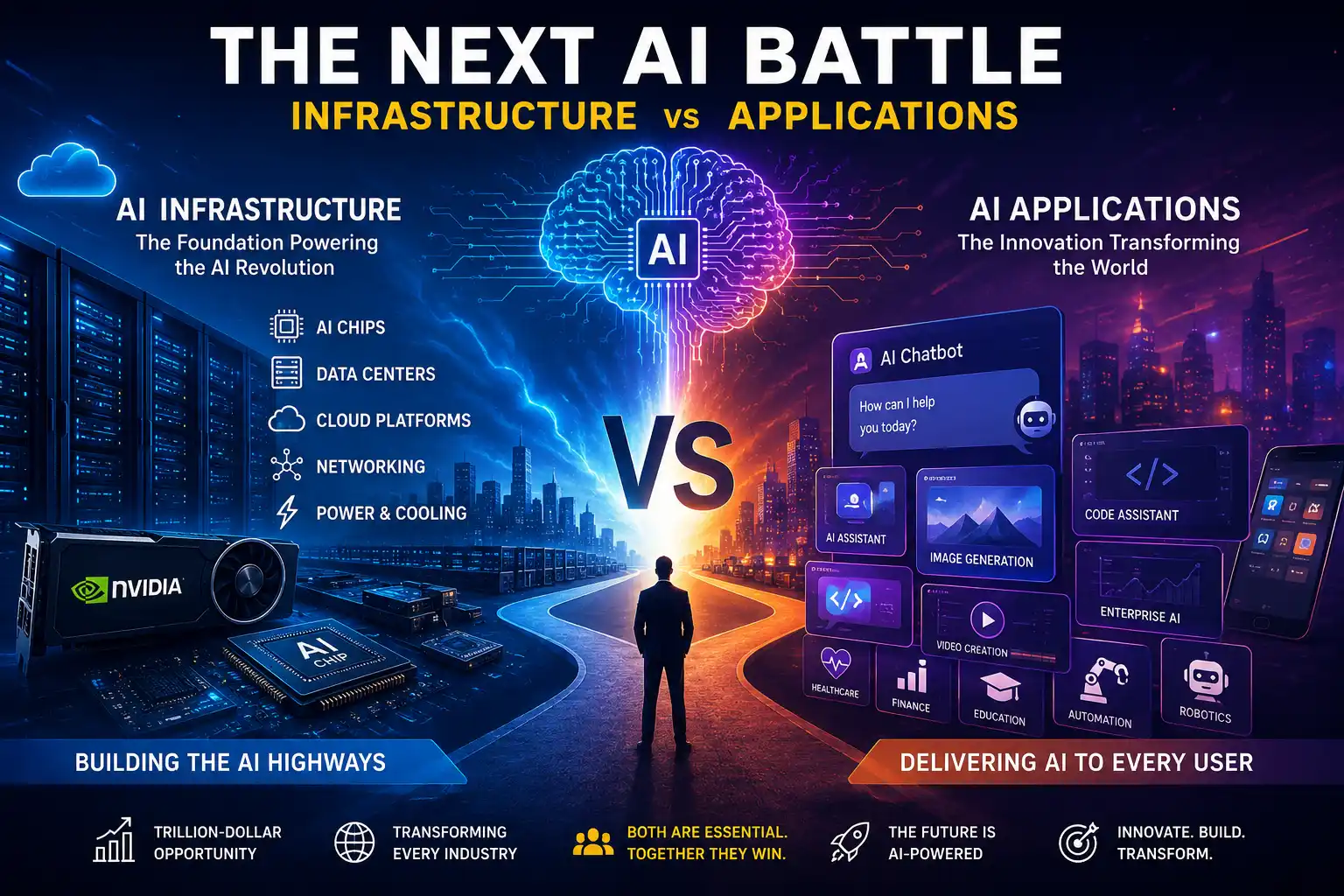
Investors are now worried that Artificial Intelligence (AI) — especially new AI tools that can automate complex tasks — might replace traditional software and many human‑driven services. This fear accelerated when companies like Anthropic launched new AI products that promise to perform advanced tasks in areas like legal work, data analysis and business workflows — functions that were earlier done by paid software or human consultants.
This shift in thinking — from AI as a helper to AI as a disruptor — has caused a big drop in software stocks because investors fear:
- AI will reduce demand for traditional software licenses.
- Customers may shift away from paying subscriptions toward cheaper AI tools.
- Software companies’ future revenue and growth may be at risk.
This kind of fear has even been called “SaaSpocalypse” by some analysts, highlighting how AI could shake the whole Software as a Service (SaaS) model.
Example of the Market Impact
- U.S. software stocks wiped out nearly $1 trillion in value as fears grew that AI could replace traditional software.
- Indian IT stocks saw deep falls — the Nifty IT Index dropped almost 6–7% in a single day. Stocks of companies like Infosys, TCS, HCL Tech, Wipro fell between 4–7%.
- Investors began selling not only software vendors but also software ETFs, dragging broader markets lower.
These declines happened without big changes in the companies’ fundamentals — the fear itself moved the market.
Why Investors Are Worried
✔ 1. Revenue Model Threat
Software companies often use subscription and license models (e.g., pay per user, pay per month).
AI tools that can do the same tasks for free or low cost put pressure on those traditional revenue streams.
✔ 2. AI Is Perceived as Replacement, Not Just Assistant
For a long time investors thought AI would help software companies increase efficiency. Now they fear AI might replace software products or services completely — not just assist them.
✔ 3. Higher Uncertainty and Lower Valuations
Because revenue visibility has become unclear, investors are discounting future earnings sharply — causing stock prices to fall.
✔ 4. Global Sell‑Off Momentum
Fear spreads quickly: when large stocks like Microsoft or Adobe fall, this spills over to related companies worldwide.
Sector‑Specific Reasons
🖥️ U.S. Software Stocks
- Microsoft’s shares dropped partly because analysts lowered expectations due to slower cloud growth and rising AI competition.
- Many enterprise software stocks lost significant value even without company‑specific bad news, hinting at thematic risk selling.
🌏 Indian IT Sector
- New AI capabilities from companies like Anthropic made investors fear that outsourced services — a core revenue source for Indian IT — could decline.
- Analysts estimated that a portion of Indian IT revenues might be affected as AI takes over basic coding, testing and analytics work.
Long‑Term Risks That Investors Are Considering
Here are some structural concerns analysts are pricing into software stocks:
📌 1. Reduced Pricing Power
If clients can use AI tools to replace multiple software products, traditional vendors may find it hard to keep prices high.
📌 2. Demand Shift Away from Traditional Software
As AI tools become more capable, basic software (and some services) might lose demand.
📌 3. Service Model Vulnerability
Companies that rely on billing hours for coding or testing may see revenue pressure as AI automates these tasks.
Contrasting Opinion: It Might Be Temporary
Not all experts believe this is permanent decline:
- Some analysts call the sell‑off overdone — meaning the market may have reacted too strongly and stocks could recover.
- Investors like Dan Ives argue that strong AI players such as Microsoft, Palantir, Snowflake and Salesforce still have bright long‑term prospects and anyone can buy the dip now.
Why AI Isn’t Simple Replacement (Long‑Term View)
Although markets fear AI replacement, experts also point out:
- Real software engineering requires complex system understanding and reliability that AI alone cannot fully provide yet.
- Many businesses will still need customized solutions, integration work and consulting — areas where humans + AI both add value.
- There’s a transition period, not an overnight replacement.
This is why companies are likely to adopt AI as an assistant first — enhancing productivity rather than replacing staff completely.
Summary
✔️ Software stocks are falling now mainly because investors fear AI will replace traditional software products and services.
✔️ New AI tools from companies like Anthropic accelerated this fear.
✔️ Many large software and IT service stocks dropped sharply worldwide.
✔️ Long‑term the market is worried about revenue, pricing power and business models.
✔️ Some experts think this fear is too much and stocks can recover when fundamentals improve.
Outcome
The recent decline in software stocks in early 2026 is primarily driven by fears of AI disruption. Investors are concerned that AI could replace traditional software products and IT services, creating uncertainty around future revenue and growth.
However, in the long term, AI adoption is inevitable for software and IT companies. If companies integrate AI smartly as an assistant alongside human expertise, it can enhance efficiency, productivity, and profitability.
This means that while short-term volatility and stock weakness may continue, the long-term growth potential remains strong. Companies that successfully balance AI integration with human skills are likely to see steady value appreciation and a bright future.